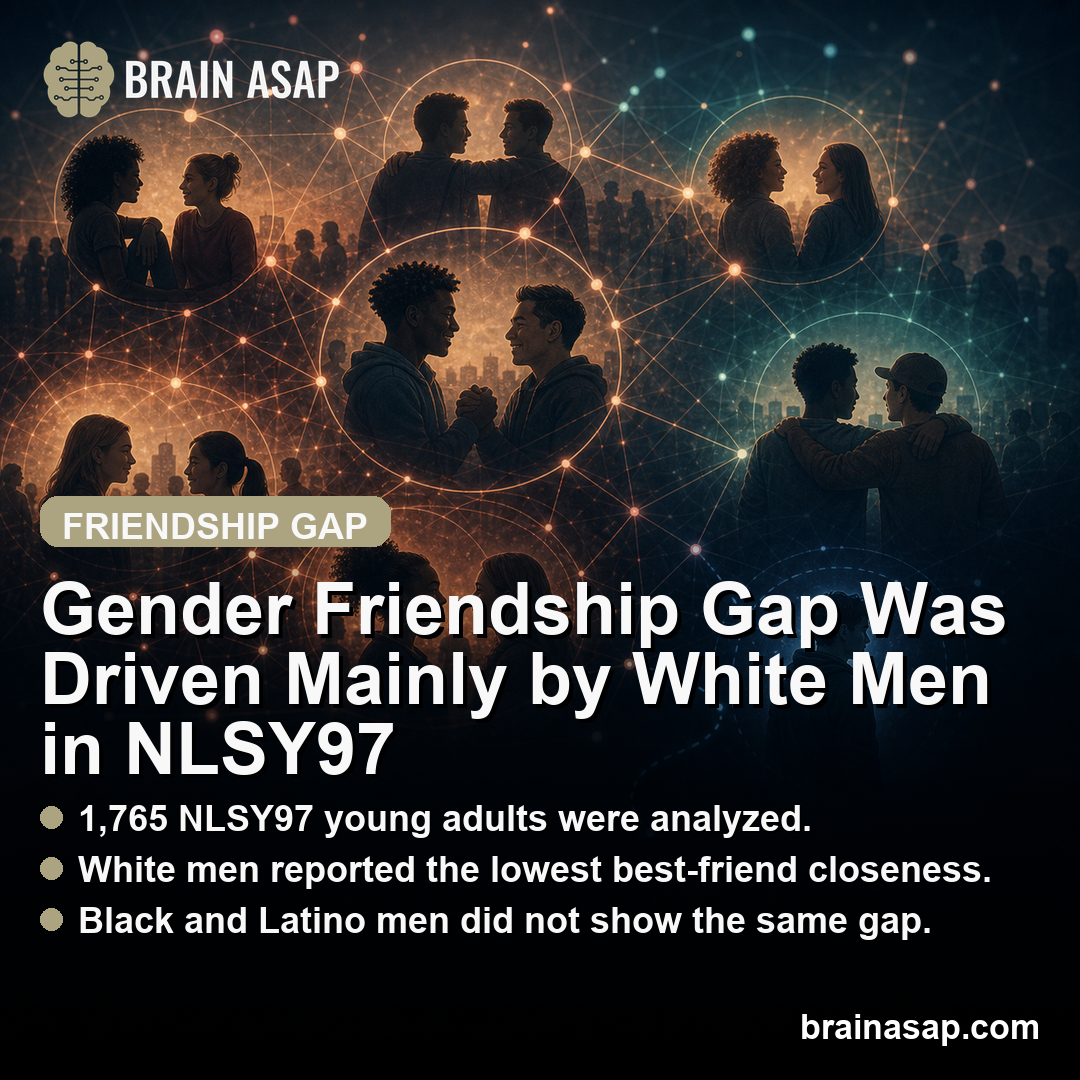
TL;DR: A 2026 Sex Roles study using NLSY97 data found that the gender friendship gap in best-friend closeness was driven mainly by white men, while Black men, Latino men, and women across groups reported more similar closeness after controls.
Key Findings
- NLSY97 cohort: The study analyzed 1,765 young adults from the National Longitudinal Survey of Youth 1997 cohort.
- Best-friend closeness scale: Participants rated how close they felt to a best friend on a 0-10 scale.
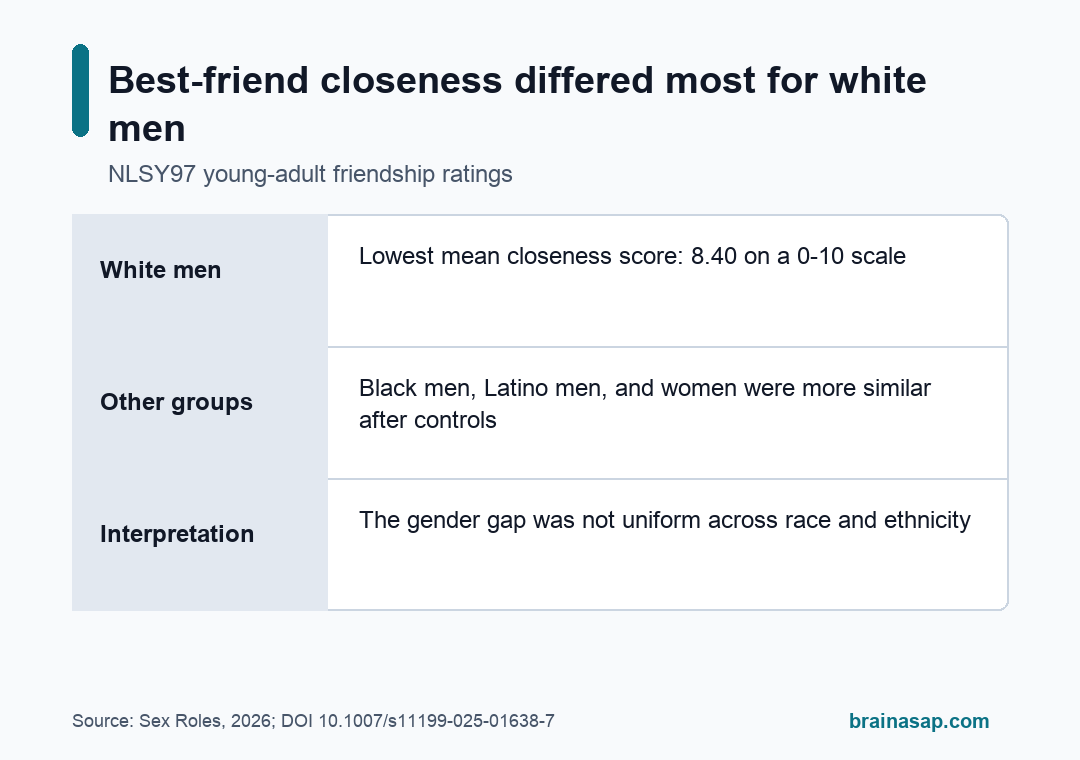
- Lowest group: White men reported the lowest average best-friend closeness, with a mean score of 8.40.
- Intersectional finding: Black men and Latino men did not show the same persistent gender gap after friendship and demographic controls.
- Caution: The data describe reported closeness in young adulthood, not the full depth or stability of friendship over a lifetime.
Source: Sex Roles (2026) | Fox
Older friendship research often treated a male-female friendship gap as if it were a broad rule.
Men, especially boys and young men, were often described as less emotionally close to friends than women.
Fox tested a narrower question: does that finding hold across Black, Latino/a, and white young adults in the same way?
The group-level result was specific: in this national U.S. cohort, white men reported the lowest best-friend closeness.
Black men, Latino men, and women from each ethnoracial group were more similar to one another once the analysis accounted for friend characteristics, communication, support, and respondent demographics.
A one-item closeness score cannot capture every part of friendship. It can still test whether the familiar gender gap is evenly distributed across groups.
In this paper, it was not. A majority-white sample can make a white male pattern look like a universal male pattern.
NLSY97 Data Tested Friendship Closeness Across Gender and Ethnoracial Groups
The study used the National Longitudinal Survey of Youth 1997 cohort, a long-running U.S. dataset that followed people born in the early 1980s.
Fox focused on 1,765 emerging adults who had friendship data in adolescence and young adulthood. The group comparison separated three patterns:
The friendship measure also has three limits: The analytic sample included 940 men and 825 women .
By ethnoracial group, it included 454 Black respondents, 337 Latino/a respondents, and 974 white respondents. Participants were ages 18-21 during the young-adult friendship measure, with an average age of 19.49.
The main outcome was simple: participants rated closeness to their best friend from 0 to 10. A higher number meant feeling closer.
The analysis then compared reported closeness by gender and ethnoracial identity, while adding controls for childhood socioeconomic status, family structure, parent education, region, same-gender friend status, frequency of communication, and whether the friend provided emotional or material support.
The controls matter because friendship closeness is not only a personality measure.
A person who talks to a best friend frequently, receives emotional support, or has a friend available for practical help may report a different level of closeness than someone whose friendship is less active.
By adding those variables in stages, the paper could ask whether a gender gap remained after accounting for some obvious features of the friendship itself.
The study also used adolescent friendship measures from 1997 and young-adult measures from 2002.
That gave the analysis a way to connect earlier family and social context with later reported best-friend closeness, instead of treating the young-adult rating as isolated from prior experience.
White Men Reported the Lowest Best-Friend Closeness Scores
Across the full sample, women reported higher closeness than men. Men averaged 8.60 on the 0-10 scale, while women averaged 9.12.
That overall gap matches the broad pattern described in much of the older friendship literature. Breaking the sample down changed the interpretation.
White men averaged 8.40, lower than white women at 9.11, Black men at 8.90, Latino men at 8.79, Black women at 9.10, and Latina women at 9.17.
The white male difference also persisted after adjustment.
In the fully adjusted models, white women still reported significantly closer friendships than white men.
White men also reported lower closeness than Black men and Latino men after the same controls.
That is the key statistical separation. The overall male-female gap did not disappear, but the group-level pattern showed where the gap was most concentrated.
Black and Latino Men Did Not Fit the Same Gender-Gap Pattern
For Black respondents, the gender difference was small.
Black men averaged 8.90 and Black women averaged 9.10.
The adjusted models did not support a meaningful gender gap in reported closeness within the Black subsample.
For Latino/a respondents, Latina women initially reported higher closeness than Latino men. After adding communication and support measures, however, the difference was no longer statistically significant.
The fully adjusted estimate for Latina women versus Latino men was small and non-significant. That finding is the main value of the paper.
It does not just say white men had lower scores.
It shows that the usual male-female friendship story changed when gender was analyzed together with ethnoracial identity.
This is also why the paper is not simply a ranking of who has “better” friendships.
The data suggest that one demographic comparison can look broad until the sample is split into more specific groups.
Communication and Support Helped Explain Some Differences
The study also tested predictors of closeness.
More frequent contact with a best friend and emotional support from that friend were generally associated with higher closeness.
Material support had a more uneven pattern.
Some predictors worked differently by group:
- Same-gender friend status predicted closeness only among white respondents.
- Socioeconomic class also predicted closeness only among white respondents.
- White men with women best friends reported about 0.49 points higher closeness than white men with men best friends.
Those patterns are not proof that one type of friendship is better.
They do suggest that friendship closeness is shaped by social context, communication habits, support, and the gendered expectations surrounding different groups.
The same-gender friend finding is especially relevant to white men. In the study, white men with women best friends reported greater closeness than white men with men best friends.
That does not establish causality, but it fits the idea that some white men’s same-gender friendships may be more constrained by norms around emotional disclosure.
Majority-White Friendship Research May Not Generalize Cleanly
The paper is careful about scope. A 0-10 closeness rating captures one part of friendship experience.
It does not directly measure vulnerability, reciprocity, loneliness, long-term stability, or the quality of day-to-day interaction. The analysis is also observational.
It can show that reported closeness differed across groups and that certain controls reduced some gaps.
It cannot prove why white men reported lower closeness or whether changing communication patterns would close the difference.
Still, the correction is worth taking seriously.
If a gender friendship gap is inferred mostly from majority-white samples, the finding may be too broad.
In this dataset, white men were the clearest low-closeness group, not men as a single universal category.
For research, that argues for intersectional designs rather than treating gender as a standalone explanation.
In public discussion, the narrow practical point is: when people talk about men’s friendships, it helps to ask which men, in which social context, and compared with whom.
The study also keeps the intervention question open.
If closeness is tied to communication and emotional support, then friendship quality may be shaped by teachable social habits, peer norms, and the availability of friendship spaces where men can practice more direct support.
At the same time, the paper should not be read as a diagnosis of individual white men. A group average can identify a pattern without explaining every person’s friendship life.
Some white men have very close friendships, and some women, Black men, or Latino men do not. The value is in correcting the broad claim, not replacing it with another stereotype.
What the Friendship Result Separates
- Full-sample gap: Women reported higher best-friend closeness than men when the cohort was pooled.
- White-men concentration: The lowest adjusted closeness scores clustered in white men, not in every male subgroup.
- Interpretive limit: A one-item closeness rating cannot measure every feature of friendship quality or stability.
Citation: DOI: 10.1007/s11199-025-01638-7. Fox EC. Are White Men Missing Out?: Differences in friendship closeness by gender and ethnoracial identity. Sex Roles. 2026;92:12.
Study Design: Intersectional analysis of best-friend closeness in a national longitudinal youth cohort.
Sample/Model: 1,765 young adults from the National Longitudinal Survey of Youth 1997 cohort.
Key Statistic: White men reported the lowest best-friend closeness; Black and Latino men did not show the same persistent gender gap.
Caveat: A single reported closeness rating does not capture the full depth or stability of friendships.