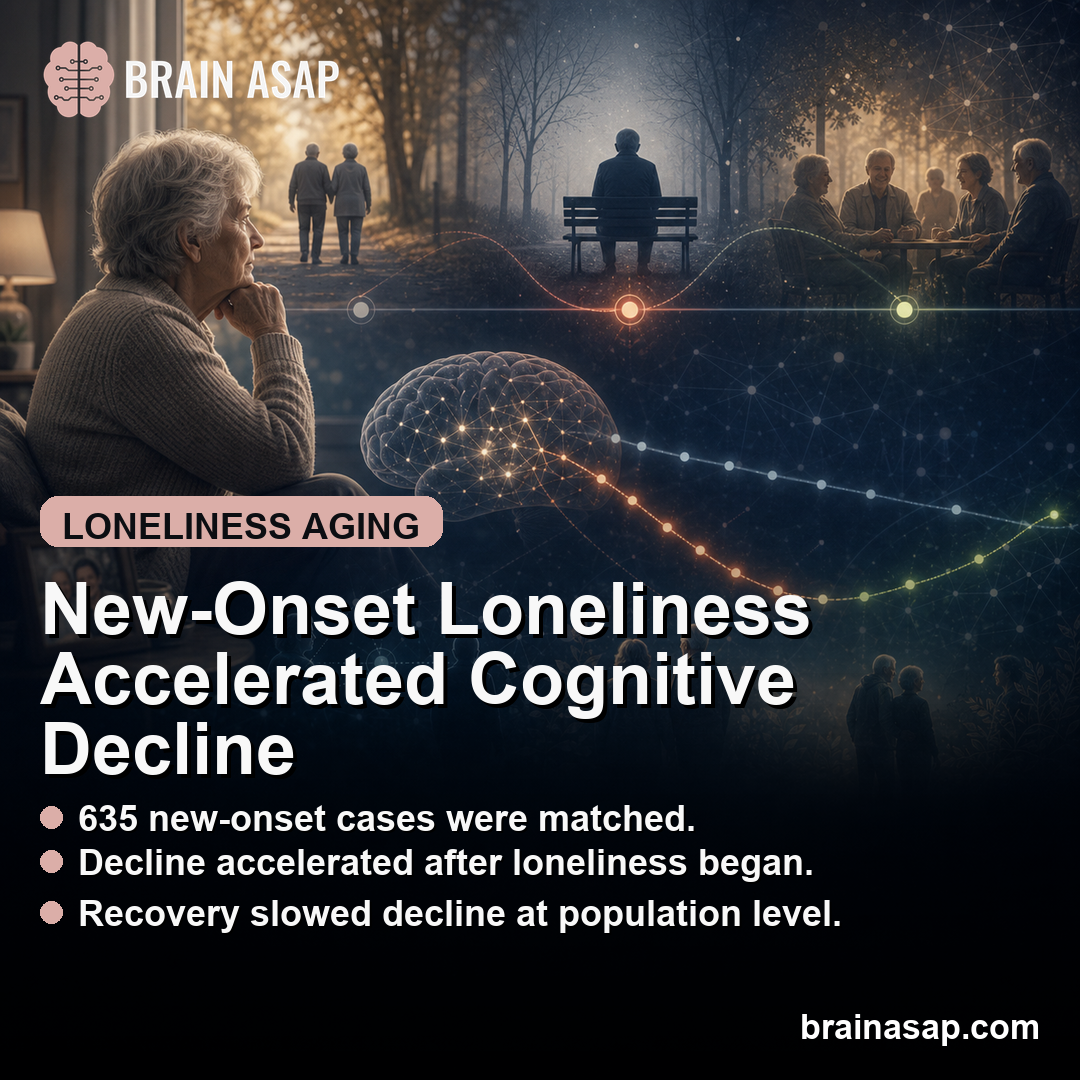
TL;DR: A 2026 longitudinal analysis in the Journal of Affective Disorders tracked 635 older adults with new-onset loneliness and found that cognitive decline matched controls before loneliness began, then accelerated after onset, especially when loneliness persisted.
Key Findings
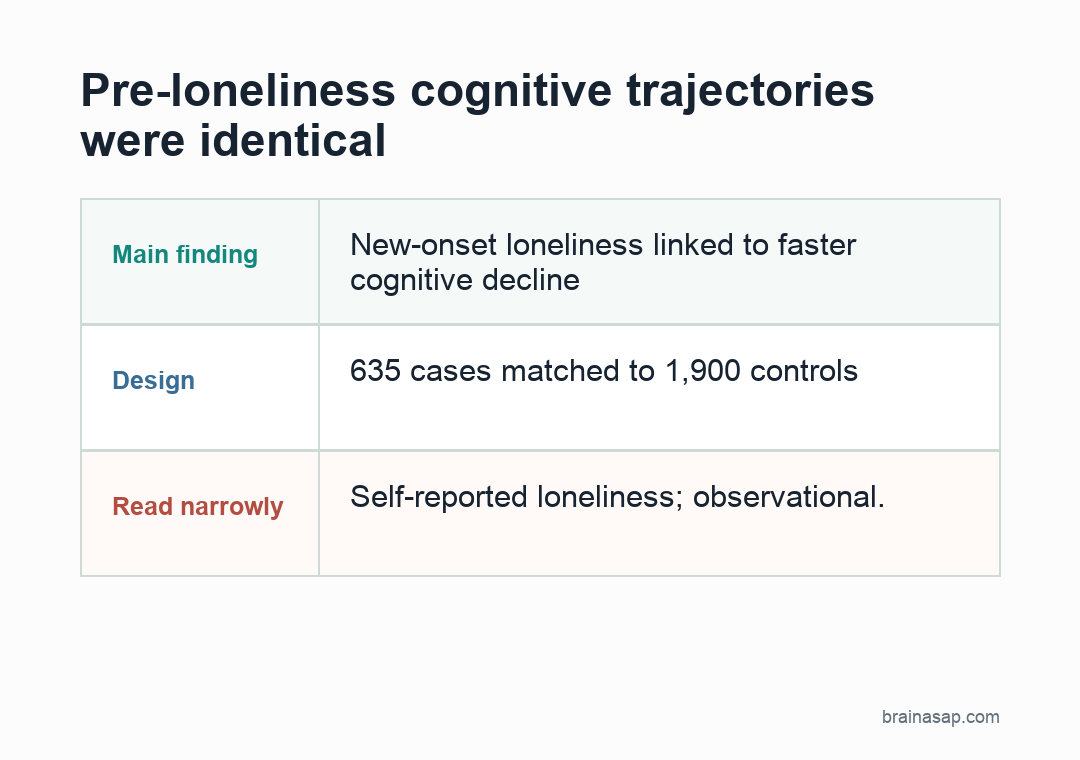
- Pre-loneliness cognitive trajectories were identical: Before the first reported episode of loneliness, cognitive scores in 635 future-lonely adults declined at the same rate as in 1,900 never-lonely matched peers — ruling out a “cognitive decline came first” reverse-causation reading.
- Trajectories diverged sharply after onset: Once an individual reported feeling lonely for the first time, their global cognitive decline accelerated. Memory, name recall, and basic orientation skills all declined faster than in non-lonely peers.
- Loneliness course mattered: Persistent loneliness produced the steepest declines, while participants whose loneliness later lifted showed slower cognitive decline rates.
- Most vulnerable subgroups identified: The post-onset acceleration was strongest in women, older participants, those with less formal education, and those with angina — the cardiovascular comorbidity adds a vascular-stress layer to the loneliness-cognition pattern.
- Three cognitive domains tracked: Word-list memory (immediate and delayed), semantic fluency (animal naming), and basic temporal orientation. All three declined faster after loneliness onset.
Source: Journal of Affective Disorders (2026) | Gong et al.
Loneliness is the subjective feeling that one’s social relationships are inadequate, distinct from being objectively alone.
Earlier studies linked loneliness to higher dementia risk but could not separate two competing readings: does loneliness drive cognitive decline, or do already-declining people withdraw socially and become lonely as a consequence?
This study’s design isolates the new-onset loneliness moment as a temporal anchor, letting the analysis test whether decline accelerates after that point relative to a matched never-lonely comparison group.
How a New-Onset Design Addresses the Chicken-and-Egg Problem
Most prior loneliness-and-cognition research started observation when participants were already lonely.
That design cannot distinguish:
- Loneliness causes cognitive decline.
- Cognitive decline causes social withdrawal and loneliness.
- Both share an upstream cause.
The Gong team’s solution: use longitudinal data to identify the precise wave at which an individual first reported loneliness, then measure cognitive decline rates separately on either side of that anchor point.
If pre-onset and post-onset trajectories differ, the temporal sequence supports the loneliness-causes-decline reading more strongly than the reverse.
635 New-Onset Lonely Adults Matched to 1,900 Never-Lonely Peers
The cohort came from the English Longitudinal Study of Ageing (ELSA), which tracks UK adults aged 50 and older.
The sample-construction process:
- Filter to non-lonely at baseline: Participants who reported no loneliness at their initial assessment.
- Exclude prior cognitive impairment: Anyone with severe cognitive impairment, dementia, or stroke history was removed.
- Identify new-onset lonely: 635 participants who eventually reported feeling lonely for the first time during the follow-up.
- Match to never-lonely controls: 1,900 individuals who never developed loneliness, matched on age, education level, body mass index, smoking habits, and existing medical conditions.
The matching design controls for the obvious confounders that could otherwise produce a spurious loneliness-decline link. The remaining concern (unmeasured genetic or biological factors) is acknowledged but cannot be fully addressed in observational data.
Three Cognitive Tests Built the Outcome Measure:
The cognitive assessment used three tests that together capture memory, language, and basic orientation:
- Word-list memory: Participants heard a 10-word list and recalled it immediately, then again after a delay — capturing both encoding and retention.
- Semantic fluency: Participants named as many animals as they could in one minute — capturing language access and semantic-category retrieval.
- Temporal orientation: Participants identified the current year, month, day, and day of the week — capturing basic cognitive orientation.
Combining these three into a global cognitive score gives a composite that is sensitive to early decline across multiple domains.
Pre-Onset Trajectories Were Identical Between Groups
The most important finding from the design comes from the pre-onset window.
Before the first reported episode of loneliness, the 635 future-lonely participants and the 1,900 never-lonely controls showed cognitive decline at the same rate.
That equivalence rules out the most threatening alternative explanation.
If the future-lonely group had been declining faster all along, the post-onset acceleration could be explained as the continuation of a pre-existing trajectory rather than as a loneliness-driven change.
The pre-onset equivalence shows that did not happen. Once an individual reported feeling lonely for the first time, the global cognitive trajectory diverged sharply.
The acceleration appeared across all three measured domains: The breadth of the effect is methodologically helpful.
If only one domain had accelerated, the result could plausibly reflect a measurement quirk in that single test.
Across all three, a unified post-onset shift is harder to explain as an artifact.
Persistent Loneliness Drove the Steepest Declines, Recovery Slowed Them
The team broke participants down by loneliness pattern over time:
- Persistent loneliness: Reported across multiple assessments — produced the steepest cumulative cognitive declines.
- Fluctuating loneliness: Came and went across assessments — intermediate declines.
- Recovered loneliness: Eventually lifted — slowed cognitive decline relative to the persistent group.
The recovered-loneliness finding is the most actionable piece of the analysis. Helping older adults overcome loneliness does not just improve mood; it appears to slow the rate of cognitive decline in this longitudinal data.
Vulnerable Subgroups Showed Larger Acceleration:
Subgroup analyses identified the populations in which the post-onset acceleration was strongest:
- Women: Steeper post-onset decline than men.
- Older participants: Steeper acceleration in older age bands.
- Less formally educated participants: Less educational reserve was associated with larger acceleration.
- Adults with angina: The cardiovascular comorbidity produced steeper declines — consistent with a model in which inflammation and reduced cerebral blood flow compound the loneliness effect.
The angina subgroup is especially informative because it points to a vascular-inflammation pathway that may add to the cortisol/social-stimulation pathways the authors invoke as the primary mechanisms.
Self-Reported Loneliness, UK-Only Sample, and Unmeasured Confounders Remain
- Self-reported loneliness: Loneliness was assessed by questionnaire rather than by behavioral observation. Self-report introduces measurement error and personal-bias risk.
- UK-only sample: ELSA captures UK adults. Whether the loneliness-cognition pattern looks the same in different cultures and healthcare systems requires separate work.
- Unmeasured confounders: Even with extensive matching, unmeasured genetic or biological factors could independently raise the risk of both loneliness and cognitive decline.
- Mechanism inferred, not measured: The cortisol pathway and the social-stimulation pathway are plausible explanations from prior literature but were not directly measured in this study.
- Cognitive battery is brief: The three tests give a helpful composite but are less detailed than a full neuropsychological battery would be.
Loneliness Screening Belongs in Routine Geriatric Checkups, Not Just Mood-Specific Visits:
The implications for routine older-adult care are direct:
- Loneliness screening should be a routine component of geriatric checkups: A short loneliness questionnaire added to annual visits could detect a modifiable risk factor for cognitive decline before that decline becomes irreversible.
- New-onset loneliness should trigger closer monitoring: A patient newly reporting loneliness is a candidate for more frequent cognitive monitoring and earlier social-engagement intervention.
- Recovery interventions may slow decline: Programs that help older adults rebuild social connections may produce measurable benefits beyond mood — the data suggest cognitive trajectories partially follow social-recovery trajectories.
- High-risk subgroups deserve targeted attention: Women, older patients, less-educated patients, and those with cardiovascular comorbidities such as angina warrant the closest monitoring and earliest intervention.
- Loneliness is a modifiable health metric: The framing implication is that loneliness should be treated as actionable medical information rather than a personal-life-circumstance background fact.
Citation: DOI: 10.1016/j.jad.2026.121299. Gong H et al. Trajectories of cognitive decline before and after new-onset loneliness: The English Longitudinal Study of Ageing. Journal of Affective Disorders. 2026.
Study Design: Longitudinal analysis of the English Longitudinal Study of Ageing using new-onset loneliness as a temporal anchor; pre-onset and post-onset cognitive trajectories compared between matched groups.
Sample Size: 635 ELSA participants who developed new-onset loneliness, matched to 1,900 never-lonely peers on age, education, BMI, smoking, and medical conditions.
Key Statistic: Pre-onset cognitive decline rates were equivalent between groups; post-onset decline accelerated across word-list memory, semantic fluency, and temporal orientation. Persistent loneliness produced steepest declines; recovered loneliness produced slowed declines. Acceleration largest in women, older participants, less-educated participants, and those with angina.
Caveat: Self-reported loneliness; UK-only sample; unmeasured genetic/biological confounders cannot be fully ruled out; mechanism inferred from prior cortisol and social-stimulation literature rather than directly measured; brief cognitive battery rather than full neuropsychological assessment.