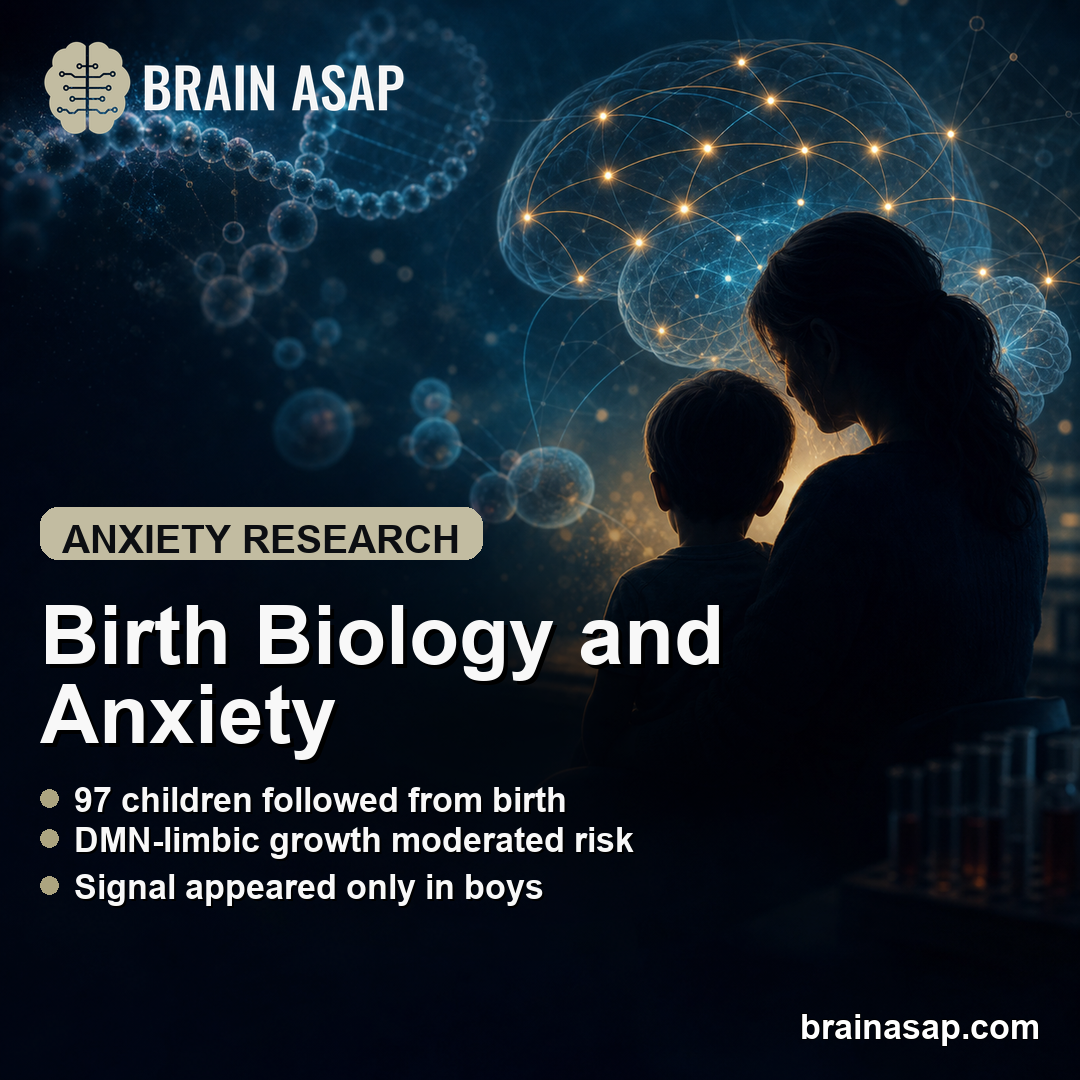
TL;DR: A 2026 Research Square preprint linked DNA methylation (DNAm), an epigenetic mark measured in cord blood at birth, with default mode network-limbic brain development and age-13 anxiety symptoms in boys.
Key Findings
- Birth-to-teen pathway tested: Researchers analyzed 97 children from the GUSTO birth cohort who had cord-blood DNAm, repeated resting-state functional MRI (fMRI) scans, and anxiety scores at age 13.
- 126 stress-related CpG sites: DNAm was summarized from methylation sites in stress-regulatory genes, including pathways tied to HPA-axis and serotonin signaling.
- Four childhood brain scans: Network integration was modeled from resting-state fMRI at ages 4.5, 6, 7.5, and 10.5 years.
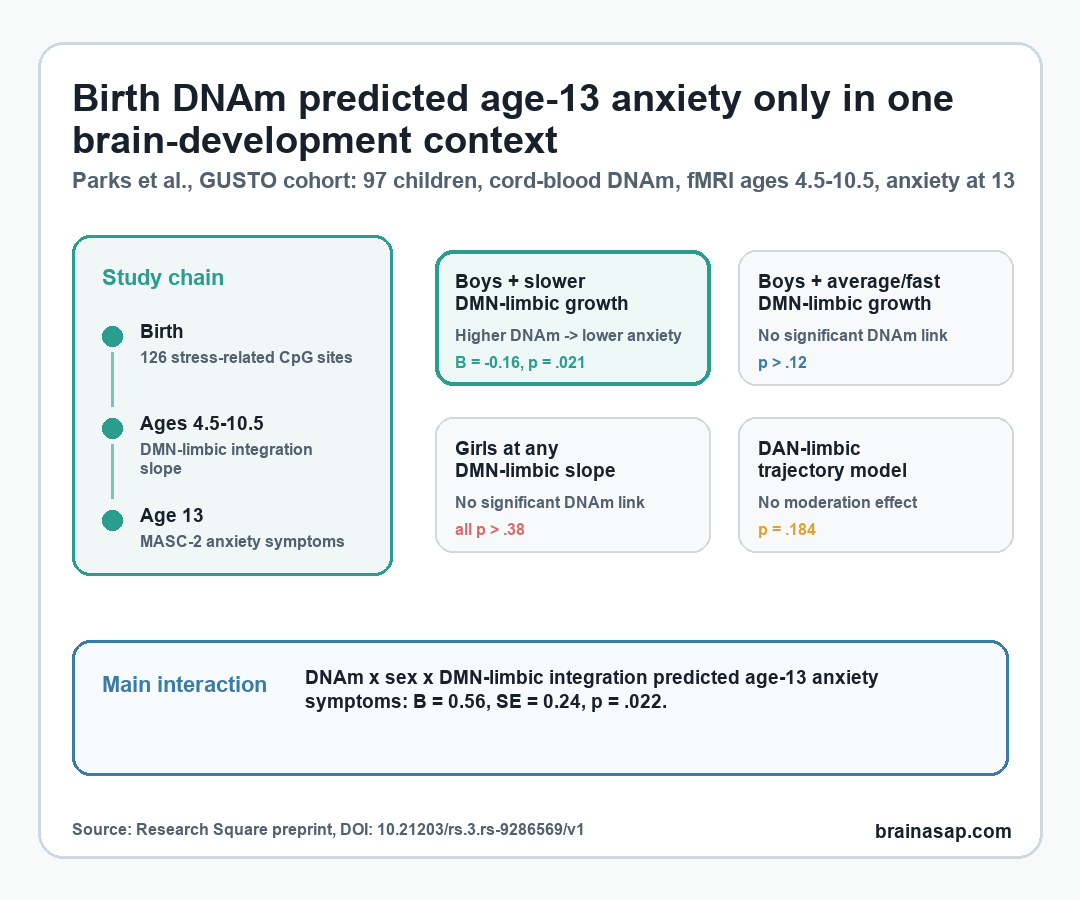
- DMN-limbic development mattered: A three-way interaction among DNAm, sex, and default mode network-limbic integration predicted age-13 anxiety symptoms (B = 0.56, p = .022).
- Signal was specific to boys: Higher DNAm predicted lower anxiety only in boys with slower increases in DMN-limbic integration (B = -0.16, p = .021), while DAN-limbic integration did not significantly moderate risk.
Source: Research Square preprint (2026) | Parks et al.
Birth Biology Was Tested Against a Developing Brain Circuit
Anxiety risk does not begin when a teenager first names the feeling. It can grow out of earlier biology, earlier stress regulation, and the way childhood brain networks mature.
Researchers tested that developmental chain directly: cord-blood DNA methylation at birth, brain-network growth across childhood, and anxiety symptoms at age 13.
DNAm is an epigenetic mark, meaning it can influence how strongly genes are expressed without changing the DNA sequence itself. The researchers focused on 126 CpG sites in stress-related genes, then reduced them into one DNAm component.
Several of the strongest contributors mapped to genes involved in neuroendocrine and stress-response biology, including NCOR2, CRHBP, HSD11B1, and HTR2A.
The brain side of the study centered on two cross-network pathways:
- DMN-limbic integration: coordination between the default mode network, involved in self-referential thought, and limbic regions involved in emotional evaluation.
- DAN-limbic integration: coordination between the dorsal attention network, involved in goal-directed attention, and limbic emotional circuitry.
Anxiety often mixes internal self-focused worry with emotional threat processing. A network that links self-reference and emotion is a plausible place to look for developmental risk.
The Cohort Linked Cord Blood, Four fMRI Waves, and Age-13 Anxiety
The analysis used 97 children from the Growing Up in Singapore Towards healthy Outcomes cohort. Children were included only if they had usable birth DNAm data, at least two good-quality resting-state fMRI scans, and anxiety assessment at age 13.
The fMRI waves covered ages 4.5, 6, 7.5, and 10.5 years, which let researchers estimate a developmental slope rather than rely on one scan.
Anxiety symptoms were measured with the Multidimensional Anxiety Scale for Children-2, a 50-item self-report tool covering physical anxiety symptoms, generalized anxiety, harm avoidance, social anxiety, obsessive-compulsive symptoms, and separation anxiety.
The average raw score in the sample was 60.31, with a wide range from 6 to 117.
The brain trajectories moved in different directions across childhood:
- DMN-limbic integration increased: the average slope was 0.80, suggesting more coordination between self-referential and affective systems over time.
- DAN-limbic integration decreased: the average slope was -0.13, suggesting a different developmental pattern for attentional-emotional coordination.
- Maternal symptoms were controlled: models adjusted for prenatal maternal depression and anxiety at pregnancy week 26, along with child ethnicity, gestational age, maternal age, and education.
Higher DNAm Looked Protective Only in One Developmental Context
The central statistical result was a three-way interaction: DNAm at birth, biological sex, and DMN-limbic integration trajectory jointly predicted anxiety at age 13. The interaction was statistically significant after the study’s two-network correction threshold, with B = 0.56, SE = 0.24, and p = .022.
The simple-slope result is the cleanest way to read it. In boys with slower increases in DMN-limbic integration, higher DNAm at birth predicted lower anxiety symptoms at age 13.
The reported estimate was B = -0.16, SE = 0.25, and p = .021. In girls, DNAm did not significantly predict anxiety at low, average, or high DMN-limbic slopes.
In boys with average or faster DMN-limbic integration, the association also was not significant. The pattern is narrower than a broad “epigenetics predicts anxiety” claim:
- Birth biology alone was not enough: DNAm mattered only when paired with a specific brain-development trajectory.
- Sex changed the direction of interpretation: the significant protective-looking association appeared in boys, not girls.
- The network mattered: the DMN-limbic pathway carried the moderation signal, while DAN-limbic integration did not.
One interpretation is that slower coupling between self-referential thought and emotional evaluation may reduce amplification of worry in boys with this DNAm profile. That hypothesis still needs replication before it can guide clinical decisions.
Why the Default Mode Network Result Makes Sense for Anxiety
The default mode network is often active during self-focused thought, memory, future simulation, and rumination. Limbic regions help evaluate emotional salience.
When those systems become tightly coordinated in the wrong context, internal thought can become emotionally sticky. For anxiety, that can mean worry that keeps feeding itself.
The study authors argue that DMN-limbic maturation during ages 4.5 to 10.5 may mark how self-referential and affective systems become organized across childhood.
The fact that DAN-limbic integration did not show the same moderation suggests the anxiety pathway was less about top-down attention and more about internally directed emotion processing.
The protective framing should stay cautious. Slower DMN-limbic integration is not automatically good, and higher methylation is not automatically protective.
The association depended on the sex, gene-component, network, and age window tested here.
What the Result Does Not Prove Yet
The study is valuable because it spans birth biology, repeated brain imaging, and adolescent symptoms. It is also limited.
The analysis included 97 children, which is small for a three-way interaction. The source is a preprint, so the finding should be treated as provisional until peer review and replication.
Four practical limits matter most:
- Generalizability: the cohort came from Singapore and may not represent other populations, cultures, or health systems.
- One anxiety time point: symptoms were measured at age 13, not across multiple adolescent years.
- Unmeasured family context: paternal or second-parent psychopathology, parenting, and family environment were not modeled in depth.
- Prediction is not screening: this result does not justify cord-blood or fMRI screening for childhood anxiety.
The clearest implication is developmental, not diagnostic. Anxiety risk may depend on how early stress-regulatory biology is routed through maturing self-referential emotion networks.
If larger studies confirm the pattern, prevention work may need to think less in terms of one risk factor and more in terms of birth biology plus brain-network timing.
Citation: DOI: 10.21203/rs.3.rs-9286569/v1. Parks et al. Sex Differences in the Interaction of Epigenetic Risk and Trajectories of Default Mode Limbic Network Integration Predicting Childhood Anxiety. Research Square. 2026.
Study Design: Longitudinal birth-cohort analysis linking cord-blood DNAm, repeated childhood resting-state fMRI, and adolescent anxiety symptoms.
Sample Size: 97 children from the GUSTO cohort with usable DNAm, repeated fMRI, and age-13 anxiety data.
Key Statistic: DNAm, sex, and DMN-limbic integration trajectory interacted to predict age-13 anxiety symptoms (B = 0.56; p = .022).
Caveat: Small preprint analysis with one adolescent anxiety time point; replication is needed before any clinical screening use.