TL;DR: A 2026 meta-analysis in Neurological Sciences pooled 10 studies that gave people with Parkinson’s disease, tested while on their dopamine medication, and healthy adults the same “think of as many ideas as you can” tasks. On average, the two groups scored about the same, with neither a creative boost nor a clear deficit.
Key Findings
- No clear average difference: The pooled gap between Parkinson’s groups and healthy groups was close to zero (Cohen’s d −0.095; 95% CI −0.308 to 0.118).
- The creativity-boost hypothesis wasn’t supported: Researchers set out to test whether medicated patients generate more ideas than healthy adults. The pooled data didn’t show it.
- No clear deficit either: Idea generation didn’t come out clearly lower in Parkinson’s, even though the disease often affects related thinking skills.
- Studies pulled in different directions: 4 of 10 found lower Parkinson’s scores on some measure, 2 found higher scores on drawing or visual tasks, and 4 found no clear difference.
- Small evidence base: 193 people with Parkinson’s across the analyzed comparisons, with 10 to 36 per study.
Source: Neurological Sciences (2026) | Colautti et al.
Some of the most memorable stories in Parkinson’s medicine are about art. Case reports describe a patient who began producing and selling artwork after a dopamine drug dose was raised, an amateur painter whose output surged a month after starting treatment, and a man in his fifties who began writing poetry for the first time after starting medication.
Those cases invite an intriguing idea: that dopamine-boosting treatment might make people with Parkinson’s more creative in general. It also fits some neuroscience. Dopamine pathways run through brain regions involved in flexible thinking and reward, and the same circuits are affected by the disease.
But a handful of striking cases can’t show what happens across patients. This review asked the broader question directly: when people with Parkinson’s on their usual medication take standard creative-thinking tests, do they score any differently from people without the disease?
The Tests Measured How Many Ideas People Could Generate
Creativity is hard to measure, so researchers focused on one well-studied part of it: divergent thinking, the ability to come up with many different answers to an open-ended prompt. It’s widely treated as a measure of creative potential rather than artistic achievement.
A classic example is the Alternative Uses Task. You’re shown an everyday object — a brick, a newspaper, a sock — and asked to list as many different uses for it as you can. Other tests in the review asked people to imagine consequences of an unlikely situation, or to turn simple lines into as many original drawings as possible.
Answers are usually scored four ways:
- Fluency: How many appropriate ideas someone produces.
- Flexibility: How many different categories those ideas span. Listing “doorstop, paperweight, bookend” is one category; adding “grind it into pigment” opens another.
- Originality: How rare the ideas are compared with other people’s answers.
- Elaboration: How much detail the ideas include.
Researchers searched three major research databases and a preprint server for studies published since 2000. They kept only studies that compared a Parkinson’s group with a healthy group on this kind of task, and that tested patients in the medication “on” state — while their usual dopamine drugs were working. People with dementia were excluded.
Ten studies qualified, covering 193 people with Parkinson’s in the comparisons that were analyzed. Because most studies reported several of the four scores, the analysis pooled 37 separate results.
Parkinson’s and Healthy Groups Scored About the Same
To combine studies that used different tests, researchers converted each comparison into a standardized difference called Cohen’s d. A value of zero means no difference between groups. Here, negative values mean the Parkinson’s group scored lower and positive values mean it scored higher.
The pooled result was d = −0.095, a sliver in the direction of lower Parkinson’s scores and very small by any usual standard. Its 95% confidence interval ran from −0.308 to 0.118, which includes zero along with small differences either way.
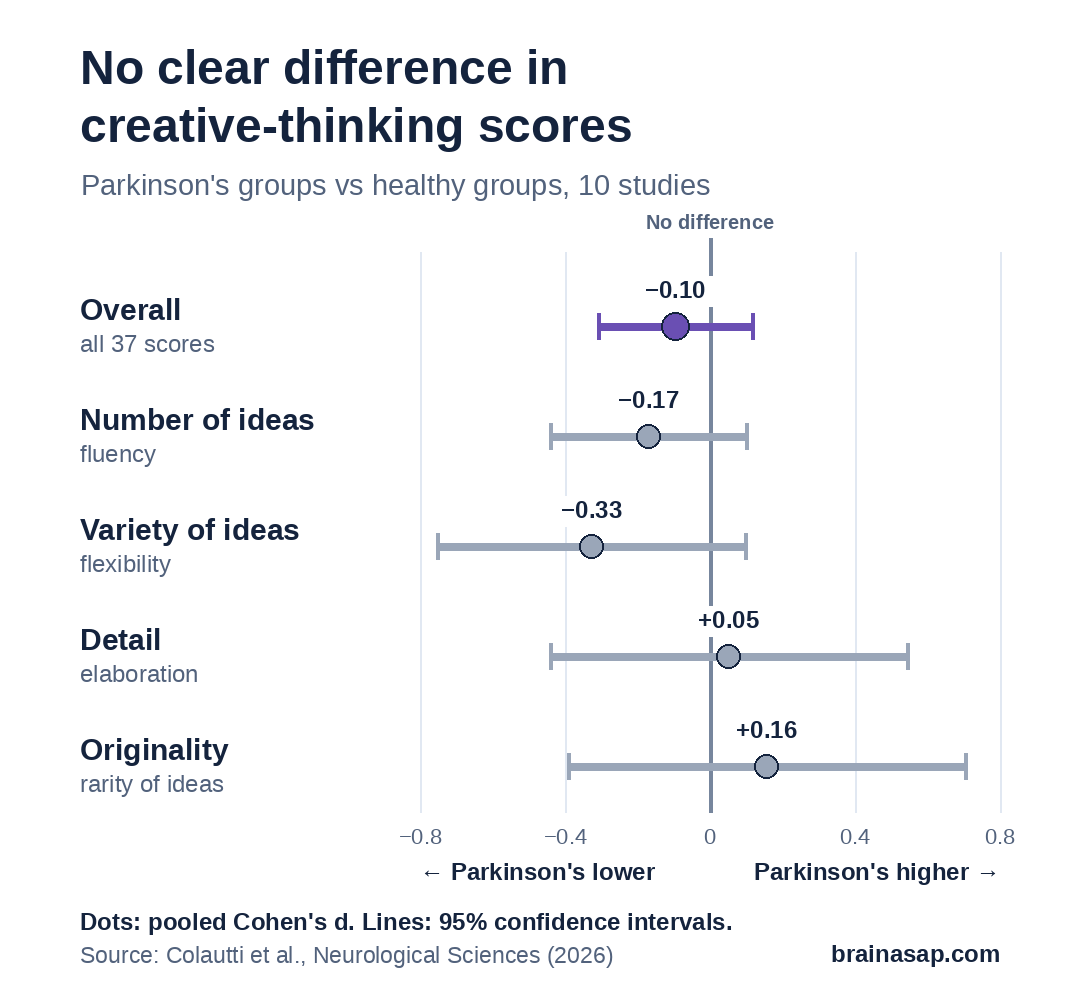
Breaking the result into the four scores didn’t change the picture. Parkinson’s groups averaged a little lower on fluency (−0.17) and flexibility (−0.33), and a little higher on elaboration (0.05) and originality (0.16). None of those differences was clear, and the four didn’t differ from one another by more than chance would explain.
The main estimate held up to two routine checks. Dropping each study in turn didn’t substantially change it, and a test for missing small studies — a common sign of publication bias — left it essentially the same.
Why the Case Reports and the Test Scores Can Point Different Ways
If some patients really do develop a new drive to paint or write, why doesn’t that show up as higher creative-thinking scores? The review’s authors think the two may simply be different things.
A divergent-thinking test measures whether someone can generate varied, original ideas on demand. A sudden urge to make art may depend more on motivation and the pleasure of creating — functions tied to the brain’s reward pathways — than on idea-generation skill.
That’s a hypothesis, not something this meta-analysis tested, but it offers a reasonable explanation of why the two kinds of evidence could disagree.
There’s also a flip side worth noticing. Parkinson’s commonly affects executive functions such as planning, switching between tasks, and holding information in mind, and those abilities feed into creative thinking.
Yet idea generation didn’t come out clearly impaired here. The authors cautiously suggest divergent thinking may be relatively preserved in some patients, a possibility they think deserves study as a potential strength.
Medication Dose Showed Only a Faint, Uncertain Trend
Researchers also checked whether studies with higher medication doses showed more favorable Parkinson’s scores. To compare different drugs, they used levodopa equivalent daily dose, which converts each Parkinson’s medication into a common unit.
Across the 26 results with dose information, higher average doses went with slightly more favorable Parkinson’s scores, but the trend fell just short of statistical significance (p = 0.053). Each study contributed only a group-average dose, and disease severity, disease duration, or age could produce the same pattern.
Individual studies were mixed. A couple found that higher doses went with more original answers; others found no link. Because the review compared groups at a single point in time rather than changing anyone’s medication, it can’t say whether dopamine drugs affect creative thinking.
Small Studies, Mixed Tests, and Heterogeneous Patients Limit the Conclusion
Pooling studies helps most when they measure the same thing in similar people. Here they didn’t quite. Researchers estimated that about 71% of the variation in results reflected real differences between studies rather than chance, which is high.
- Different tests: Some tasks leaned on language, others on drawing or imagining scenarios, and Parkinson’s can affect those skills differently.
- Different patients: Groups ranged from newly diagnosed to an average of nearly 10 years since diagnosis.
- Small samples: With 10 to 36 patients per study, modest real differences could easily be missed.
- Patient selection: Six of the ten studies were judged at high risk of bias in how patients were recruited, often from clinic convenience samples.
A “no clear difference” result also isn’t proof that the groups are identical. It means the current studies, taken together, don’t show a meaningful average gap in either direction. The review also didn’t include convergent-thinking tests, which ask for a single best answer, so it covers only one side of creative thinking.
The results apply to people tested on their medication and without dementia. Answering whether dopamine treatment changes creativity will take studies that follow the same patients over time, ideally with larger groups and more consistent tests.
Citation: DOI: 10.1007/s10072-026-09234-7. Colautti et al. Creative thinking in Parkinson’s disease: A systematic review and meta-analysis. Neurological Sciences. 2026;47:632.
Study Design: Systematic review and random-effects meta-analysis of studies comparing medicated people with Parkinson’s disease and healthy controls on divergent-thinking tasks.
Sample Size: 10 studies; 193 people with Parkinson’s in the analyzed comparisons; 37 pooled results.
Key Statistic: Pooled Cohen’s d = −0.095 (95% CI −0.308 to 0.118), showing no clear difference between groups.
Caveat: Small, varied studies with high between-study variation; a null pooled result does not prove equivalence, and the review cannot test medication effects.