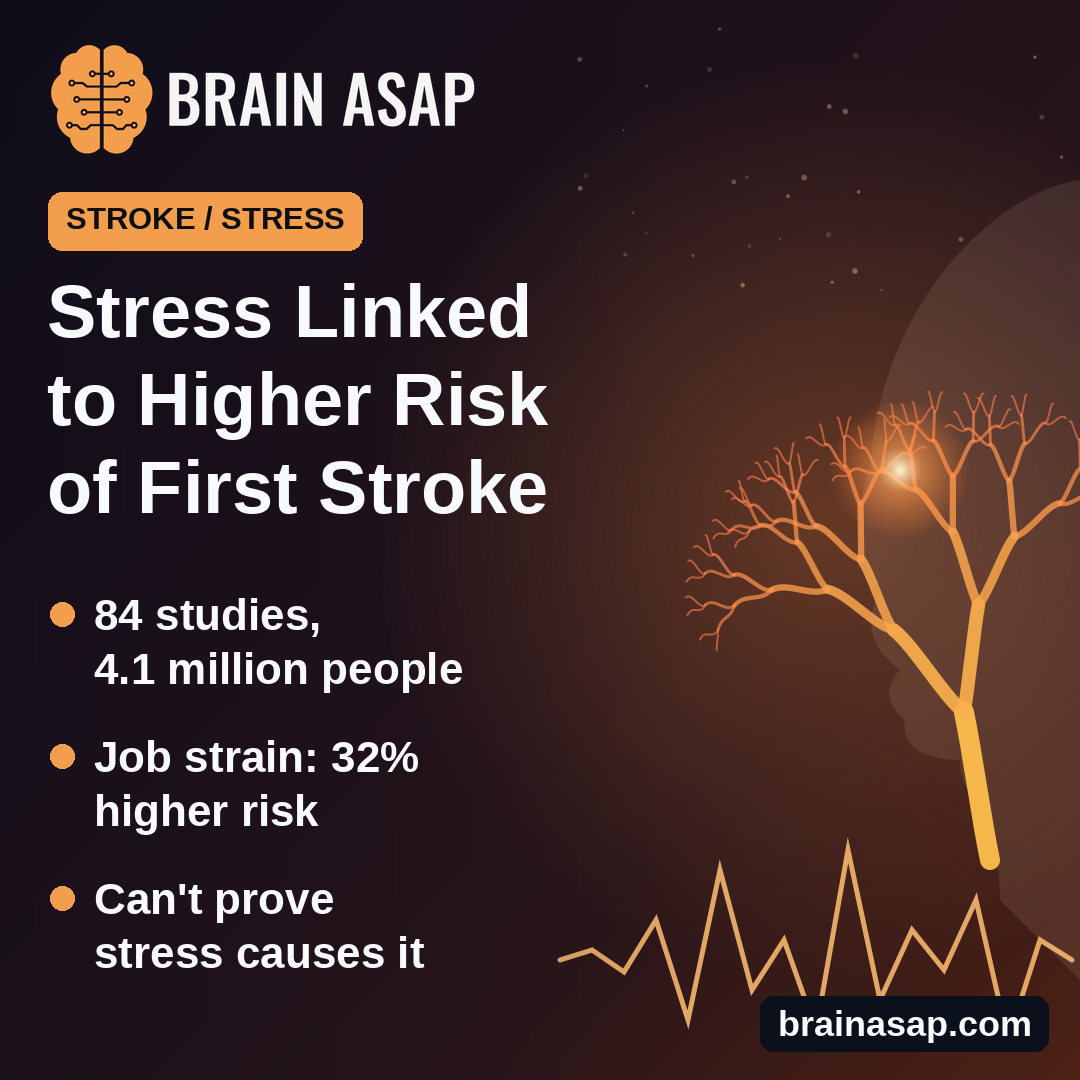
TL;DR: In a review of 84 studies covering 4.1 million people, those with psychological distress or job strain had roughly 30% higher risk of a first stroke. The studies were observational, so they cannot show that stress itself causes strokes.
Key Findings
- 84 studies, 4.1 million people: All stroke-free when first assessed.
- Psychological distress: 27% higher risk of first stroke (48 studies).
- Job strain: 32% higher risk (20 studies).
- Relationship stress: 11% higher risk (7 studies).
- Hostility and anger traits: 51% higher, but only 3 studies.
- Likely overstated: Correcting for small-study bias cut the distress and job figures to about 15%.
Source: BMC Neurology (2026) | Khalifa et al.
High blood pressure, diabetes and smoking are the usual suspects when doctors talk about stroke. Stress gets mentioned less often, partly because it is harder to measure.
This review pulled together decades of studies to ask how strongly stress tracks with a person’s first stroke, and which kinds of stress matter most.
Four Kinds of Stress, 84 Studies
The researchers searched four databases through January 2026. They kept 72 studies that followed people with no prior stroke over time and 12 that compared people who had a stroke with people who had not. Everyone was stroke-free at the start.
They sorted stress into four groups:
- Psychological: Depression, anxiety, perceived stress, general distress.
- Job-related: Work strain, high demands, job dissatisfaction.
- Relationships: Social isolation, conflict, lack of support.
- Behavioral traits: Hostility, anger expression, poor coping.
Strokes counted included the most common type caused by a clot, bleeding strokes, and mini-strokes (TIAs).
Job Strain and Distress Carried the Clearest Signal
In the studies that followed people over time, psychological distress was linked to a 27% higher risk of a first stroke, and job strain to a 32% higher risk. These two groups had the most studies behind them, 48 and 20.
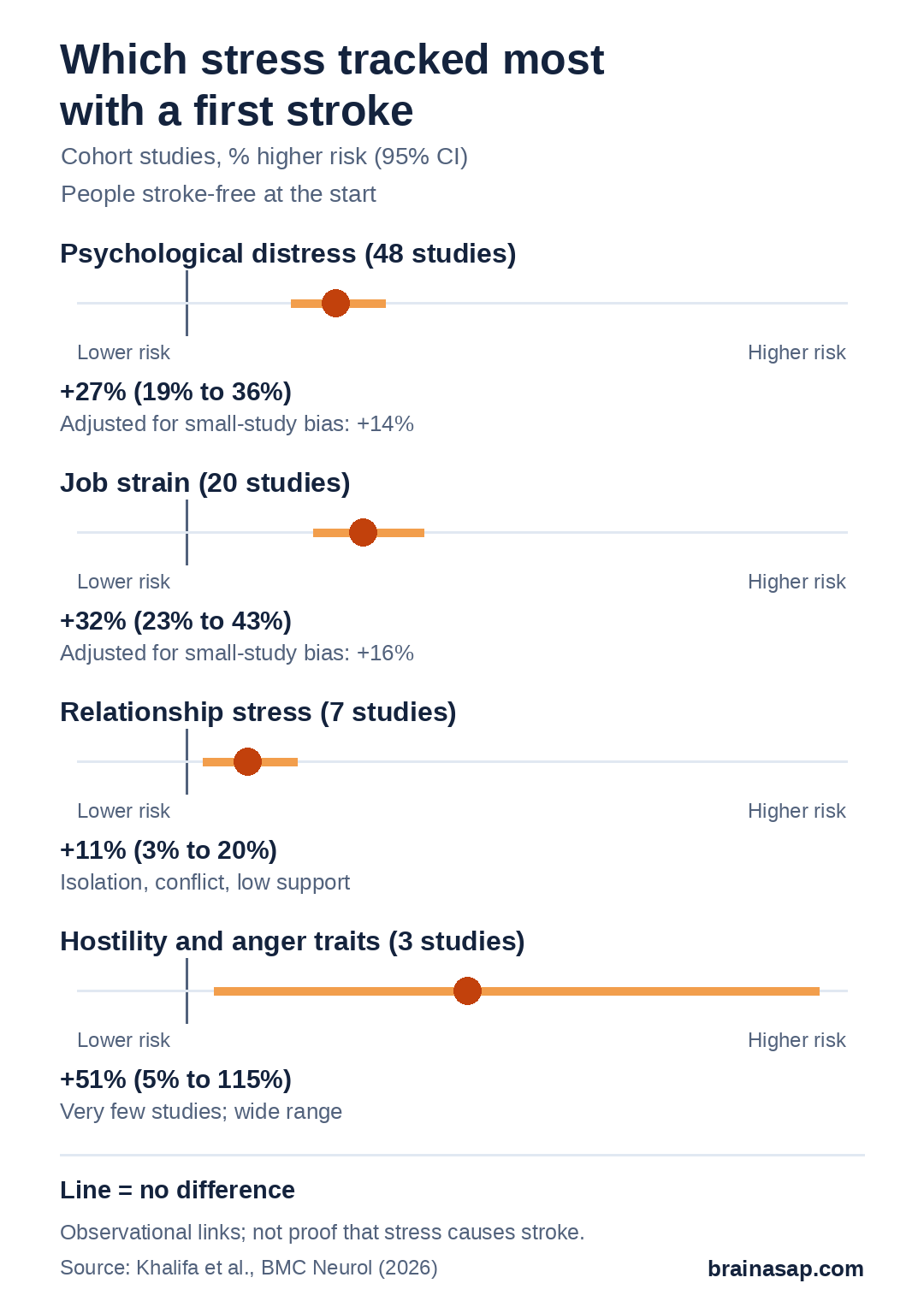
Relationship stress had a smaller link, 11%. Hostility and anger traits had the largest estimate, 51%, but it rests on just three studies and has a very wide range of uncertainty.
The Real Effect Is Probably Smaller
The researchers found signs that small studies with striking results were overrepresented. When they adjusted for that:
- Psychological distress: Fell from 27% to 14% higher risk.
- Job strain: Fell from 32% to 16% higher risk.
Both links stayed statistically significant. Results also varied a lot between studies, so the pooled numbers are averages across very different groups, not a fixed risk for any one person.
No Clear Difference Between Men and Women
When the researchers split the psychological-stress results by sex, the link was significant in men (19% higher risk) and not in women. But a formal test found no significant difference between the two. The authors call it inconclusive, not evidence that stress affects only men’s stroke risk.
What the Studies Cannot Rule Out
- Observational: Stress may travel with smoking, drinking, poor sleep and low income, and not every study adjusted for these.
- Self-reported stress: Mostly questionnaires, often only once at the start.
- Mixed definitions: “Stress” meant different things across studies.
- Mostly high-income countries.
- English-language studies only.
Stress Belongs on the Stroke-Risk List
These results add weight to the idea that long-running distress and job strain belong alongside blood pressure and smoking when thinking about stroke risk. Plausible routes include raised blood pressure and inflammation, and the unhealthy habits that often come with stress.
What the review cannot say is whether lowering stress lowers stroke risk. That would take trials that reduce stress and then count strokes over years.
Citation: DOI: 10.1186/s12883-026-05307-4. Khalifa MA, Hassanein D, Alsabbagh AAI, et al. Psychosocial stress and risk of first-ever stroke: a systematic review and meta-analysis. BMC Neurol. 2026;26:606.
Study Design: Systematic review and meta-analysis of 72 prospective cohort and 12 case-control studies (PRISMA/MOOSE).
Sample Size: 84 studies; 4,128,167 participants.
Key Statistic: Cohort hazard ratios: psychological stress 1.27 (95% CI 1.19 to 1.36); vocational stress 1.32 (1.23 to 1.43).
Caveat: Observational; publication bias (adjusted HRs 1.14 and 1.16); high heterogeneity; mostly self-reported stress.