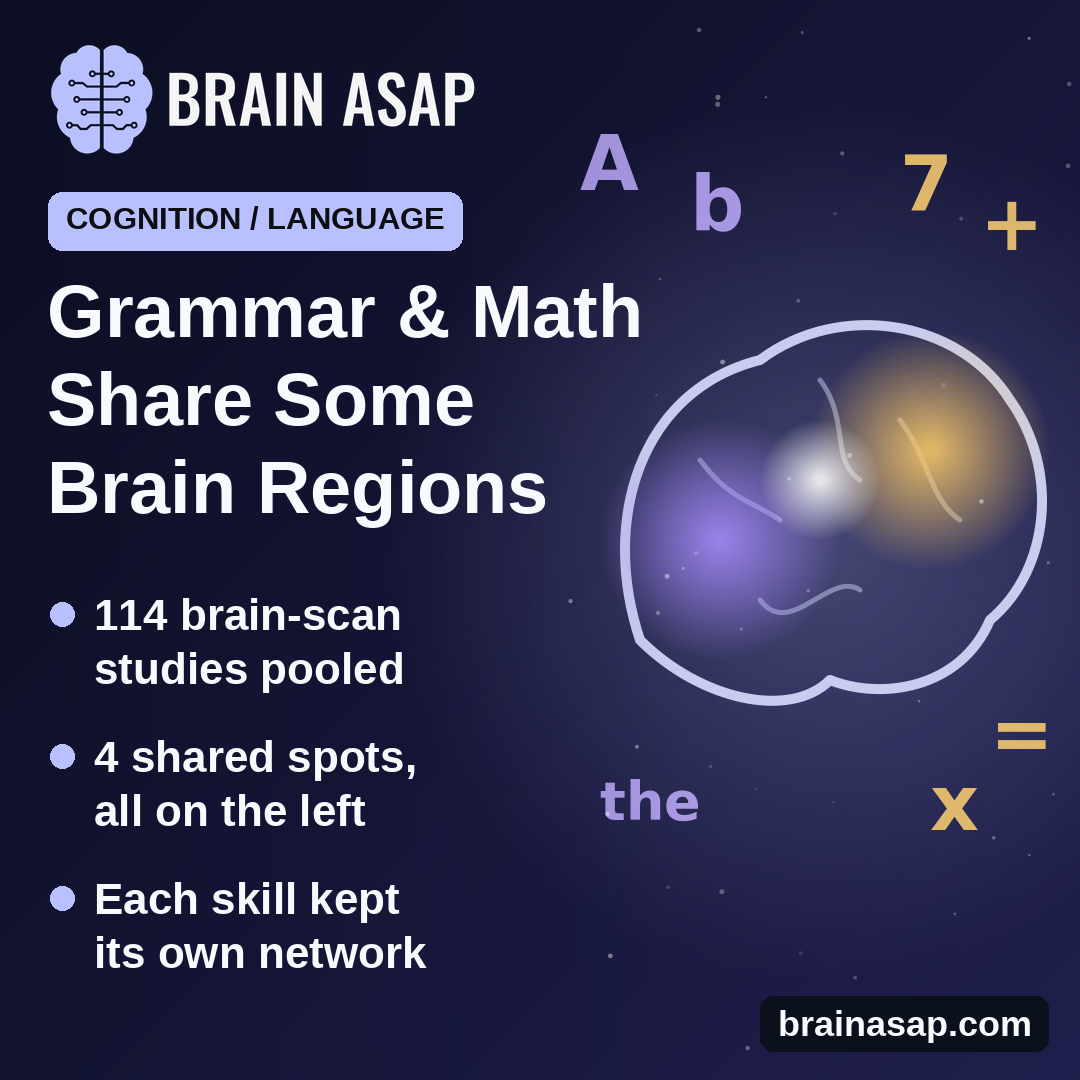
TL;DR: Pooling 114 brain-scan studies, researchers found that grammar and arithmetic both lit up four spots on the left side of the brain, all part of a general problem-solving network. Beyond that, each skill leaned on its own separate regions.
Key Findings
- 114 fMRI studies: 48 on grammar, 66 on arithmetic, in healthy children and adults.
- Four shared spots, all left side: Frontal, motor-planning, parietal and insula areas.
- Shared spots are general-purpose: Part of the brain’s “multiple-demand” network for hard, rule-based tasks.
- Grammar’s own turf: Classic left-side language areas, including Broca’s area.
- Math’s own turf: Parietal areas on both sides of the brain.
- Same result in adults only.
Source: Neuroscience & Biobehavioral Reviews (2026) | Viesel-Nordmeyer et al.
Kids who are good with sentence structure tend to be good with arithmetic too, and kids who struggle with one often struggle with the other. Researchers have long argued about why.
One idea is that math is partly a language skill. Another is that both lean on a more general ability to spot and apply rules. This review looked inside the brain for clues.
Two Ideas About Why Grammar and Math Travel Together
Both explanations have some support:
- Math as language: Word problems and number words carry grammar, like “smaller” and “smallest.”
- Shared rule-handling: “The dog that the cat chased barked” and “3 × (4 + 2)” both need nested rules applied in the right order.
If math mainly borrows from language, the overlap should show up in classic language areas. If both lean on general rule-handling, it should show up in areas that switch on for many kinds of demanding tasks.
Pooling 114 Brain-Scan Studies
The researchers used activation likelihood estimation (ALE), a method that pools the reported peak locations of brain activity from many fMRI studies and finds where they cluster more than chance would predict.
They gathered 48 studies of grammar tasks, such as judging whether a sentence is grammatical, and 66 of arithmetic tasks, such as solving sums. All participants were healthy. Most grammar experiments were in adults; about a third of the arithmetic experiments involved children or teenagers.
Four Shared Spots, All on the Left
Where grammar and arithmetic both reliably activated the brain, the researchers found four regions, all in the left hemisphere:
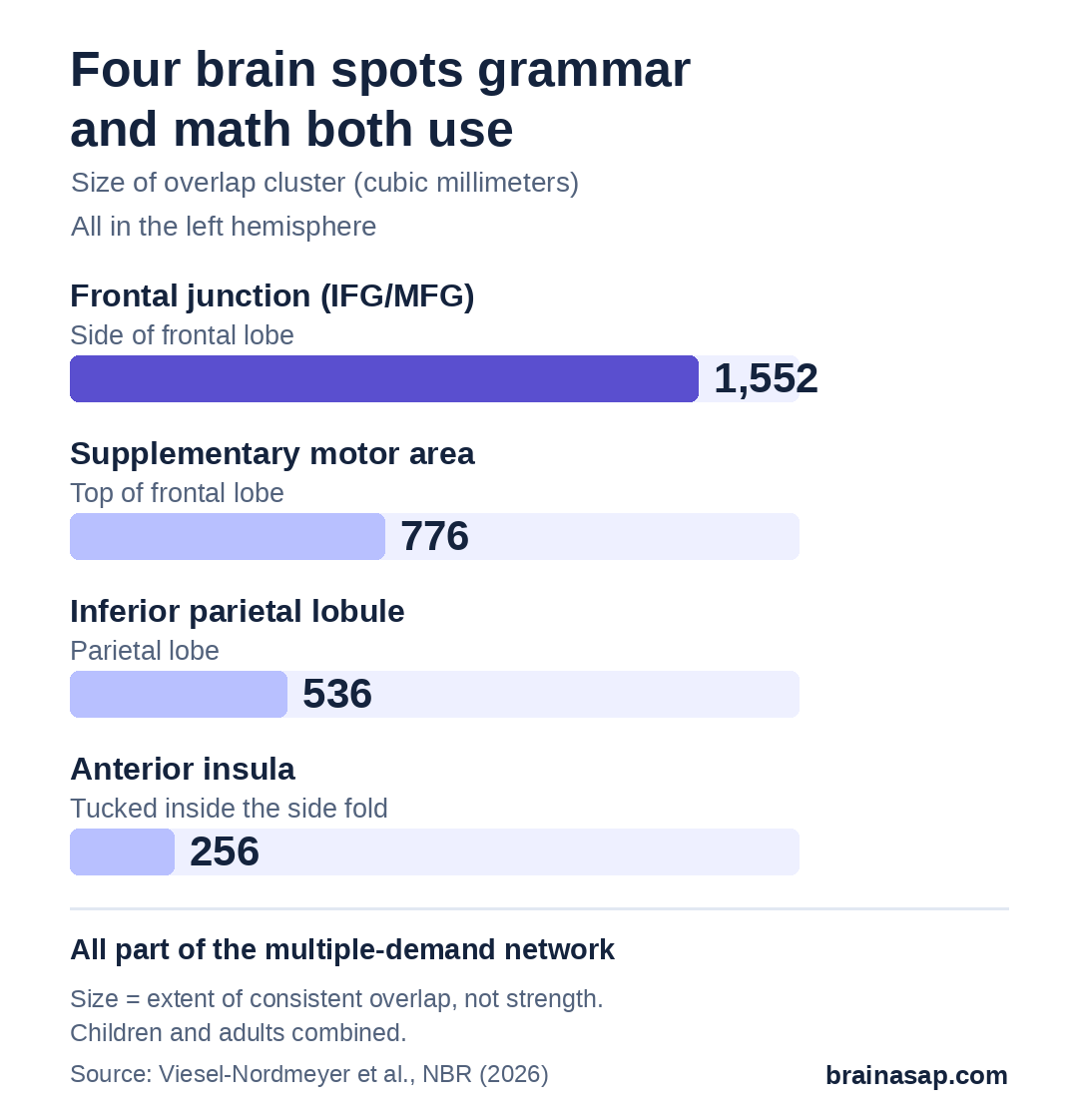
All four belong to what neuroscientists call the multiple-demand network, a set of frontal and parietal areas that switch on for many hard tasks involving attention, working memory and problem solving. The researchers read this as support for the shared rule-handling idea, not the math-as-language one.
Each Skill Also Had Its Own Territory
Comparing the two directly showed clear differences:
- More for grammar: Left Broca’s area (the largest difference), left temporal areas near Wernicke’s area, and a front part of the motor-planning region.
- More for arithmetic: The intraparietal sulcus on both sides, a region tied to handling quantities, plus the insula on both sides and other frontal spots.
When the researchers reran everything using only adult studies, the same four shared regions and the same differences appeared.
Overlap on a Map Is Not the Same Computation
- Peak locations only: The method shows where activity clusters, not what the neurons compute there.
- Mixed tasks: Different grammar tasks and math operations were pooled together.
- Difficulty effects: About 30% of math studies compared hard with easy problems, which can drive general effort areas.
- Too few child studies to compare children and adults directly.
- Accepted manuscript: Final published version may differ slightly.
Better Tests Needed in Growing Brains
The picture that emerges is that grammar and arithmetic share a general-purpose engine for structured rules, while each keeps its own specialized hardware. That could help explain why the skills rise and fall together without being the same thing.
The open question is how this develops. Studies that scan the same children on both grammar and math tasks as they grow would show whether the shared network drives the link between the two skills.
Citation: DOI: 10.1016/j.neubiorev.2026.106925. Viesel-Nordmeyer N, Ziegler JC, Prado J. How are grammatical and arithmetic processing related in the brain? An ALE meta-analysis. Neurosci Biobehav Rev. 2026;190:106925.
Study Design: Coordinate-based activation likelihood estimation (ALE) meta-analysis of whole-brain fMRI studies, with conjunction and contrast analyses.
Sample Size: 48 grammar and 66 arithmetic studies (50 and 70 experiments).
Key Statistic: Four left-hemisphere overlap clusters; largest at the IFG/MFG junction (1,552 mm³).
Caveat: Accepted manuscript; spatial overlap does not show shared computation; mixed tasks; few child studies.