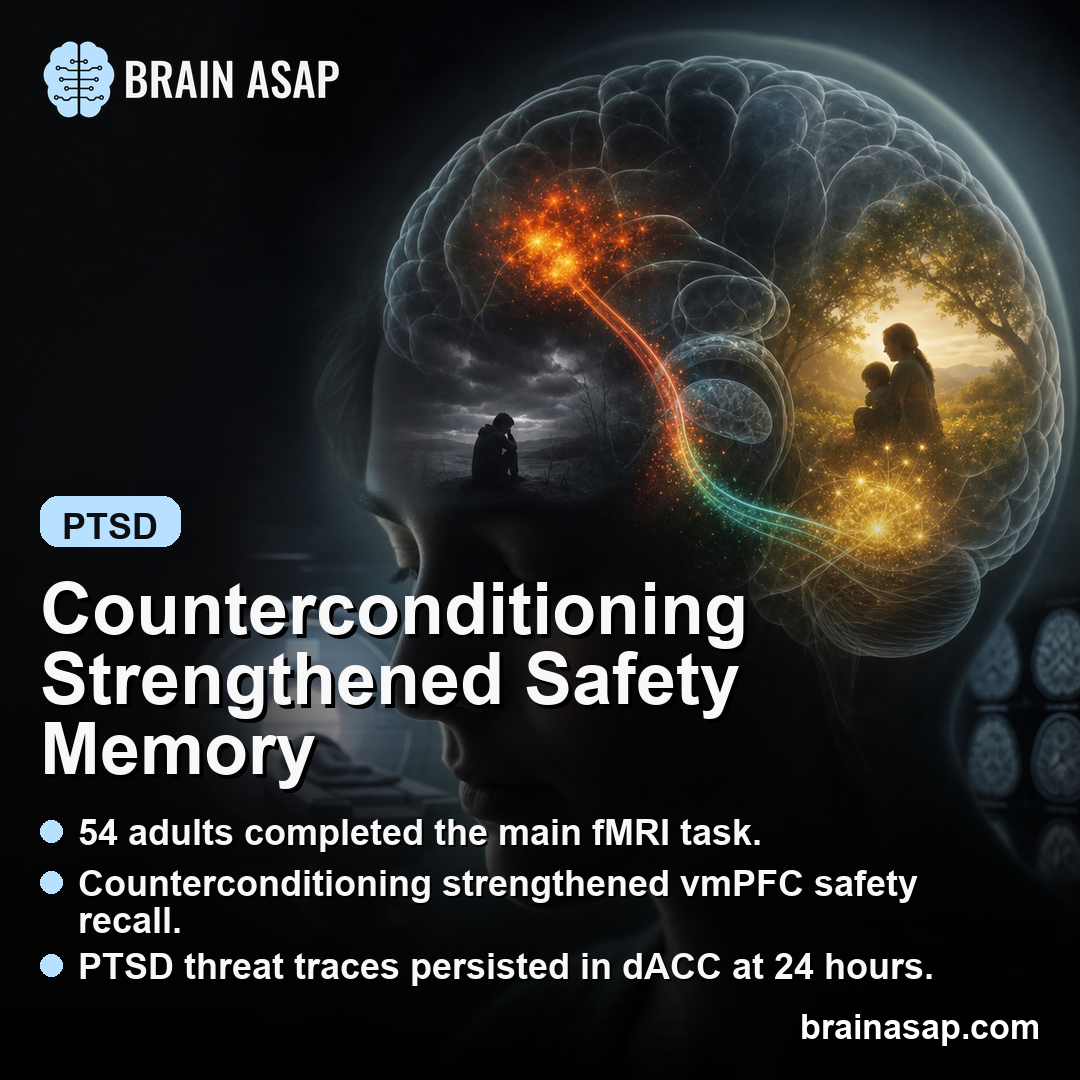
TL;DR: A 2026 functional MRI (fMRI) study in Translational Psychiatry found that counterconditioning, a form of exposure learning that replaces a threat cue with a positive outcome, strengthened safety-memory signals in adults with PTSD more than standard extinction did.
Key Findings
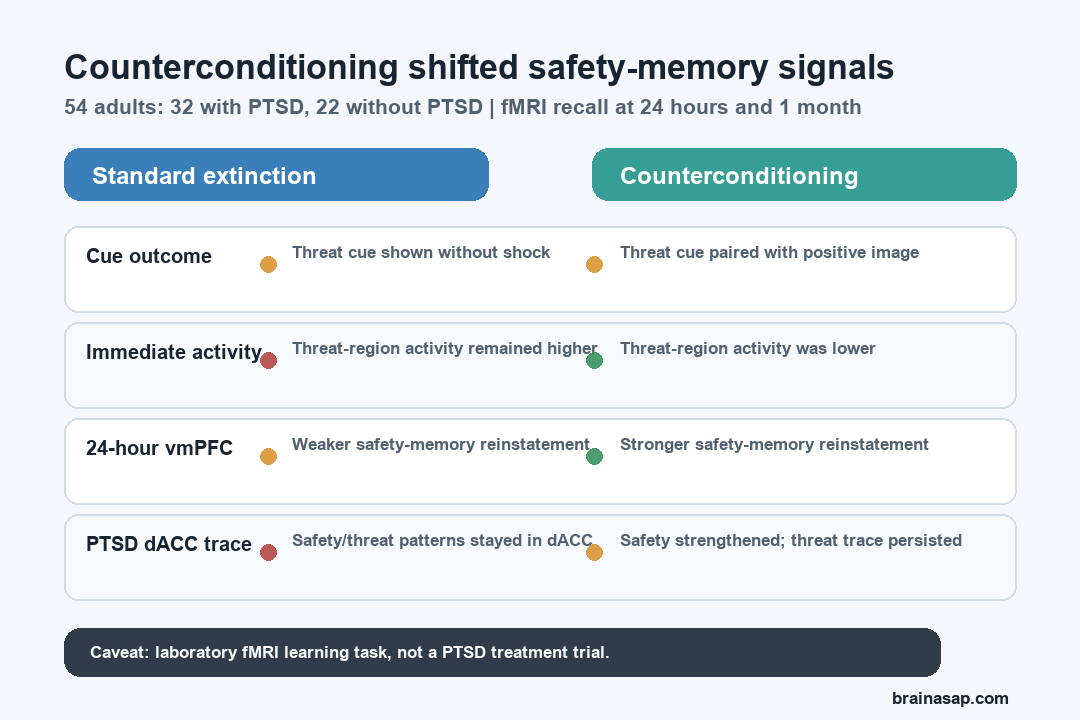
- Safety learning was tested: Researchers studied 54 adults, including 32 with post-traumatic stress disorder (PTSD) and 22 without PTSD, during a 3-day fMRI fear-learning task.
- Counterconditioning reduced threat-region activity: During safety learning, the counterconditioning cue produced lower activity than standard extinction in threat-related regions including the dorsal anterior cingulate cortex, insula, thalamus, and periaqueductal gray.
- Safety memory was stronger at 24 hours: The counterconditioning cue showed greater ventromedial prefrontal cortex (vmPFC) safety-memory reinstatement than standard extinction at the next-day recall test.
- PTSD threat traces persisted: In the PTSD group, both previously threatening cues still reinstated dorsal anterior cingulate cortex (dACC) threat-memory patterns at 24 hours.
- One-month findings were more tentative: A smaller effective sample of 44 participants still showed stronger vmPFC safety-memory reinstatement for the counterconditioning cue at 1 month.
Source: Translational Psychiatry (2026) | Cooper et al.
Counterconditioning is a simple idea with a difficult clinical target: instead of only presenting a feared cue without the bad outcome, the cue is paired with a positive outcome. In this study, that meant replacing expected shock with pleasant nature images during a brain-imaging task.
PTSD exposure therapy relies partly on extinction learning. The goal is not to erase the original threat memory.
The goal is to build a stronger safety memory that can be retrieved later when the cue appears again.
Standard Extinction and Counterconditioning Tested the Same Threat Cues
Researchers used a within-person fMRI task with three stimulus categories. During threat learning, two categories predicted mild finger shock, while a third category never did.
During safety learning, one formerly threatening category became standard extinction: it appeared without shock or reward. The other became counterconditioning: it appeared with a brief positive nature image instead of shock.
- Threat learning: Participants learned which categories predicted shock.
- Standard extinction: One threat cue was shown again, but the shock was omitted.
- Counterconditioning: A different threat cue was paired with a positive image.
- Recall tests: Participants returned about 24 hours later and again about 1 month later for unreinforced recall tests.
The design let researchers compare two safety-learning strategies inside the same person. That helps isolate the neural difference between omitting threat and adding a positive replacement outcome.
Threat-Related Activity Fell More During Counterconditioning
During safety learning, counterconditioning produced lower relative activity than standard extinction in several threat-related regions. Those regions included the dACC, insula, thalamus, and periaqueductal gray.
The dACC is important here because it is often discussed as a threat-learning and threat-retrieval region. Lower activity during counterconditioning suggests that replacing the threat with a positive outcome changed the immediate neural response more than simple omission did.
The behavioral measures were less decisive. Shock expectancy and skin-conductance responses showed successful learning and safety learning, but they did not clearly separate standard extinction from counterconditioning.
vmPFC Safety Patterns Were Stronger After 24 Hours
The more important finding came from multivariate fMRI pattern analysis. Researchers asked whether brain activity during later recall resembled earlier threat-learning patterns or earlier safety-learning patterns.
At the 24-hour recall test, the counterconditioning cue produced stronger safety-memory reinstatement in the vmPFC than standard extinction did. The vmPFC is a key region for retrieving safety learning and inhibiting fear responses.
- vmPFC pattern: Counterconditioning showed stronger safety-memory reinstatement than standard extinction at 24 hours.
- dACC pattern: In PTSD, standard extinction safety memories were more likely to show up in the dACC, a region linked to threat retrieval.
- Interpretation: Counterconditioning appeared to push safety memory toward a more useful prefrontal safety network.
Counterconditioning did not erase threat memory. The safety trace looked stronger and better allocated in the brain regions the researchers expected to support safety recall.
PTSD Still Carried a Resistant dACC Threat Trace
The PTSD group showed a clinically important boundary condition. At 24 hours, both previously threatening cues still reinstated dACC threat-memory patterns more strongly than the never-threatening cue.
In other words, counterconditioning strengthened safety memory, but it did not fully remove the next-day threat trace in PTSD. The authors also reported a heightened return of physiological arousal at 24 hours in the PTSD group.
Adding positive safety learning helped, but dACC-linked threat retrieval remained resistant. The mixed result keeps the treatment-development question focused on both stronger safety recall and persistent threat retrieval.
One-Month Recall Looked Promising but Less Certain
The 1-month analysis had a smaller effective sample of 44 participants. Researchers therefore treated those results separately and more cautiously.
Even with that limitation, vmPFC safety-memory reinstatement remained stronger for the counterconditioning cue than for standard extinction. In exploratory within-group tests, the PTSD group showed stronger counterconditioning than standard extinction in vmPFC safety-memory reinstatement at 1 month.
- Most stable signal: Counterconditioning strengthened vmPFC safety-memory patterns.
- Main limitation: The 1-month sample was smaller, and 25% of PTSD participants did not return for that test.
- Clinical caution: This was an fMRI learning experiment, not a PTSD treatment trial.
The study points to a testable treatment idea. Exposure therapy may work better when threat cues are made harmless and also linked to new positive or meaningful safety outcomes.
The Result Supports Better Exposure-Learning Designs
PTSD treatment research often asks how to improve exposure without simply making sessions longer or harder. Counterconditioning is attractive because it could be added to exposure principles without requiring invasive procedures.
The next question is not whether a nature-image fMRI task should become therapy. It is whether personally meaningful positive outcomes, self-referential rewards, or other vmPFC-engaging strategies can strengthen safety recall during real PTSD treatment.
In this experiment, counterconditioning outperformed standard extinction on neural safety-memory measures. The remaining threat trace in PTSD shows why the method needs more work before it can be treated as a clinical upgrade.
Citation: DOI: 10.1038/s41398-026-03966-y. Cooper et al. Augmenting extinction with counterconditioning strengthens and sustains neural safety representations in PTSD. Translational Psychiatry. 2026.
Study Design: Three-day fMRI fear-learning and safety-recall experiment comparing standard extinction with counterconditioning in adults with and without PTSD.
Sample Size: 54 adults in the main analysis: 32 with PTSD and 22 without PTSD; 44 participants in the 1-month recall analysis.
Key Statistic: At 24 hours, counterconditioning produced greater vmPFC safety-memory reinstatement than standard extinction, while PTSD participants still showed dACC threat-memory reinstatement for both previously threatening cues.
Caveat: This was a laboratory fMRI learning task, not a clinical treatment trial, and the 1-month PTSD follow-up had notable attrition.