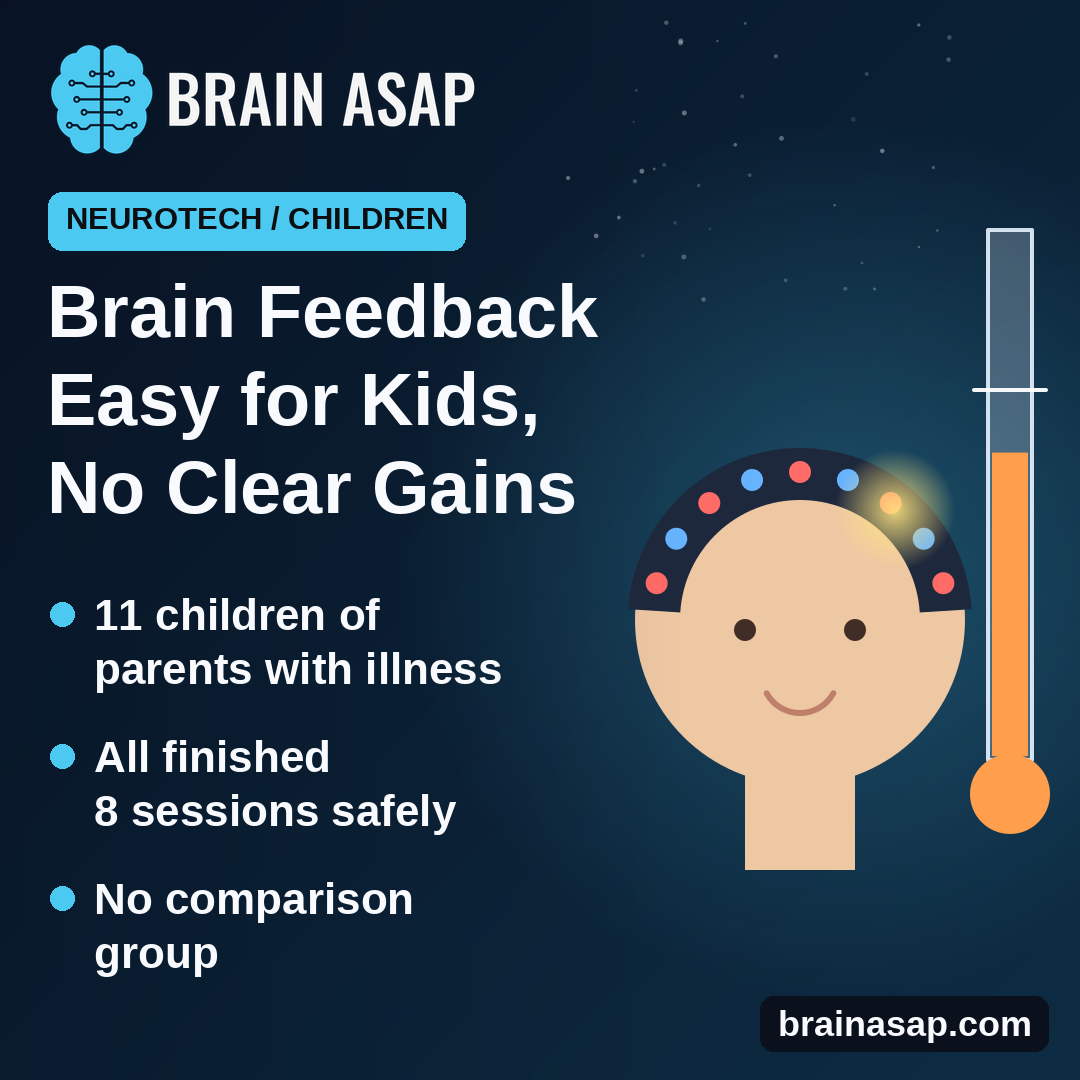
TL;DR: Eleven Indian children whose parents had addiction or serious mental illness all completed 8 sessions of brain-activity feedback training with no side effects. Their brain signals and thinking scores did not change clearly, and there was no comparison group.
Key Findings
- 11 children, aged 6 to 12: 9 had a parent with a substance use disorder; 2 had a parent with depression plus anxiety or psychosis.
- All finished: 88 sessions over 2 days, no reported side effects or discomfort.
- Target brain signal: Rose slightly across sessions, but not significantly.
- Thinking tests: Accuracy was higher afterward on several tasks, but none of the changes held up after statistical correction.
Source: Frontiers in Human Neuroscience (2026) | Saha et al.
Children who grow up with a parent struggling with addiction or a serious mental illness are more likely to have trouble with planning, focus and self-control. Could a simple brain-training game help strengthen those skills early?
Researchers at the All India Institute of Medical Sciences in Kalyani, India, ran a first small test of one such approach.
A Thermometer Driven by the Child’s Own Brain
The children wore a soft cap fitted with light sensors, a method called functional near-infrared spectroscopy (fNIRS). It tracks blood oxygen in the outer brain, a rough sign of how active an area is. The target was the right front side of the brain, a region involved in working memory and self-control.
On screen, a thermometer bar rose and fell with activity in that spot. Children tried to keep the bar above a line. They could use any mental trick they liked: 9 of 11 said they recalled happy memories, familiar places or test questions, and 2 imagined solving a Rubik’s Cube.
- 8 sessions, about 16 minutes each.
- 2 days, 4 sessions per day.
- Setup: 3 to 4 minutes per child.
Every Child Completed All 8 Sessions
The main aim was to see whether the setup was practical for young, at-risk children. It was. All 11 completed every session, and the researchers recorded no side effects, discomfort or invalid trials. The children were recruited through a parent’s stay in a hospital psychiatric unit. Of 20 families approached, 7 declined and 2 dropped out after the first testing visit.
Brain Signals Rose a Little, Then Connections Faded
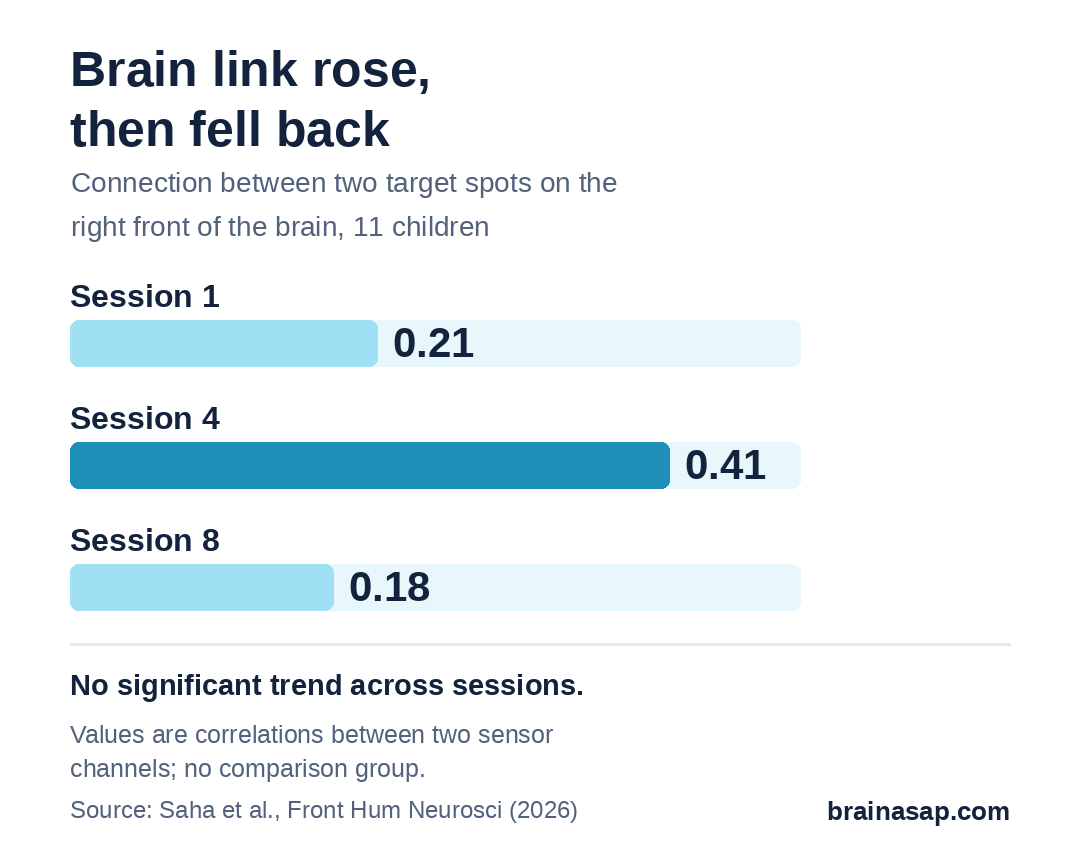
Activity in the target area crept upward over the sessions, but the trend fell just short of statistical significance. The link between the two target sensor spots strengthened by session 4, then weakened again by session 8.
Thinking Scores Moved, but Not Convincingly
Before and after training, children took a memory task, a color-word attention task called the Stroop test, and a reasoning puzzle test. Accuracy was higher on most tasks afterward. On the Stroop test’s hardest trials, accuracy went from 66% to 85%.
But none of the before-and-after changes survived the correction needed when running many comparisons. Children were also slower on the memory task afterward, not faster. A larger rise in brain activity went along with bigger Stroop gains, but that link was not significant either.
Without a Comparison Group, Gains Can’t Be Credited
- No sham training: Practice, attention from staff or simply growing older could explain any gains.
- Very small: 11 children, chosen for feasibility rather than statistical power.
- Short: All training packed into 2 days.
- Mixed family risks: Parents had different conditions.
A Fair Test Needs a Fake-Feedback Group
The study shows this kind of training can be run smoothly with young children from families under heavy strain, which is not a given. Whether it actually sharpens focus or self-control is still open. That requires a larger trial where some children get fake feedback, so the real training can be judged against it.
Citation: DOI: 10.3389/fnhum.2026.1936277. Saha T, Giri P, Nag R, et al. fNIRS-based neurofeedback targeting the right dorsolateral prefrontal cortex (dlPFC) in children at familial risk for substance use disorder and/or severe mental illness: a proof-of-concept study from eastern India. Front Hum Neurosci. 2026;20:1936277.
Study Design: Single-arm, uncontrolled pre-post proof-of-concept study.
Sample Size: 11 children aged 6 to 12; 88 sessions.
Key Statistic: Session-wise rise in target brain signal not significant (p = 0.058); no behavioral change survived Bonferroni correction.
Caveat: No control or sham group; very small sample; 2-day training.