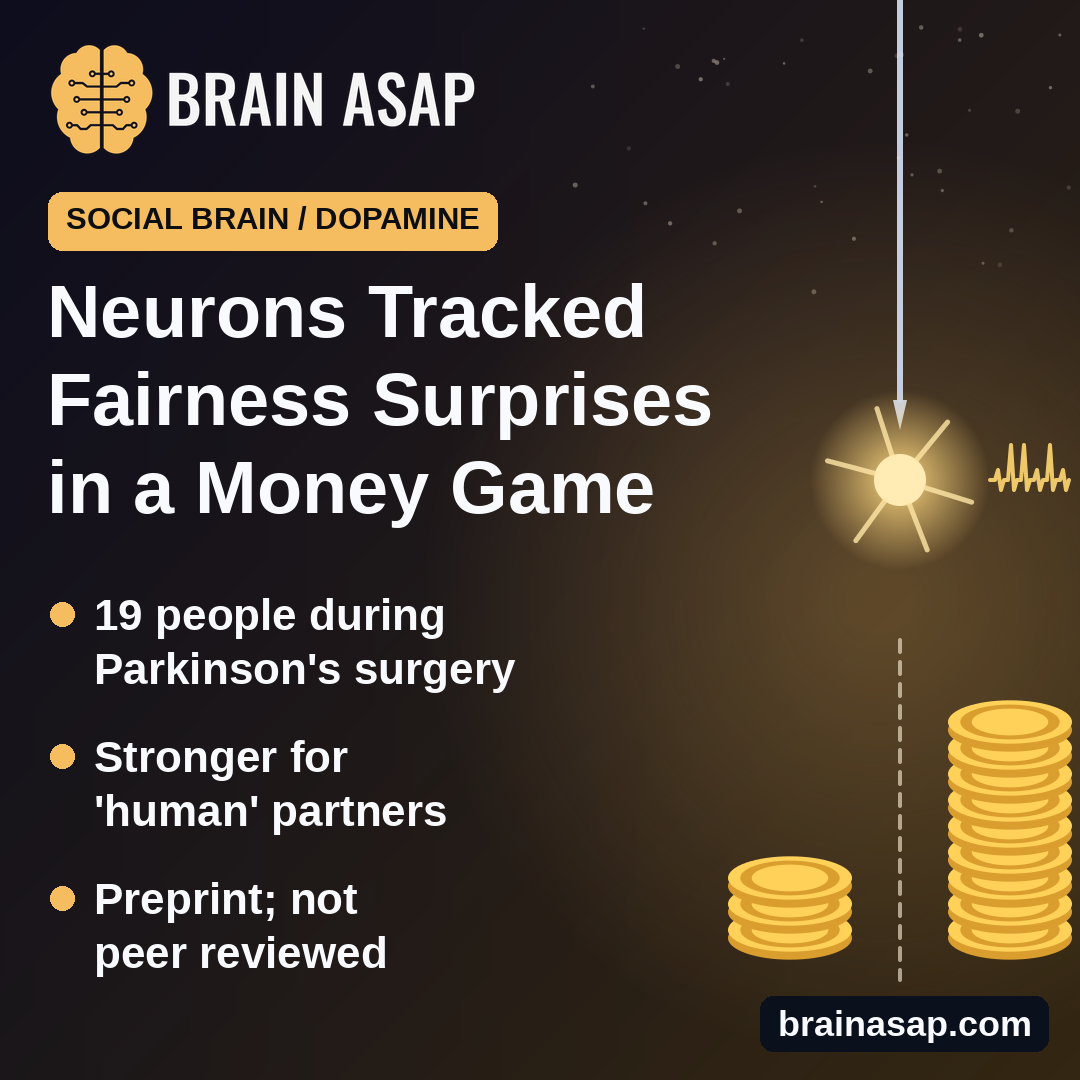
TL;DR: During Parkinson’s surgery, 19 people played a game where they accepted or rejected money splits. Dopamine-like neurons deep in their brains fired more when an offer beat what the person expected, and this signal was stronger when the offer seemed to come from a person rather than a computer.
Key Findings
- Better or worse than expected: 40 dopamine-like neurons fired more for offers above a person’s sense of fair.
- Stronger for “human” partners: The signal was significantly weaker for computer partners.
- Not just offer size: The signal held after accounting for how much money was offered.
- Higher expectations of people: Players expected fairer offers from human than computer partners.
- No mood signal: The neurons did not track how players said they felt.
Source: bioRxiv preprint (2026) | Davis et al.
If someone offers you $3 out of $20, you might turn it down just to make a point, even though $3 beats nothing. People carry an internal sense of what is fair, and they adjust it as they see how others behave.
A team at the Icahn School of Medicine at Mount Sinai in New York got a rare look at how single brain cells track those fairness surprises, by recording from people during brain surgery.
A Fairness Game Played on the Operating Table
The participants were 19 people with Parkinson’s, mostly men in their mid-60s, who were having deep brain stimulators implanted. Surgeons pass a fine recording electrode through the brain to find the right spot, which lets researchers listen to individual neurons.
While awake, participants played the ultimatum game. On each trial, a partner proposed how to split $20:
- Accept: Both sides get the proposed split
- Reject: Neither side gets anything
Offers ranged from $1 to $9. Some rounds came from pictures of “human” partners and others from a “computer” partner. The money was hypothetical.
Players Rejected Low Offers and Expected More From People
As in healthy younger adults, players rejected low offers more often and felt worse after rejecting. Overall rejection rates did not differ significantly between human and computer partners.
A learning model that tracks each person’s shifting sense of a fair offer fit their choices well. By that model, players started out expecting fairer offers from human partners than from the computer, about $15 versus $10 of the $20.
The difference between an offer and that internal expectation is called a norm prediction error: positive when an offer beats expectations, negative when it falls short.
Dopamine-Like Neurons Signaled “Better Than Expected”
The electrode passed through the substantia nigra, a midbrain region whose dopamine neurons are lost in Parkinson’s. Of 69 neurons recorded there, 40 had the slow firing and wide spikes typical of dopamine neurons.
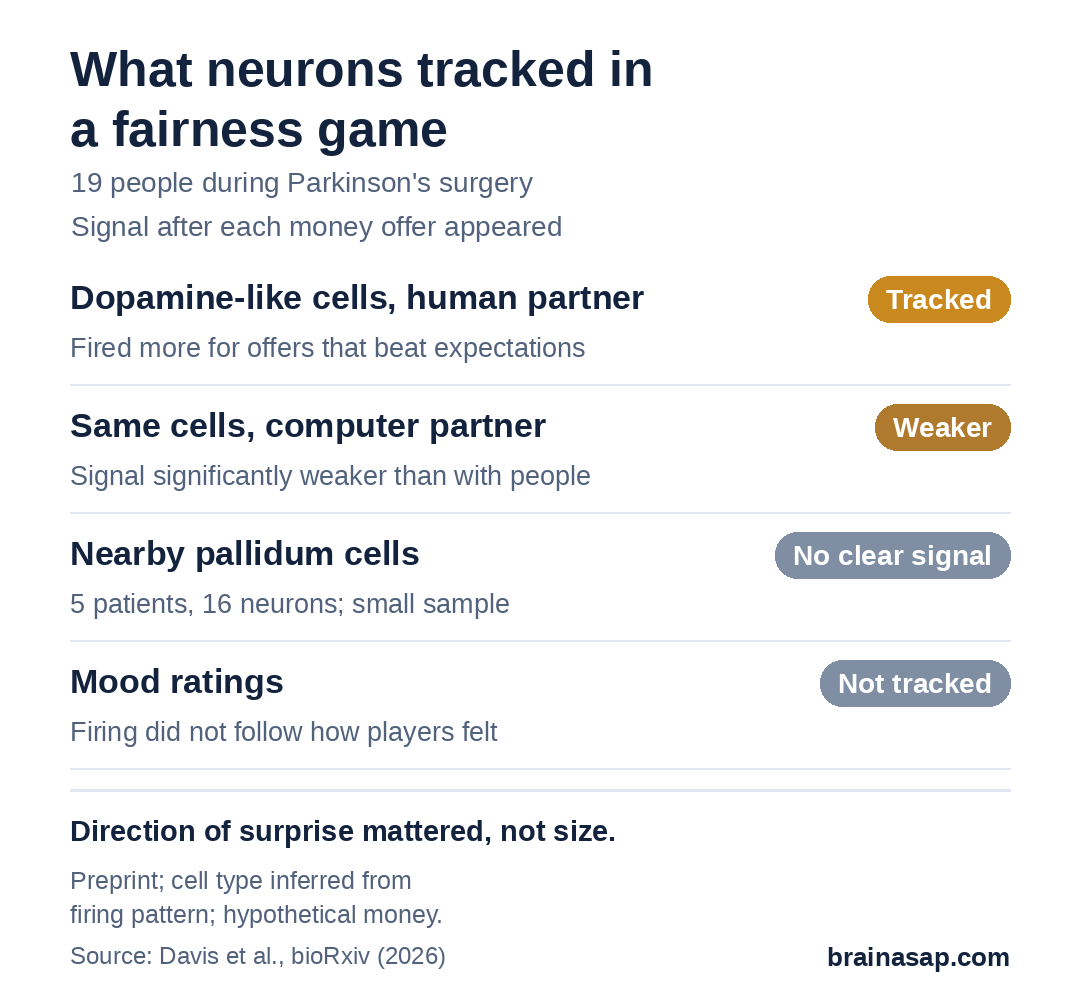
In the second after an offer appeared, these neurons fired more when the offer beat the player’s expectation than when it fell short. The size of the surprise did not matter, only its direction.
In a nearby region, the globus pallidus, neurons recorded from 5 other patients showed no significant signal.
Small Numbers and a Parkinson’s Brain
- Preprint: Not yet peer reviewed
- Few people and cells: 19 patients and 40 dopamine-like neurons; 6 game blocks with flat responses were excluded
- Cell type inferred: Neurons were labeled dopamine-like from their firing pattern, not confirmed chemically
- Parkinson’s brains: Patients were off their medication, and their dopamine systems were already depleted
- Mostly older men: 16 of 19 were men
- Uneven conditions: More human-partner rounds than computer rounds
- Pretend money and partners: No real payout or real people
How the Brain Learns Social Rules
Dopamine neurons are famous for signaling when rewards are better or worse than expected. This study hints that the same cells may also track social surprises, such as whether someone treated you more fairly than you anticipated.
The open question is whether this signal actually shapes how people update their sense of fairness, and whether it looks the same in brains without Parkinson’s.
Citation: DOI: 10.64898/2026.09.18.752742. Davis AN, Perl O, Kopell BH, et al. Single neurons in the human substantia nigra encode social learning signals. bioRxiv. Preprint posted September 20, 2026.
Study Design: Intraoperative single-neuron recordings during an iterated ultimatum game, with computational modeling of choices.
Sample Size: 19 Parkinson’s patients, 27 sessions, 40 putative dopamine neurons in the substantia nigra; comparison group of 5 patients in the globus pallidus.
Key Statistic: Prediction-error direction predicted firing in human-partner rounds (beta 0.19, 95% CI 0.05 to 0.34, p = 0.008); stronger than computer rounds (interaction p = 0.036).
Caveat: Not peer reviewed; small surgical sample; cell type inferred from waveforms; hypothetical money.