Astrocyte BMP Suppression Eased Fragile X Signals
TL;DR: In a fragile X mouse model, suppressing BMP signaling specifically in astrocytes reduced sound-triggered seizure severity and partially restored synaptic activity in the auditory cortex, a sound-processing region relevant to sensory over-responsiveness.
Key Findings
- BMP signaling was elevated in fragile X astrocytes: The study focused on bone morphogenetic protein signaling, a developmental pathway that was upregulated in FXS astrocytes.
- Smad4 conditional knockout made the test astrocyte-specific: Authors suppressed BMP signaling by deleting Smad4 in astrocytes rather than blocking the pathway across the whole brain.
- Audiogenic seizure severity fell in male FXS mice: The intervention improved a sensory-triggered seizure phenotype relevant to fragile X mouse models.
- Astrocyte transcriptomes and proteomes shifted toward normal: Metabolic, secretory, secreted-protein, and membrane-protein disruptions were mitigated when BMP signaling was suppressed.
- Auditory-cortex synaptic activity partly recovered: Astrocyte Smad4 deletion partially rescued synaptic activity in the sound-processing cortex.
Source: Nature Communications (2026) | Deng et al.
Fragile X syndrome starts with loss of FMRP, a protein needed for normal brain development and synaptic plasticity. Deng and colleagues found that astrocytes, the star-shaped support cells that help regulate synapses and the local brain environment, carried an overactive BMP signaling program in a fragile X mouse model.
The paper’s core question is simple and useful: if fragile X astrocytes carry an abnormal signaling program, can correcting that program improve brain function in a mouse model?
Fragile X Astrocytes Had an Overactive BMP Pathway
Fragile X syndrome is usually tied to loss of FMRP, a protein needed for normal synaptic development and plasticity. FMRP loss affects neurons, but astrocytes also respond to the altered brain environment and can shape how synapses mature.
The pathway highlighted here was bone morphogenetic protein signaling, usually shortened to BMP signaling. BMP proteins are better known for developmental patterning, but they also influence cell identity, gene expression, and how glial cells behave in the mature nervous system.
In fragile X astrocytes, BMP signaling was upregulated. That made it a plausible upstream control point rather than one more downstream abnormality in a long list.
The astrocyte angle is especially important for neurodevelopmental disorders because synapses are built inside a cellular neighborhood. Neurons provide the electrical signaling, but astrocytes help tune neurotransmitter balance, extracellular ions, metabolic support, and the molecules that tell synapses when to form or prune.
Smad4 Deletion Made the Experiment Cell-Specific
The authors did not simply give mice a broad BMP blocker. They generated a fragile X mouse model in which Smad4, a central BMP pathway signal-transducer, was conditionally knocked out in astrocytes.
BMP signaling affects many cell types, so a whole-brain pathway change would be difficult to interpret. An astrocyte-specific change asks whether astrocytes themselves are carrying part of the fragile X phenotype.
- FXS mouse model: carried the fragile X-related molecular background.
- Astrocyte Smad4 cKO: suppressed BMP signaling specifically in astrocytes.
- Auditory-cortex readout: tested synaptic activity in a sound-processing region relevant to sensory phenotypes in the model.
The abbreviation cKO means conditional knockout: a gene is deleted only in selected cells or conditions. Here, that selectivity is the whole point of the experiment.
Smad4 is a useful target because it sits downstream of multiple BMP signals. Deleting it does not identify one perfect drug target, but it tests whether reducing the pathway inside astrocytes can change the fragile X state.
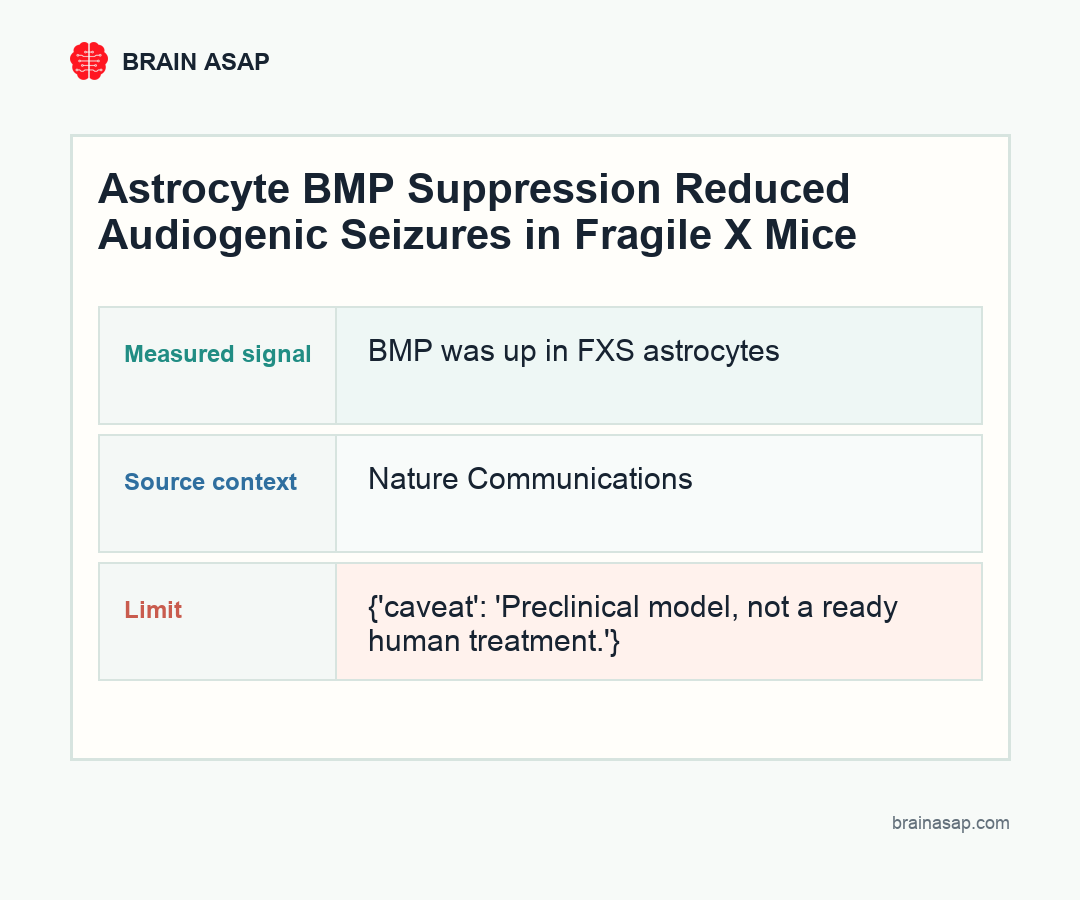
Audiogenic Seizures Gave the Rescue a Functional Test
Fragile X mice can show audiogenic seizures, meaning seizures triggered by sound. That phenotype is not the whole disorder, but it gives researchers a concrete functional outcome tied to sensory excitability.
Suppressing astrocyte BMP signaling reduced audiogenic seizure severity in male FXS mice. That connects an astrocyte molecular pathway to behavior rather than stopping at gene-expression changes.
The sex detail should not be glossed over. The reported seizure improvement was in male FXS mice, so future work needs to clarify how the pathway behaves by sex, developmental timing, and brain region.
Audiogenic seizures are especially relevant because fragile X biology often involves sensory over-responsiveness. A sound-triggered seizure phenotype gives researchers a way to test whether sensory circuits are easier to stabilize after astrocyte signaling is adjusted.
Transcriptomics and Proteomics Showed Different Astrocyte Layers
The authors profiled astrocytes with transcriptomic and proteomic approaches. Transcriptomics measures RNA, which indicates which genes are being expressed; proteomics measures proteins, which are often closer to what cells are actually doing.
In fragile X astrocytes, the disrupted programs included metabolic pathways, secretory machinery, secreted proteins, and membrane proteins. Those categories fit astrocyte biology because astrocytes regulate energy support, release signals, and help organize synaptic environments.
BMP suppression mitigated many of those molecular changes. RNA and protein signals did not perfectly overlap, which is useful rather than embarrassing: astrocyte disease biology can look different depending on whether researchers measure messages, machinery, or secreted products.
The secretory and membrane-protein findings are especially important for astrocytes. These cells do not only sit beside neurons; they release molecules, shape extracellular conditions, and help determine how synapses are built and maintained.
The combined RNA-protein approach is stronger than either layer alone. If the RNA profile says a pathway is disrupted but protein data show a different cellular bottleneck, the therapeutic target may sit closer to the protein machinery than to the transcript that first drew attention.
Synaptic Activity Partly Recovered in the Sound-Processing Cortex
The auditory cortex matters here because it processes sound, and fragile X mouse models can show sensory over-responsiveness and sound-triggered seizures. The paper reported a partial rescue of synaptic activity in this region after astrocyte BMP signaling was suppressed.
That result gives the seizure finding a circuit-level companion. The intervention did not only shift astrocyte RNA and protein profiles; it also changed activity at the neuron-to-neuron communication points in a sensory cortex tied to the behavioral readout.
The rescue was partial and circuit-specific, so it should not be described as a full correction of fragile X synapses. It supports a narrower claim: astrocyte BMP signaling influenced both molecular astrocyte state and synaptic function in a fragile X-relevant sensory circuit.
Astrocyte BMP Targeting Is Promising, Not a Fragile X Cure
The study is preclinical mouse work, and the intervention was genetically targeted. Translating that into a human therapy would require safe timing, cell specificity, dose control, and confidence that BMP suppression would not disrupt other developmental or repair functions.
The mechanistic contribution is specific: fragile X is often discussed as a neuronal synapse disorder, but this mouse study found that changing astrocyte BMP signaling improved astrocyte molecular profiles, reduced audiogenic seizure severity, and partially rescued auditory-cortex synaptic activity.
If the pathway holds up, future fragile X treatment research may need to treat neuron-astrocyte communication as part of the therapeutic map. Ignoring astrocytes could mean missing a control point that helps decide how fragile X circuitry behaves.
The next step is to learn whether BMP suppression helps because it changes astrocyte metabolism, secreted signals, synapse support, or all of those at once. That distinction will decide whether the best target is Smad4 itself, a downstream astrocyte program, or a narrower molecule released into the synaptic environment.
Future work also has to test timing. A pathway that helps during early development is plausibly risky to suppress broadly, while a later intervention window is plausibly safer if it mainly adjusts mature astrocyte support functions. That timing question is central for any fragile X therapy aimed at glial biology, especially in a disorder where early development and lifelong circuit function are both involved.
Paper: Suppression of astrocyte BMP signaling improves molecular signatures and functional deficits in a fragile X syndrome mouse model. Nature Communications. 2026. DOI: 10.1038/s41467-026-71919-6
Authors: Deng et al.
Study Design: Fragile X mouse mechanism study using astrocyte-specific Smad4 conditional knockout, transcriptomics, proteomics, audiogenic seizure testing, and synaptic-activity analysis in the auditory cortex.
Sample Size: Fragile X mouse model with astrocyte-specific genetic manipulation; exact group counts should be checked in the final formatted article.
Key Result: Astrocyte Smad4 conditional knockout reduced audiogenic seizure severity in male FXS mice and partially rescued synaptic activity in the auditory cortex.
Boundary: Mouse astrocyte BMP signaling explains a mechanism; a human fragile X treatment would still need safe timing, cell specificity, and dose control.