Baby Teeth Metals Linked to Child Brain and Behavior
TL;DR: A Science Advances study used naturally shed baby teeth as biological time capsules and found that higher early-life metal mixtures, especially during two postnatal windows, tracked with later behavioral symptoms and MRI signs of altered brain development.
Key Findings
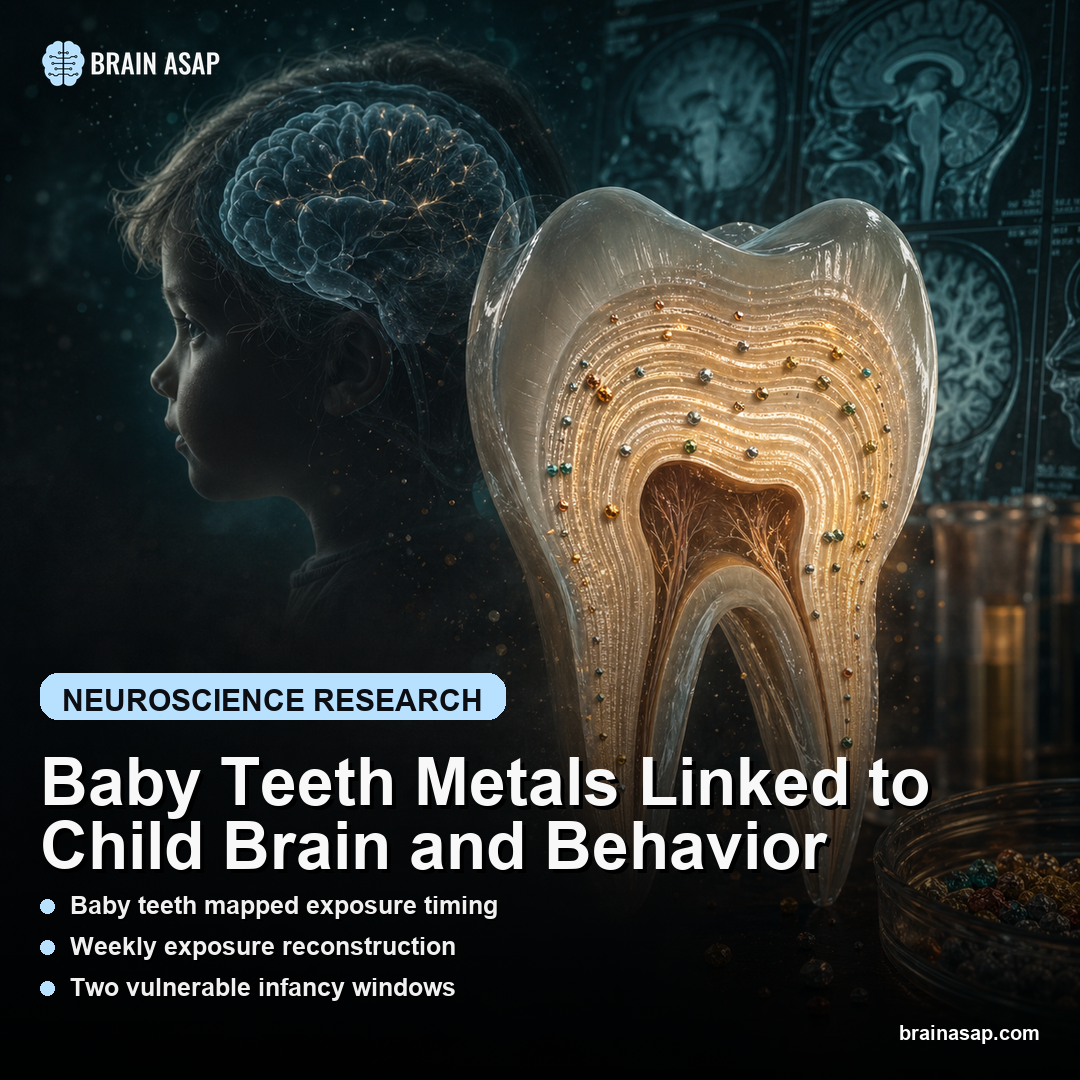
- Baby teeth mapped exposure timing: The study linked early-life metal exposure histories from baby teeth to behavioral ratings and MRI measures at ages 8 to 14.
- Weekly exposure reconstruction: Teeth were used to estimate nine metal concentrations from 20 weeks before birth through 40 weeks after birth.
- Two vulnerable infancy windows: Higher metal mixtures were most strongly tied to later behavioral symptoms during weeks 4 to 8 and weeks 32 to 42 after birth.
- Late-infancy behavior signal: In weeks 32 to 42, higher mixture exposure was associated with higher behavioral symptom scores (β = 0.15; 95% CI, 0.004 to 0.28).
- MRI moved with behavior: Higher exposure windows also tracked with smaller brain volume, reduced global network efficiency, and weaker white matter integrity.
Source: Science Advances (2026) | Rechtman et al.
Baby teeth usually arrive in a memory box, not a brain-imaging study. But they record chemistry with unusual precision: layer by layer, week by week, starting before birth. In this paper, that record became a timeline of environmental exposure that is plausibly lined up against adolescent behavior and MRI scans.
Baby Teeth Turned Exposure Into a Week-by-Week Timeline
The clever move in the study was methodological. Blood and urine can tell you something about current or recent exposure, but they are snapshots. Teeth are closer to a hard drive.
As a child’s teeth form, trace metals circulating in the body are incorporated into growth layers. The team used that structure to reconstruct exposure to a mixture of metals across a very specific window: 20 weeks before birth to 40 weeks after birth, when brain development does not move at one steady pace.
The children came from the PROGRESS birth cohort in Mexico City, a long-running study designed to connect early social and chemical exposures with later health. By adolescence, the researchers had three unusually valuable pieces of information for the same children: tooth-based exposure histories, parent-reported behavioral symptoms, and MRI measures of the brain.
The Strongest Windows Appeared After Birth
The headline result was not simply that metals were associated with child outcomes. It was that timing carried information. The strongest behavioral links appeared in early infancy, with one window around weeks 4 to 8 after birth and another around weeks 32 to 42.
Developmental risk is often framed mainly around pregnancy. Pregnancy matters, but the first year after birth is also a period of rapid brain growth, sensory learning, immune calibration, and circuit refinement, so exposure during narrow infancy windows may leave detectable traces years later.
The late-infancy association was the clearest numerical signal in the scanned material: higher metal mixture exposure during weeks 32 to 42 was linked with higher behavioral symptom scores, with a regression estimate of 0.15 and a 95% confidence interval from 0.004 to 0.28.
Only about 4% of children had scores in the clinical range, so the result should not be read as destiny. It points to small environmental shifts that may matter across a population.
MRI Changes Tracked the Same Metal-Exposure Windows as Behavior
The behavioral findings would be easier to dismiss if they sat by themselves. They did not. The same metal-exposure windows were also linked to MRI measures that point toward altered brain organization.
Children with higher early-life metal mixtures showed evidence of three converging MRI differences:
- Smaller brain volume: a broad structural signal rather than a single isolated region.
- Lower global efficiency: a graph-theory sign that information may move less easily through the brain network.
- Weaker white matter integrity: a marker of the organization of fiber tracts connecting distant brain regions.
The convergence across tooth chemistry, MRI, and behavior is what makes the study more than an exposure screen. It does not claim that metal exposure explains every behavioral symptom. It argues that early environmental chemistry, brain wiring, and later behavior can be measured in the same developmental pathway.
Nine Metals Were Modeled Together Instead of Treating Lead Alone
Lead gets most of the public attention, but real exposure does not arrive as one clean variable. Children encounter mixtures through food, drinking water, air, housing, soil, and the built environment.
Some metals are toxic at low levels. Others are essential nutrients but can still become disruptive when timing, dose, and balance go wrong.
The study treated the exposure profile as a mixture, which is closer to lived biology. That choice also makes interpretation harder. A mixture analysis can point to vulnerable windows and combined risk, but it cannot neatly say that one metal alone caused a specific MRI feature.
That limitation is not a flaw so much as the real problem. The developing brain is not exposed to a spreadsheet one column at a time. It is exposed to a chemical environment.
The Policy Message Is About Infancy, Not Panic
This is an observational cohort study, so it cannot prove that reducing one exposure during one exact week would prevent a later behavioral symptom. Families also should not read it as a reason to panic about a single test result or a single childhood exposure.
The policy message is different. If exposure timing matters, then environmental protection during pregnancy and infancy often need sharper windows than broad slogans about early life.
Reducing avoidable metals in water, food, housing, and consumer environments is not just a toxicology issue. It is a brain-development issue.
For clinicians, the study adds another reason to take environmental histories seriously when children present with attention, mood, or anxiety-related symptoms. For researchers, it shows why baby teeth may become a powerful archive for connecting early exposures to later brain outcomes.
The most memorable part is simple: a tooth that falls out at age six can still contain a chemical diary from infancy. This paper asks us to read that diary as part of the brain’s developmental record.
Why Teeth May Beat Questionnaires for Early Exposure
Environmental-health studies often depend on imperfect memory. A parent may know a child lived near traffic, used well water, or spent time in older housing, but they usually cannot reconstruct chemical exposure week by week during infancy. Teeth offer a different kind of evidence.
The tooth method is powerful because it creates a biological timeline instead of a retrospective estimate. That does not make it definitive.
It still needs careful calibration, and it captures metals incorporated into dental tissue rather than every exposure route directly. But it gives researchers a much sharper temporal lens than most early-life exposure studies can manage.
That sharper lens is what allowed the authors to move from a broad statement like “early metal exposure matters” to a more actionable question: which developmental weeks appear most sensitive?
Prevention is often won by timing. A narrow infancy window is easier to protect than an undefined childhood exposure span.
Paper: Fetal and postnatal metal metabolism-related changes in brain function are associated with childhood behavioral deficits. Science Advances. 2026;12(17):eadz1340. DOI: 10.1126/sciadv.adz1340
Authors: Rechtman et al.
Study Design: Prospective birth-cohort analysis linking tooth-based exposure reconstruction, behavioral assessment, and MRI.
Sample Size: 489 children aged 8 to 14 from the PROGRESS cohort.
Key Statistic: Higher metal mixture exposure in weeks 32 to 42 after birth was associated with higher behavioral symptom scores (β = 0.15; 95% CI, 0.004 to 0.28).
Important Caveat: The study was observational, so it can identify exposure windows and brain-behavior associations but cannot prove that one metal exposure caused a specific later symptom.