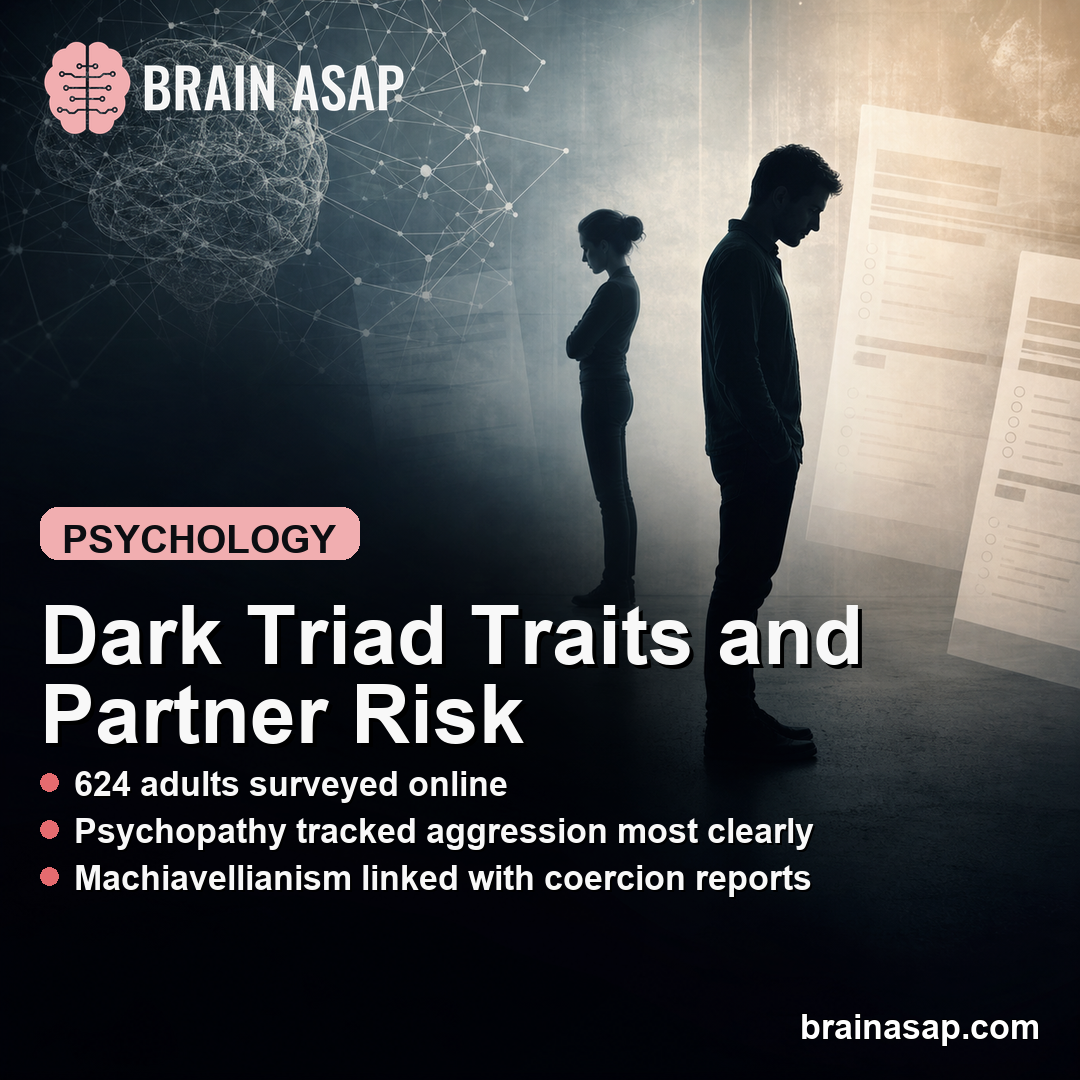
TL;DR: A 2025 study in Journal of Sex & Marital Therapy linked higher Dark Triad traits, a personality cluster covering psychopathy, narcissism, and Machiavellianism, with more aggressive relationship expectations and greater self-reported sexual coercion in a 624-person online survey.
Key Findings
- The survey included 624 adults: participants completed personality, attachment, relationship-expectation, and sexual-aggression questionnaires.
- Dark Triad traits were the main exposure: psychopathy, narcissism, and Machiavellianism were measured as related but distinct antagonistic personality traits.
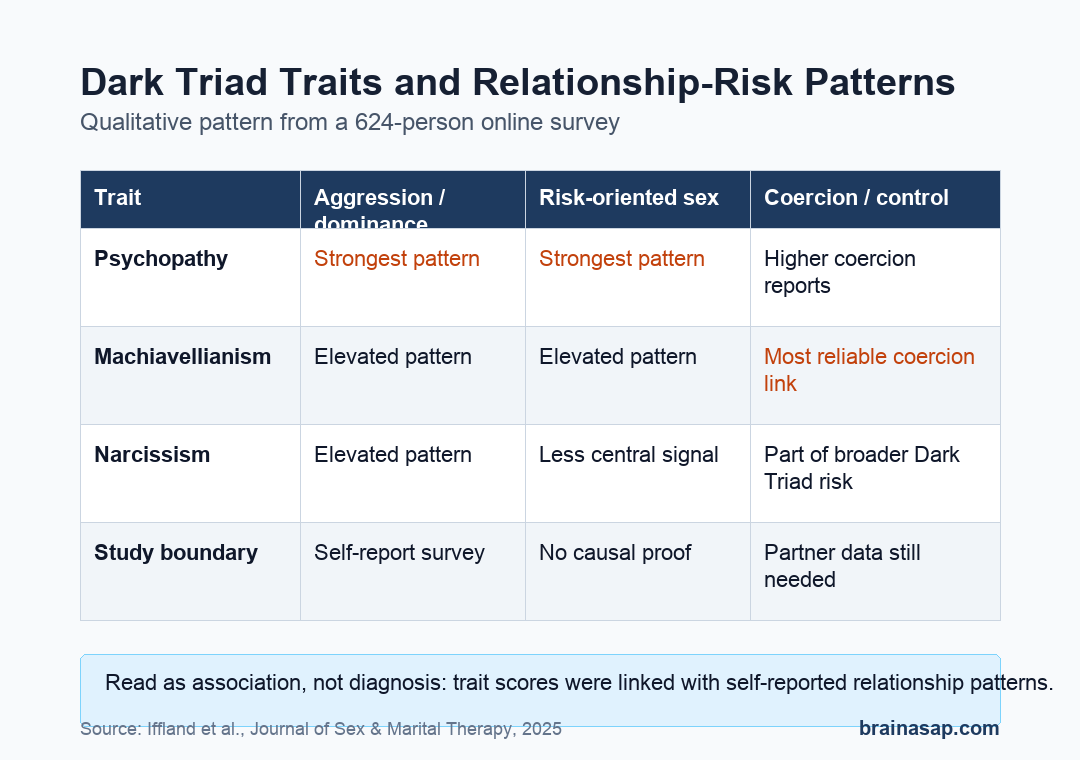
- Psychopathy showed the strongest relationship-pattern signal: higher psychopathy tracked most clearly with aggression, dominance, and adventurous or risky sexual expectations.
- Machiavellianism stood out for coercion: higher Machiavellianism was most reliably linked with self-reported sexual coercion toward a partner.
- The design was cross-sectional: the study shows associations in self-report data, not proof that personality traits caused the relationship behaviors.
Source: Iffland et al. Journal of Sex & Marital Therapy. 2025.
Researchers Measured Dark Triad Traits in Relationship Context
The study focused on whether Dark Triad personality traits map onto specific expectations inside romantic relationships. Dark Triad is shorthand for three traits that involve callousness, self-focus, or strategic manipulation.
Psychopathy refers to impulsivity, low empathy, and antisocial tendencies. Narcissism refers to grandiosity, entitlement, and sensitivity to admiration or rejection. Machiavellianism refers to calculated manipulation used to gain or keep control.
Those labels can sound broad, so the researchers paired personality measures with relationship-specific questionnaires. They wanted to know whether antagonistic traits were connected with patterns such as aggression, dominance, sexual expectations, anxious closeness, and coercive behavior.
The sample included 624 adult participants recruited for an online survey. Most participants were women, and the average age was in the late twenties.
Participants completed several self-report measures:
- Personality traits: questionnaires measured psychopathy, narcissism, and Machiavellianism.
- Relationship personality: items measured how participants expected to behave with intimate partners, including aggression and dominance.
- Attachment-related closeness: questions assessed anxious dependency, separation distress, and emotional merging.
- Sexual aggression history: participants reported whether they had used coercive tactics or experienced them from a partner.
The design goes beyond asking whether someone endorsed a personality label. It tracks how those traits appeared in the narrower setting where conflict, intimacy, and control are most consequential.
Psychopathy Tracked Most Strongly With Aggressive Relationship Expectations
Higher Dark Triad scores were associated with a more combative relationship style. Participants with higher scores were more likely to report expectations involving physical aggression, provocation, dominance, and rude behavior.
Among the three traits, psychopathy showed the strongest link with this aggressive relationship pattern. That fits the trait definition because psychopathy includes impulsivity, reduced empathy, and weaker behavioral restraint.
The same trait also stood out for sexual expectations. Higher psychopathy was linked with stronger preference for adventurous, risky, or less conventional sexual experiences.
That result should not be read as saying novelty-seeking is inherently harmful. The clinical point is narrower: in this sample, the novelty-and-risk pattern appeared alongside aggression, dominance, and other antagonistic relationship features.
The relationship-style findings separated into three broad domains:
- Aggression and dominance: higher antagonistic traits tracked with more conflict-oriented partner expectations.
- Risk-oriented sexuality: psychopathy was especially connected with adventurous or risky sexual preferences.
- Control and closeness: Machiavellianism showed a different pattern, with anxious closeness as well as coercion-related behavior.
The split argues against treating the Dark Triad as one interchangeable risk label. The three traits overlapped, but they did not point to exactly the same relationship profile.
Machiavellianism Was Most Linked With Sexual Coercion Reports
The sexual-coercion section asked participants whether they had used tactics such as pressure, force, or a partner’s inability to resist to obtain sexual activity. Those items are sensitive, and self-report likely underestimates some behavior.
Even with that limitation, higher Dark Triad traits were linked with higher self-reported perpetration of sexual coercion. Machiavellianism was the most reliable predictor in that part of the analysis.
The association is clinically plausible because Machiavellianism centers on strategic manipulation. A person high in this trait may use guilt, false promises, pressure, or power differences to get what they want from a partner.
The study also found overlap between people reporting perpetration and victimization. Many participants who said they had used coercive tactics also reported that a partner had used coercive tactics against them.
There are several possible explanations, and the survey cannot choose between them:
- Mutual conflict: some relationships may include reciprocal coercion, aggression, or retaliation.
- Selection effects: people with manipulative or hostile traits may repeatedly enter high-conflict relationships.
- Perception differences: people high in control-related traits may interpret partner behavior through a more suspicious or coercion-focused lens.
The safest reading is not that every self-report reflects the same situation. It is that coercion risk and coercion exposure clustered together in a subgroup with more antagonistic relationship traits.
Anxious Closeness Complicated the Control Picture
Machiavellianism was also associated with anxious closeness. That can sound contradictory because Machiavellian behavior is often described as cold or detached.
The study’s interpretation is more specific. Some people may seek closeness not mainly for emotional security, but to monitor, influence, or control a partner.
In that context, separation distress could reflect mistrust as much as attachment need. A person may want constant access to a partner because distance reduces control.
Therapy and risk assessment need that distinction. A partner’s intense closeness demand can look like dependency, but the same behavior may also function as surveillance, jealousy, or manipulation.
Relationship assessment should therefore separate at least three issues:
- Need for reassurance: does the person fear abandonment and seek comfort?
- Need for control: does the person use closeness to monitor, restrict, or pressure a partner?
- Conflict response: does distress turn into aggression, coercion, or retaliation?
Those distinctions keep the interpretation concrete. They also prevent the common mistake of treating “toxic relationship” as a diagnosis rather than a loose public label.
The Survey Cannot Prove Personality Caused Partner Harm
The main limitation is the cross-sectional survey design. All measures were collected at one time, so the study cannot prove that Dark Triad traits caused aggression or coercion.
Self-selection is another important boundary. The recruitment language referenced toxic relationships, which likely drew people with unusually difficult romantic histories.
The sample also had a high proportion of women and a high rate of reported sexual victimization. Those features limit how directly the results can be generalized to the wider population.
Self-report adds another layer. People often underreport behavior that is socially unacceptable, illegal, or shameful. People high in manipulative traits can also describe themselves or their partners in biased ways.
Still, the study gives clinicians and researchers a useful map. It suggests that aggression, dominance, anxious control, and sexual coercion should be assessed directly when antagonistic traits appear in a relationship history.
Future work would be stronger if it studied both members of a couple, followed relationships over time, and used behavioral or partner-report measures alongside questionnaires.
Citation: DOI: 10.1080/0092623x.2025.2557475. Iffland et al. The Dark Triad and Relationship Expectations: Attempting an Empirical Approach to Study Toxic Relationships. Journal of Sex & Marital Therapy. 2025.
Study Design: Cross-sectional online survey.
Sample Size: 624 adults.
Key Statistic: Psychopathy showed the strongest relationship with aggressive and dominance-oriented expectations, while Machiavellianism was most reliably linked with self-reported sexual coercion.
Caveat: The study relied on self-report and cannot prove that personality traits caused later relationship harm.