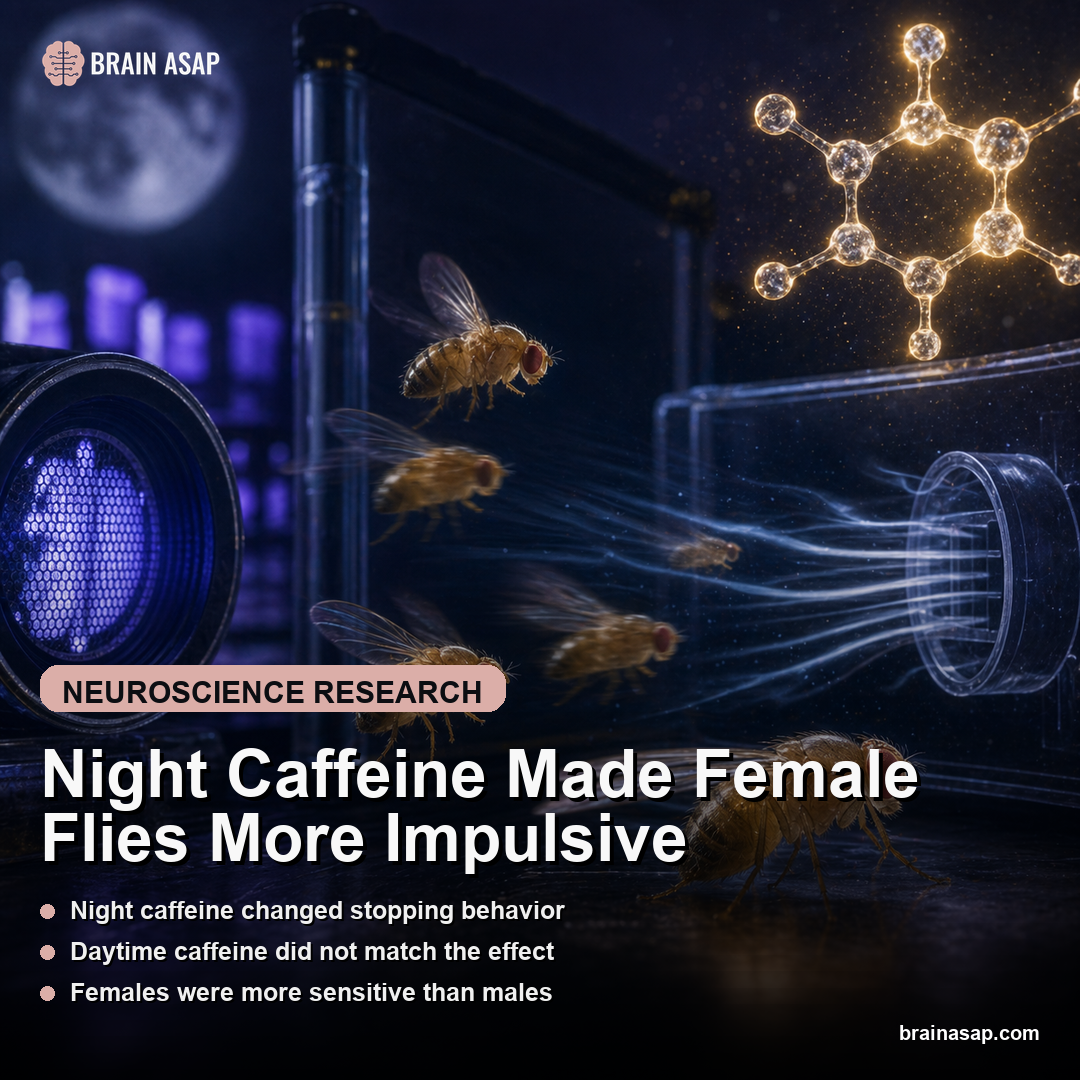
TL;DR: In Drosophila melanogaster, caffeine consumed at night impaired inhibitory control in an airflow task, especially in females. The effect was not explained by simple hyperactivity or sleep deprivation, and the study points to dopamine signaling in mushroom-body circuits as part of the mechanism.
Key Findings
- Nighttime caffeine impaired stopping behavior: flies kept moving under strong airflow, a stimulus that normally suppresses movement.
- Daytime caffeine did not match the effect: the result depended on when caffeine was consumed, not just whether caffeine was present.
- Females were more sensitive than males: females showed stronger caffeine-induced motor impulsivity despite comparable caffeine exposure.
- Sleep loss and hyperactivity were tested: walking speed was unchanged, and artificial sleep deprivation did not reproduce the same inhibitory-control deficit.
- Dopamine signaling was required: the paper highlights dopamine receptor signaling in mushroom-body α/β and γ lobes as part of the effect.
Source: iScience (2025) | Saldes et al.
Caffeine is often treated as a simple alertness tool: drink it, feel more awake, keep going.
This iScience paper shows why timing and biology can make that picture too simple.
In fruit flies, nighttime caffeine changed the ability to stop moving when stopping would normally be the appropriate response.
The study is not saying late coffee makes humans reckless in a one-to-one way.
It is a fruit-fly model.
But it does show that caffeine’s behavioral effects can depend on circadian timing, sex, and dopamine-linked inhibitory control.
An Airflow Task Measured Whether Flies Could Stop Moving
The behavior at the center of the study was motor impulsivity . Three details anchor the result:
Motor impulsivity means acting or continuing to act when inhibition would be more appropriate. In this experiment, the action was movement under an unpleasant airflow stimulus.
Fruit flies normally reduce movement when exposed to strong airflow. The airflow is aversive, meaning the animal treats it as something to avoid.
A fly with intact inhibitory control should suppress movement under that condition. After consuming caffeine at night, flies were less able to suppress movement.
They continued moving or flying despite the airflow cue.
That is why the authors describe the behavior as impulsive: the animals failed to hold back an action when the environment was telling them to stop.
This is a cleaner behavioral readout than simply asking whether caffeine made flies move more. The key test was not “did caffeine increase activity?” It was “did caffeine weaken the stop readout?”
Night Caffeine Was Different From Day Caffeine
The day-night contrast is the core of the paper. Flies given caffeine during the day did not show the same inhibitory-control deficit. The effect appeared when caffeine was consumed at night.
The result points to circadian timing. Circadian rhythms are internal biological rhythms that follow roughly a 24-hour cycle.
They affect sleep, metabolism, hormone signaling, neural excitability, and behavior. A drug can have different effects depending on the biological time at which it is taken.
The study therefore argues against a flat “caffeine equals impulsivity” interpretation. Caffeine interacted with the nighttime state of the nervous system. The same stimulant entered a different biological context.
That detail is especially relevant because people who use caffeine at night often do so in demanding settings, including shift work, health care, transportation, studying, and military operations.
The human implications need direct human testing, but the timing principle is worth taking seriously.
The Effect Was Not Just Hyperactivity or Sleep Loss
A weaker study would have stopped after showing that caffeinated flies moved under airflow. This study went further by testing two obvious alternative explanations: hyperactivity and sleep deprivation.
- Walking speed stayed stable: the caffeine effect was not just a broad increase in movement.
- Artificial sleep loss did not copy the result: light or mechanical sleep deprivation did not produce the same inhibitory-control deficit.
- The stop readout weakened: the behavioral change was specific to suppressing movement under aversive airflow.
If caffeine simply made flies hyperactive, then the airflow result would be less specific.
But the paper reports that walking speed was unchanged.
The flies were not moving faster across the board; they were specifically worse at suppressing movement when airflow made stopping adaptive.
If the result came from sleep loss, then artificial sleep deprivation should create a similar deficit.
The researchers tested sleep deprivation through light or mechanical stimulation, but those manipulations did not elicit the same inhibitory-control problem.
Those controls make the result more informative.
Night caffeine appeared to impair behavioral inhibition in a way that could not be reduced to “the flies were more active” or “the flies were tired.”
Female Flies Were More Sensitive Despite Similar Caffeine Exposure
The sex difference is one of the most important parts of the study.
Female flies showed stronger nighttime caffeine-induced impulsivity than males.
According to the university summary, both sexes had similar caffeine levels, so the difference was not simply that females received more caffeine internally.
The result should not be copied directly onto women drinking coffee.
Fruit flies do not have human social context, human sleep schedules, human metabolism, or human hormones in the same way people do.
But the finding is still helpful.
A tractable model organism can reveal sex-specific biology that would be difficult to isolate in people.
The authors note that flies do not have human hormones like estrogen, which suggests that other genetic or physiological factors can help explain the heightened female sensitivity.
For neuroscience, the valuable result is direct: sex changed a stimulant’s behavioral effect even when the exposure looked similar.
Dopamine Signaling Linked Caffeine to Inhibitory Control
The mechanism points toward dopamine, a neurotransmitter involved in movement, motivation, reward, learning, and action selection. A neurotransmitter is a chemical readout that neurons use to communicate.
The paper reports that dopamine signaling was required for caffeine-induced impulsivity. More specifically, it highlights the dDA1/Dop1R1 dopamine receptor in mushroom-body α/β and γ lobes.
The mushroom bodies are paired structures in the fruit-fly brain that are important for learning, memory, and behavioral control.
They are not human brain regions, but they are experimentally powerful because researchers can manipulate defined circuits and test behavior.
That mechanism makes the result more than a caffeine curiosity.
It connects nighttime stimulant exposure to a specific neural-control system.
The fly failed to stop because caffeine altered signaling in circuits that help regulate action.
Night-Shift Caffeine Needs Human Impulse-Control Studies
“Do not drink coffee at night” is too blunt for this study. The study was in fruit flies, and the outcome was a specific airflow-linked motor-inhibition task.
The more helpful human test is whether nighttime caffeine changes inhibitory control under fatigue, stress, or high-stakes work conditions.
That test is relevant for people who use caffeine after dark to stay functional: nurses, physicians, drivers, emergency workers, students, caregivers, security personnel, and military workers.
The study also separates alertness from control. Feeling more awake does not automatically mean the nervous system is better at stopping an action at the right moment.
Future human studies would need to measure caffeine timing, sex, sleep loss, circadian phase, dose, metabolism, attention, and impulse-control tasks.
They would also need to separate feeling alert from making better decisions.
A person can feel awake while still having altered inhibition.
In a controlled fly model, nighttime caffeine impaired inhibitory control through a circadian- and sex-sensitive mechanism involving dopamine signaling.
That is enough to justify more careful research on when caffeine is used, not just how much is used.
What the fly result separates:
- Wakefulness: Caffeine can increase arousal without improving every control process.
- Stopping behavior: The key deficit was failure to suppress movement during aversive airflow.
- Translation limit: The experiment identifies a fly circuit mechanism, not a direct human caffeine rule.
Citation: DOI: 10.1016/j.isci.2025.113197. Saldes et al. Nighttime caffeine intake increases motor impulsivity. iScience. 2025;28(8):113197
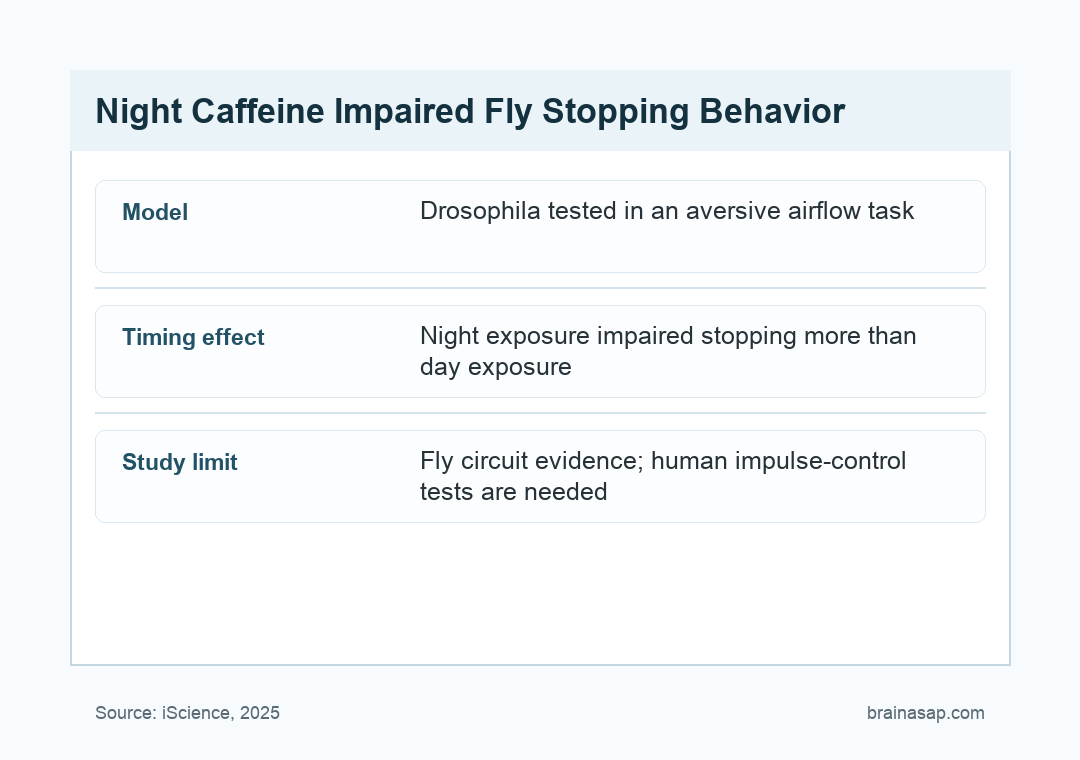
Study Design: Drosophila melanogaster behavioral study testing caffeine dose, day versus night exposure, sex, sleep deprivation controls, locomotion, and dopamine-linked circuit mechanisms.
Sample/Model: Fruit flies tested in an aversive airflow assay measuring movement suppression.
Key Statistic: Nighttime caffeine impaired inhibitory control, with stronger effects in females; daytime caffeine, hyperactivity, and artificial sleep deprivation did not explain the pattern.
Caveat: The study identifies a mechanism in fruit flies; human caffeine timing would need direct sleep, dopamine, and impulse-control testing.