TL;DR: A 2025 study in Communications Biology found that a week-long mind-body retreat shifted brain-network, plasma-protein, metabolomic, and cell-growth measures, but the uncontrolled design keeps the result exploratory.
Key Findings
- Healthy retreat attendees were measured: The 20 participants were sampled from 561 retreat attendees and measured before and after the intervention.
- 33 hours meditation: The retreat included about 33 hours of guided meditation plus lectures and group healing rituals.
- DMN and salience decreased: Meditation decreased functional integration in the default mode network (p=0.00009) and salience network (p=0.000003).
- Neurites grew more: Post-intervention plasma increased in vitro neurite outgrowth in PC12 assays (p=0.01).
- BDNF and metabolism shifted: Analyses found BDNF pathway upregulation (p=0.001), glycolytic metabolism enhancement (p=0.008), and tryptophan metabolism modulation (pFDR=0.03).
Source: Communications Biology (2025) | Jinich-Diamant et al.
Mind-body research often gets trapped between hype and dismissal.
This study is more informative than either: a 7-day retreat produced measurable brain and blood-linked changes, while the design keeps the causal claim deliberately narrow.
A Retreat Study That Measured More Than Mood
The intervention combined lectures about reconceptualization, guided meditation, and open-label placebo-style healing rituals. The participants were healthy adults, not patients being treated for a diagnosed disorder.
What makes the study unusual is the measurement stack.
The team used functional MRI (fMRI), a scan that tracks blood-flow changes as a proxy for brain activity, plasma proteomics, metabolomics, exosome miRNA transcriptomics, neurite growth assays, and real-time cellular metabolism assays before and after the retreat.
- Brain state: fMRI measured large-scale network organization during meditation.
- Blood measures: proteomic, metabolomic, and exosome analyses tracked circulating molecular changes.
- Cell assays: post-retreat plasma was tested for effects on neurite growth and cellular metabolism.
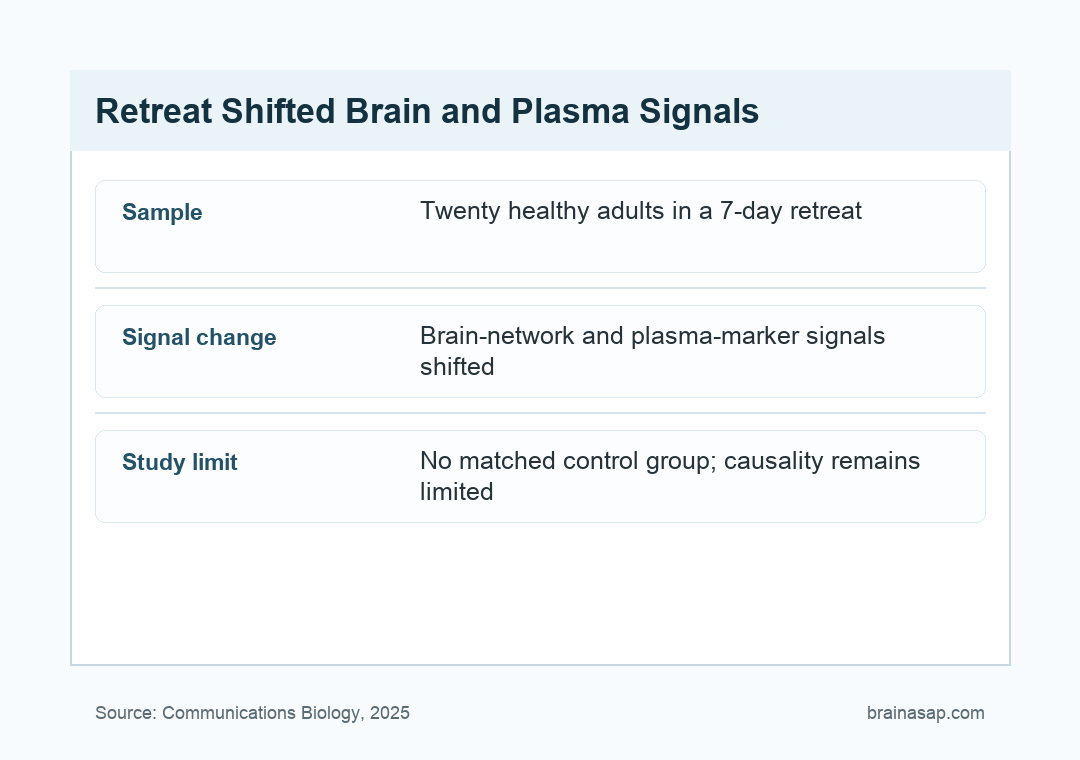
- Design limit: all of those readouts came from a pre-post retreat design without a matched control group.
The stack is valuable because mind-body interventions rarely stay inside one biological lane. Attention, prediction, stress physiology, sleep, immune signaling, and metabolism can all change together during an intensive retreat.
Meditation Made Large-Scale Networks Less Modular
During meditation, the default mode and salience networks showed lower functional integration, and whole-brain modularity decreased. In network terms, the brain looked less partitioned into separate communities during the measured meditative state.
The paper interprets that as a shift in how the brain engages self-reference, salience, interoception, and prediction. That is a neural-state finding, not proof that the retreat permanently rewired the brain.
The default mode network is often linked to self-referential thought, while the salience network helps prioritize internal and external measures.
A shift in both networks fits a meditation context where attention, body awareness, and appraisal are deliberately trained.
Post-Retreat Plasma Changed Cells in a Dish
The blood-based assays gave the study its second layer. Plasma collected after the retreat increased neurite outgrowth in PC12 cells, enhanced glycolytic metabolism, and shifted BDNF-associated proteins.
Those assays are indirect but intriguing. They suggest that circulating factors changed enough after the retreat to alter cell behavior under controlled lab conditions.
PC12 cells are a laboratory model often used to study neurite extension, the growth of neuron-like projections.
A plasma effect in that assay is not evidence that new neurons grew in participants’ brains; it shows that the post-retreat blood environment changed a growth-related readout.
The Biology Was Broad, Which Is Both Strength and Problem
The paper reports changes in inflammatory, anti-inflammatory, endogenous opioid, tryptophan metabolism, and neurotransmission-associated exosome miRNA pathways. Breadth is exciting because mind-body interventions plausibly work through multiple systems.
Breadth is also risky because a small pre-post study can generate many measures.
Without a matched control group, it cannot cleanly separate meditation, expectation, retreat environment, sleep, diet, social bonding, novelty, or time away from normal life.
Those factors can all move biology. Sleep can alter inflammatory markers and metabolism, diet can shift plasma metabolites, social context can change stress physiology, and expectation can shape autonomic and endocrine responses.
A Serious readout With a Control-Group Hole
The authors are explicit about logistical limitations and the lack of age- and gender-matched controls. That caveat should travel with the headline wherever the study is discussed.
The best reading is neither credulous nor dismissive.
The retreat produced measurable short-term neural and molecular shifts; the next test is which ingredients caused which changes, how long they last, and whether they matter clinically.
A retreat also changes sleep schedule, diet, social exposure, exercise, expectancy, and time away from work.
Those ingredients are not nuisances; they are plausible biological inputs that need to be separated before a meditation-specific mechanism can be claimed.
Three controls would sharpen the next study:
- Matched retreat control: compare the same setting without the meditation or reconceptualization component.
- Meditation-only arm: separate formal practice from diet, sleep, social context, and expectancy.
- Longer follow-up: test whether fMRI and plasma changes persist after participants return to normal routines.
The control problem is therefore scientific, not dismissive.
A matched retreat without the meditation component, or meditation delivered without the full retreat context, would help identify which ingredients drove the fMRI and plasma shifts.
How to Read the Mind-Body Retreat Evidence
The evidence base here is best described as exploratory observational pre-post study of a 7-day retreat combining meditation, reconceptualization, and open-label placebo-style healing rituals.
Because sleep, diet, expectation, social context, and stress physiology can all move during a retreat, the design supports biological measurement more strongly than ingredient-level causality.
The sample also sets the boundary: 20 healthy adults randomly selected from 561 retreat participants; 14 female, mean age 46.35 years; fMRI analyses used n=19 and exosome transcriptomics used n=16.
In this small retreat sample, the biological measurements show short-term change but cannot separate meditation from sleep, diet, expectation, or the retreat setting.
The most helpful numerical anchor is this: meditation decreased default mode connectivity (p=0.00009), salience network connectivity (p=0.000003), and whole-brain modularity (p=0.001), while post-retreat plasma increased neurite outgrowth (p=0.01).
Those numbers support short-term biological change, not a clinical efficacy claim.
The healthy-adult sample also matters. The findings cannot be assumed to apply to depression, anxiety, chronic pain, cognitive decline, or inflammatory disease without trials in those groups.
The measured pathways still give those future trials targets.
If a clinical study tests a similar retreat in patients, it can predefine default-mode connectivity, salience-network integration, BDNF-linked proteins, tryptophan metabolism, and neurite-assay effects rather than fishing broadly after the fact.
Where the Jinich-Diamant Result Fits Next
The larger value is measurement breadth without clinical overclaiming.
The study shows that an intensive retreat can leave measurable signatures across fMRI and plasma assays, while also showing exactly why controlled follow-up matters.
The next step is controlled dismantling: meditation alone, reconceptualization alone, ritual context, social setting, retreat diet, sleep, and expectation all need to be separated before the biology can be assigned to any one ingredient.
Durability is the other missing piece.
A one-week shift in network organization or plasma signaling could fade quickly, or it could mark the beginning of a longer adaptation if practice continues.
Follow-up sampling would decide which interpretation fits.
Clinical meaning would also require symptom or function endpoints.
A molecular shift becomes more persuasive when it travels with sleep quality, mood, pain, cognition, inflammatory symptoms, or another outcome patients can feel.
For now, the most defensible claim is that the retreat changed measurable states across brain networks and circulating biology.
The clinical test remains whether those state changes can be reproduced, assigned to specific practices, and linked to durable benefits.
Citation: DOI: 10.1038/s42003-025-09088-3. Jinich-Diamant et al. Neural and molecular changes during a mind-body reconceptualization, meditation, and open label placebo healing intervention. Communications Biology. 2025;8:1525
Study Design: Exploratory observational pre-post study of a 7-day retreat combining meditation, reconceptualization, and open-label placebo-style healing rituals.
Sample/Model: 20 healthy adults randomly selected from 561 retreat participants; 14 female, mean age 46.35 years; fMRI analyses used n=19 and exosome transcriptomics used n=16.
Key Statistic: Meditation decreased default mode connectivity (p=0.00009), salience network connectivity (p=0.000003), and whole-brain modularity (p=0.001), while post-retreat plasma increased neurite outgrowth (p=0.01).
Caveat: Single-study evidence; interpret with the source design and sample.