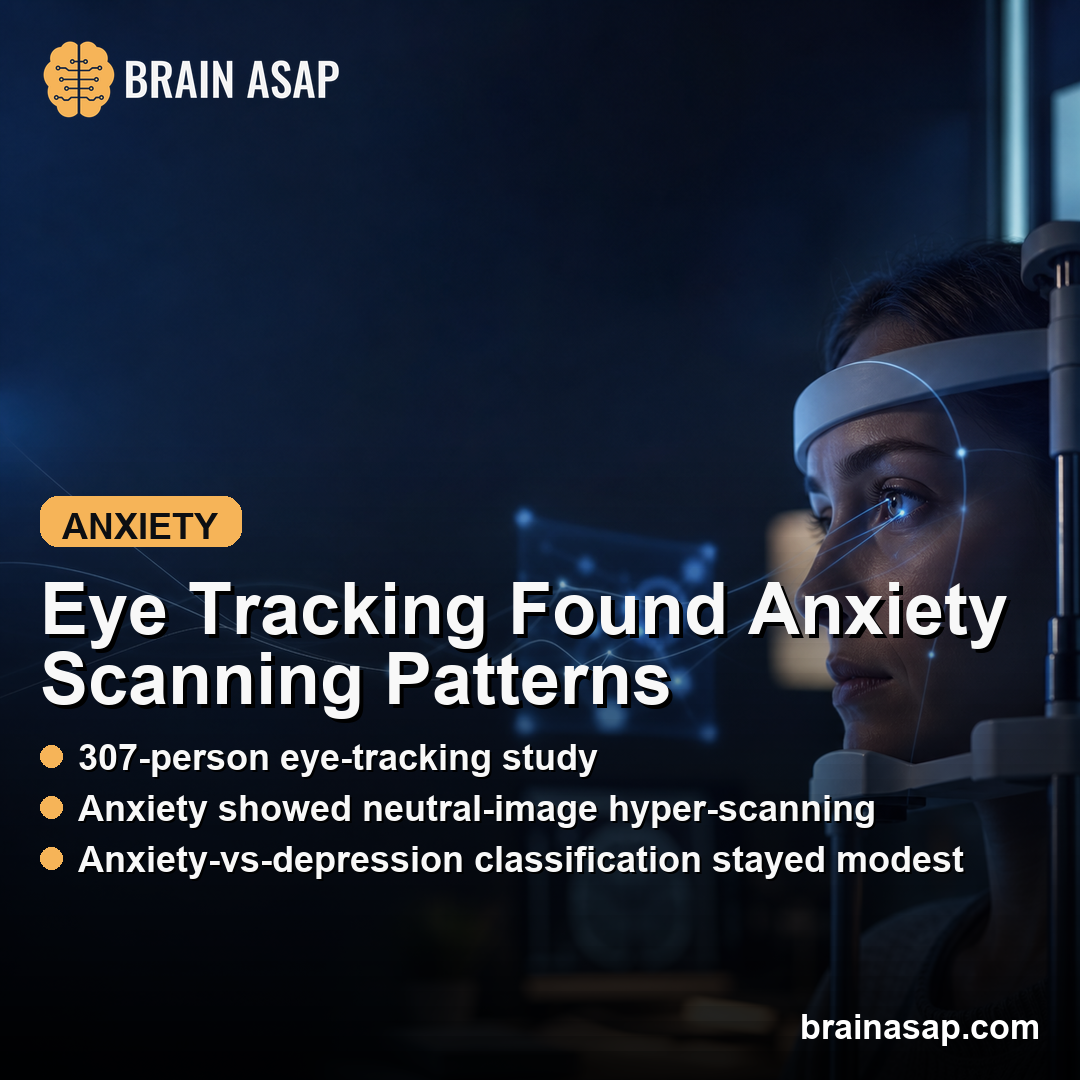
TL;DR: A 2026 study in The British Journal of Psychiatry found that people with anxiety disorders showed hyper-scanning during neutral image viewing and hyper-pursuit during moving-dot tracking, suggesting that eye-tracking could capture measurable patterns of anxiety-related vigilance.
Key Findings
- 307-person sample: Researchers compared 91 patients with anxiety disorders, 118 with depressive disorders, and 98 healthy controls.
- Neutral viewing still differed: The anxiety group made more fixations and saccades, with longer scan paths, even while looking at neutral images rather than threat pictures.
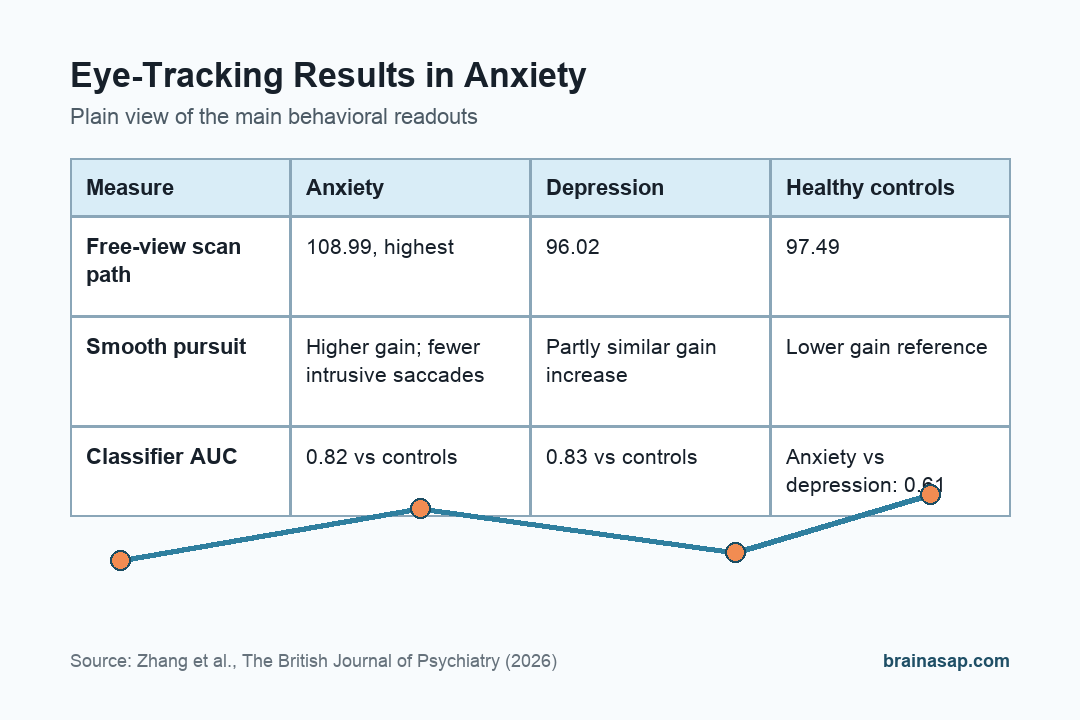
- Hyper-scanning pattern: Mean scan path length was 108.99 in anxiety, compared with 96.02 in depression and 97.49 in healthy controls.
- Hyper-pursuit pattern: During smooth pursuit, anxiety was linked to higher velocity gain and fewer intrusive saccades than healthy controls.
- Moderate classification result: Eye-movement components classified anxiety versus healthy controls with an AUC of 0.82, but anxiety versus depression was weaker at 0.61.
Source: The British Journal of Psychiatry (2026) | Zhang et al.
Eye Tracking Tested Anxiety Against Depression and Healthy Controls
Eye-tracking biomarkers are attractive because they measure behavior directly. Instead of asking only how anxious someone feels, researchers can record how the eyes move while the person views images, holds fixation, or follows a moving target.
Researchers tested whether anxiety disorders have a distinct oculomotor profile. The study included 91 patients with anxiety disorders, 118 patients with depressive disorders, and 98 healthy controls recruited in Shanghai.
The anxiety group mostly had generalized anxiety disorder, but also included panic disorder and social anxiety disorder. Depression was included so the analysis could ask a harder question: whether anxiety differed from another affective disorder, not just from healthy controls.
- Fixation stability: Participants tried to hold their gaze on a central dot while distractors appeared.
- Free viewing: Participants viewed 35 neutral black-and-white images including patterns, natural scenes, social scenes, and objects.
- Smooth pursuit: Participants followed moving dots across horizontal, vertical, and Lissajous tracking paths.
Anxiety Showed More Neutral-Image Scanning
The clearest anxiety-specific result came from the free-viewing task. Compared with both depression and healthy controls, the anxiety group showed more fixations, more saccades, and longer scan paths.
The images were not threat-specific. A hypervigilant scanning profile appeared during neutral visual exploration, suggesting broader environmental monitoring rather than only a reaction to frightening content.
The numbers were modest but consistent. Anxiety participants averaged 24.29 fixations, compared with 22.53 in depression and 22.68 in healthy controls. Their mean saccade count was 18.87, compared with 16.91 and 16.67.
Scan path length showed the same direction: 108.99 in anxiety, 96.02 in depression, and 97.49 in controls. Researchers describe the result as hyper-scanning, meaning a more active and fragmented way of sampling visual information.
Smooth Pursuit Added a Second Anxiety Marker
Free viewing was not the only difference. During smooth-pursuit tasks, anxiety was also linked to higher velocity gain, which means the eyes tracked the moving target with stronger gain than controls.
In vertical smooth pursuit, velocity gain was 0.26 in anxiety and 0.20 in healthy controls. In slow Lissajous movement, horizontal gain was 0.45 in anxiety and 0.37 in controls, while vertical gain was 0.47 versus 0.38.
Intrusive saccades moved in the opposite direction. In the horizontal pursuit task, anxiety participants had 1.84 intrusive saccades on average, compared with 2.48 in healthy controls.
- Higher gain: The eyes followed moving targets more strongly than in healthy controls.
- Fewer intrusive saccades: Anxiety participants made fewer unwanted jump-like eye movements during some pursuit conditions.
- More catch-up behavior: The broader profile suggested active correction during continuous tracking.
Six Components Summarized the Eye-Movement Data
The researchers did not treat every eye metric as a separate clinical answer. They used principal component analysis, a method that groups related variables, to condense 50 differing eye-movement measures into lower-dimensional patterns.
Six interpretable components remained: active visual exploration, pupillary arousal, smooth-pursuit control, pupillary variability, blink activity, and microsaccade instability. Anxiety scored higher than controls on active visual exploration, pupillary arousal, and smooth-pursuit control.
Several components tracked symptom severity inside the clinical groups. In anxiety, Hamilton Anxiety Rating Scale scores correlated with pupillary variability, blink activity, and microsaccade instability.
These correlations suggest the measures may reflect both stable visual-control traits and state-related arousal.
- Trait-like pattern: Active visual exploration separated anxiety from healthy controls and from depression.
- State-related physiology: Pupillary, blink, and microsaccade measures varied with symptom severity.
- Shared affective pattern: Some smooth-pursuit and pupillary changes also appeared in depression, so they were not anxiety-only markers.
Classification Was Better for Patients Versus Controls Than Anxiety Versus Depression
Machine-learning models used the six component scores to classify groups. Anxiety versus healthy controls reached an AUC of 0.82, with 0.74 accuracy, 0.77 sensitivity, and 0.71 specificity.
Depression versus healthy controls was similar, with an AUC of 0.83. The harder comparison was anxiety versus depression, where the best model reached only AUC 0.61.
That difference is important. Eye tracking looked promising for separating clinical groups from healthy controls, but it was not strong enough here to serve as a standalone anxiety-versus-depression diagnostic test.
The Main Limit Is Clinical Specificity
The study was cross-sectional, so it cannot show whether eye-movement differences cause anxiety symptoms or change with treatment.
The groups also differed in gender and education. Researchers adjusted for those variables rather than perfectly matching the sample.
Subtype balance was another limitation. Most anxiety patients had generalized anxiety disorder, so the study cannot say whether panic disorder, social anxiety disorder, and specific phobia each have the same eye-tracking pattern.
- Not a diagnostic test yet: Anxiety-versus-depression classification was modest.
- Single-site sample: The findings need replication in other settings and age ranges.
- Symptom overlap: Anxiety and depression share arousal and attentional-control mechanisms, which can blur group separation.
The useful conclusion is narrower: eye tracking may provide a low-burden behavioral readout of vigilance, visual exploration, and pursuit control in anxiety research. It could complement clinical assessment, especially if future studies show that these measures predict symptom course or treatment response.
Citation: DOI: 10.1192/bjp.2026.10626. Zhang et al. Hyper-scanning and hyper-pursuit define eye movement biomarkers of anxiety disorders. The British Journal of Psychiatry. 2026;1-9.
Study Design: Cross-sectional eye-tracking study comparing anxiety disorders, depressive disorders, and healthy controls.
Sample Size: 307 participants: 91 with anxiety disorders, 118 with depressive disorders, and 98 healthy controls.
Key Statistic: Eye-movement components classified anxiety versus healthy controls with AUC 0.82, but anxiety versus depression reached only AUC 0.61.
Caveat: The study was cross-sectional and single-site, with modest anxiety-versus-depression specificity.