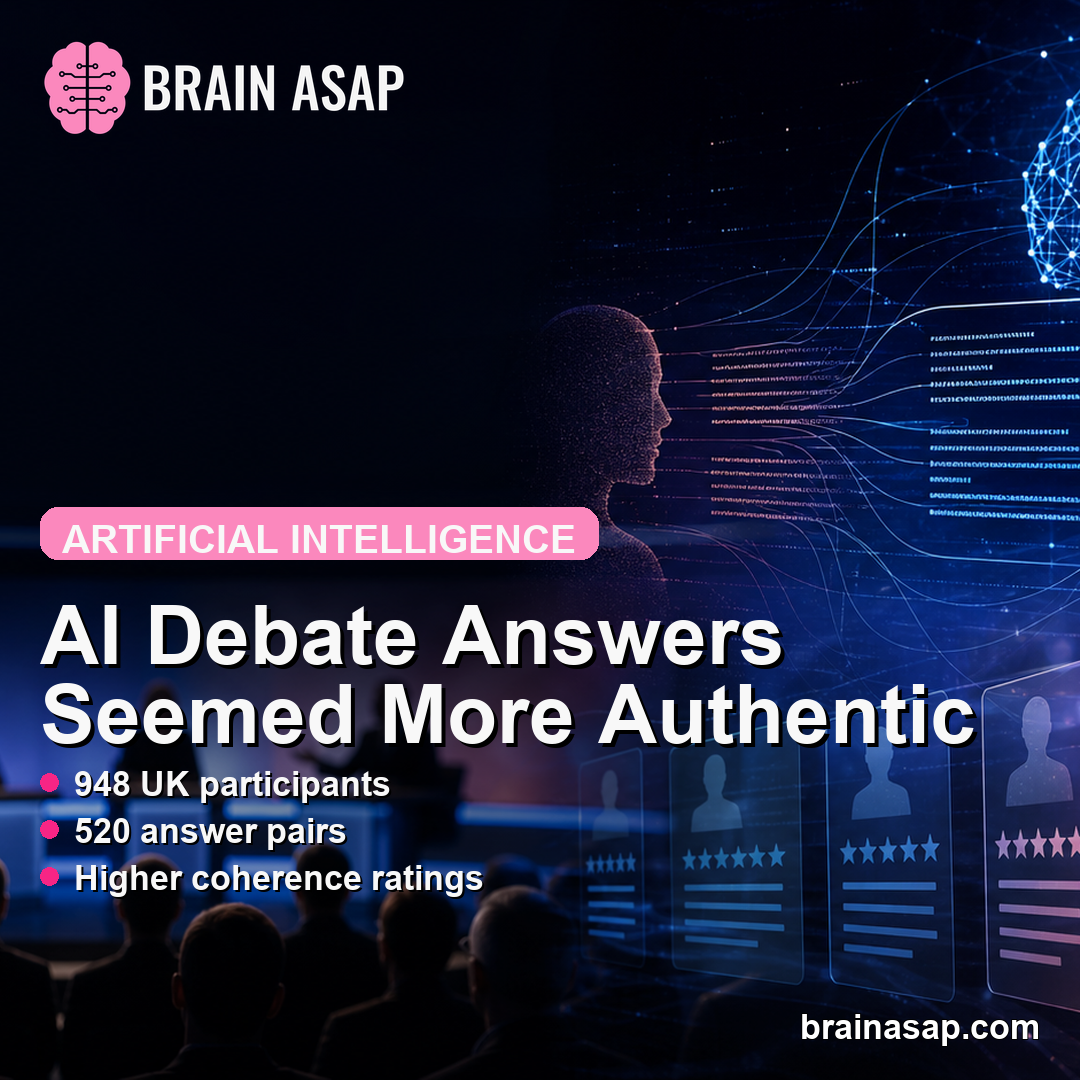
TL;DR: A 2026 study in PLOS One found that UK survey participants rated LLM-generated impersonated debate responses as more authentic, coherent, and relevant than real televised-debate answers, even though many generated answers differed from what the real speakers said.
Key Findings
- 948 UK participants: The survey used a representative cross-section of British society to rate real and LLM-generated political debate responses.
- 520 response pairs: Researchers generated impersonated answers for 520 debate prompt/response pairs from 112 public speakers.
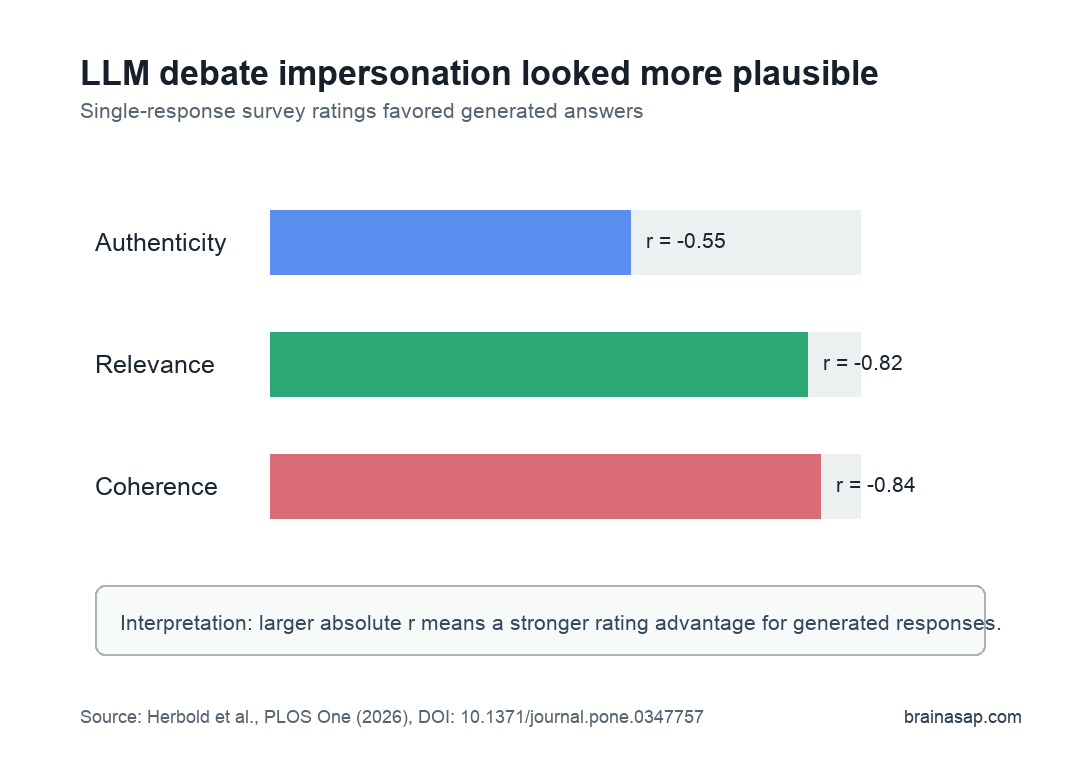
- Large relevance and coherence effects: In single-response ratings, impersonated responses were rated higher for relevance (r=-0.82) and coherence (r=-0.84).
- Authenticity stayed higher: Generated responses were rated more authentic than originals in single-response ratings (r=-0.55), side-by-side comparisons (r=0.28), and biography-supported ratings (r=0.25).
- 13% estimated stance mismatch: Qualitative analysis suggested that about 13% of generated responses could communicate a different stance than the real speaker’s response.
This is not a study about whether AI can write a better essay than a person. It is a public-perception study about whether people believe a generated political answer could have come from a named public figure.
The concern is that LLM impersonation did not need to be perfect to look plausible; it only needed to be coherent, relevant, and speaker-shaped enough for ordinary readers to accept it.
GPT-4 Turbo Impersonated 112 Public Debate Speakers
Researchers used a BBC1 political debate programme as the source material. The dataset covered 30 episodes broadcast from 2020 to 2022, with public figures answering audience prompts on current topics.
The team extracted 119 unique audience prompts and 555 responses, then filtered the material to speakers with Wikipedia pages and usable response context. The final set included 520 prompt/response pairs from 112 speakers.
GPT-4 Turbo received the debate prompt and the first-paragraph Wikipedia biography of the target speaker. The model was instructed to answer in that person’s style, without naming the speaker, identifying itself as AI, or adding extra explanation.
- Original content: Real answers from televised panel members.
- Impersonated content: GPT-4 Turbo answers written as if the named public figure had responded.
- Human ratings: Participants judged authenticity, coherence, relevance, content similarity, confidence, familiarity, and views on AI in public debate.
Participants Rated AI Answers as More Authentic
The first track showed participants one debate prompt, one named speaker, and either the original or generated response. In that setting, impersonated answers were rated more authentic, with a large effect size of r=-0.55.
The same track produced even larger advantages for perceived quality. Generated responses were rated more relevant (r=-0.82) and more coherent (r=-0.84) than real debate answers.
- Authenticity: Generated answers looked more speaker-plausible in single-response ratings (r=-0.55).
- Relevance: Generated answers were judged more on-topic than original responses (r=-0.82).
- Coherence: Generated answers were judged more logically organized than original responses (r=-0.84).
The side-by-side design reduced the authenticity gap but did not remove it. When participants saw original and generated answers together, the generated answer still had a statistically significant authenticity advantage, though the effect was weaker at r=0.28.
Providing speaker biographies also did not solve the problem. In a track where participants saw biographical information, the generated response still received higher authenticity ratings than the real response, with r=0.25.
Random Speaker Controls Showed People Were Not Accepting Everything
A useful control tested whether participants simply assumed any debate answer was authentic. Researchers paired real responses with random wrong speakers and compared those ratings with actual-speaker and impersonated-speaker conditions.
Random-speaker pairings were rated significantly less authentic. That means participants were not blindly accepting every statement as plausible; they were responding to perceived fit between the answer and the named person.
Familiarity with the speaker did not clearly protect raters. Among people who were more familiar with the public figures, the distributions looked similar, although smaller subgroup sizes made some tests less statistically decisive.
Generated Answers Often Differed From the Real Speaker’s Content
The risk is not just that generated answers sounded polished. The paper found that original and generated answers often differed in content.
When participants compared answers side by side, about half of the response pairs were judged dissimilar, compared with about one-third judged similar. Content similarity was not strongly tied to authenticity ratings.
The qualitative analysis focused on 50 dissimilar pairs. Three patterns explained the content differences:
- 42% same-position pairs: Both answers addressed the prompt and had the same broad position, but differed in presentation.
- 32% one-answer pairs: One source dodged the prompt while the other answered it.
- 26% different-position pairs: Both answers addressed the prompt but communicated notably different positions.
Extrapolated to the full dataset, researchers estimated that about 13% of generated responses could communicate a different position than the real answer.
- Same position: Different wording or argument structure, but the same broad position.
- Prompt-dodging difference: One answer addressed the prompt while the other avoided it.
- Different position: The generated response could make the public figure appear to take a different position.
LLM Style Looked Different, but People Still Accepted It
Linguistic analysis found that generated responses were not stylistically identical to real debate answers. Original responses used more epistemic markers such as “I think,” while generated responses used more nominalizations, more diverse vocabulary, and more words from the original prompt.
Those differences did not stop the impersonations from being rated as authentic. The study did not find an obvious “uncanny valley” where AI style made participants reject the generated content.
Several stylistic differences may have helped the model. LLM answers tended to stay on topic, reuse prompt wording, and present a smoother structure than live panel responses produced under broadcast pressure.
- Epistemic markers: Real speakers used more phrases that signal personal stance, such as “I think.”
- Lexical overlap: Generated answers repeated more words from the prompt.
- Nominalizations: Generated answers used more abstract noun forms, with a large effect size.
Transparency Was the Clearest Public Preference
The exit poll asked participants about AI in public debates before and after revealing which material was generated. More than 90% did not change their views after disclosure, but the direction among changers was informative.
Some participants became more favorable toward AI use after seeing its quality, while also reporting a stronger need for regulation. Free-text responses often mentioned that generated answers were better or more coherent than human answers.
The clearest policy preference was transparency. More than 85% of participants thought AI use should be made explicit and that information about how the AI system was developed should be shared.
Authentic-Sounding Political AI Raises a Targeted Misinformation Problem
The study did not test a malicious prompt that forced the model to push a chosen agenda. Even without that instruction, generated answers sometimes differed from the real speaker’s content while remaining plausible to raters.
The specific concern is targeted impersonation. AI-generated misinformation does not have to invent only generic claims; it can imitate a public person and attach a plausible-sounding position to that person.
The study’s authors reported that one detector classified original versus impersonated responses with 89% accuracy, but they also noted that more sophisticated generation strategies could challenge such moderation.
The practical risk is narrow but serious: synthetic debate answers can make a named public figure appear to give a plausible response they did not actually give, so public platforms need disclosure, provenance, and detection systems.
Citation: DOI: 10.1371/journal.pone.0347757. Herbold et al. LLM-impersonated debate contributions are more authentic, relevant and coherent than their original. PLOS One. 2026;21(7):e0347757.
Study Design: Representative UK survey experiment comparing real televised-debate responses with GPT-4 Turbo impersonated responses.
Sample Size: 948 UK participants rated material drawn from 520 prompt/response pairs and 112 public speakers.
Key Statistic: In single-response ratings, generated answers were rated more authentic (r=-0.55), relevant (r=-0.82), and coherent (r=-0.84) than real answers.
Caveat: The study used written survey judgments from one UK political-debate dataset, not real-time social media exposure or audiovisual deepfake material.