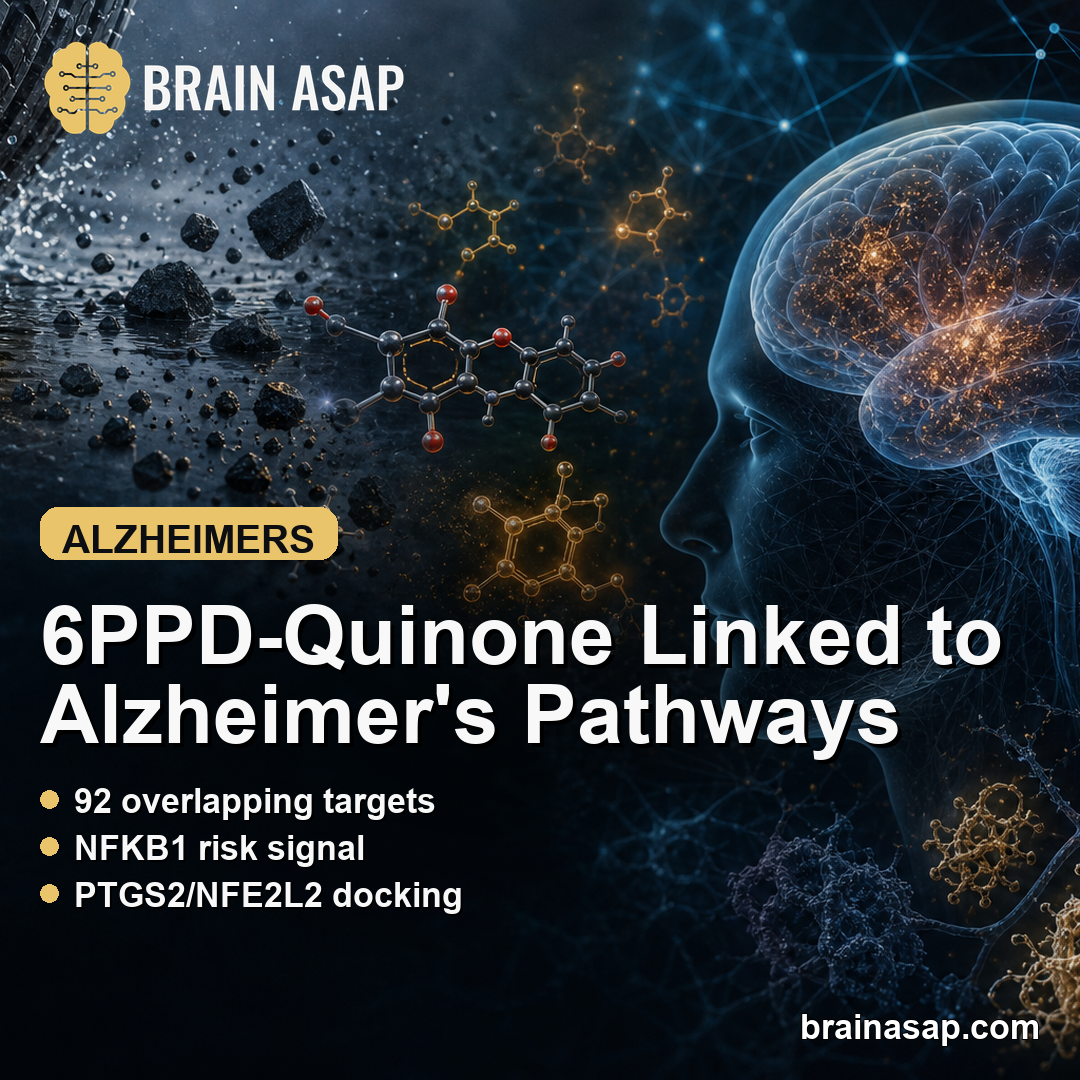
TL;DR: A 2026 study in Open Medicine used network pharmacology, Alzheimer’s disease transcriptomic datasets, machine learning, Mendelian randomization, and molecular docking to link 6PPD-quinone, a tire-wear chemical transformation product, with inflammation, oxidative-stress, kinase-signaling, and synaptic pathways relevant to Alzheimer’s disease.
Key Findings
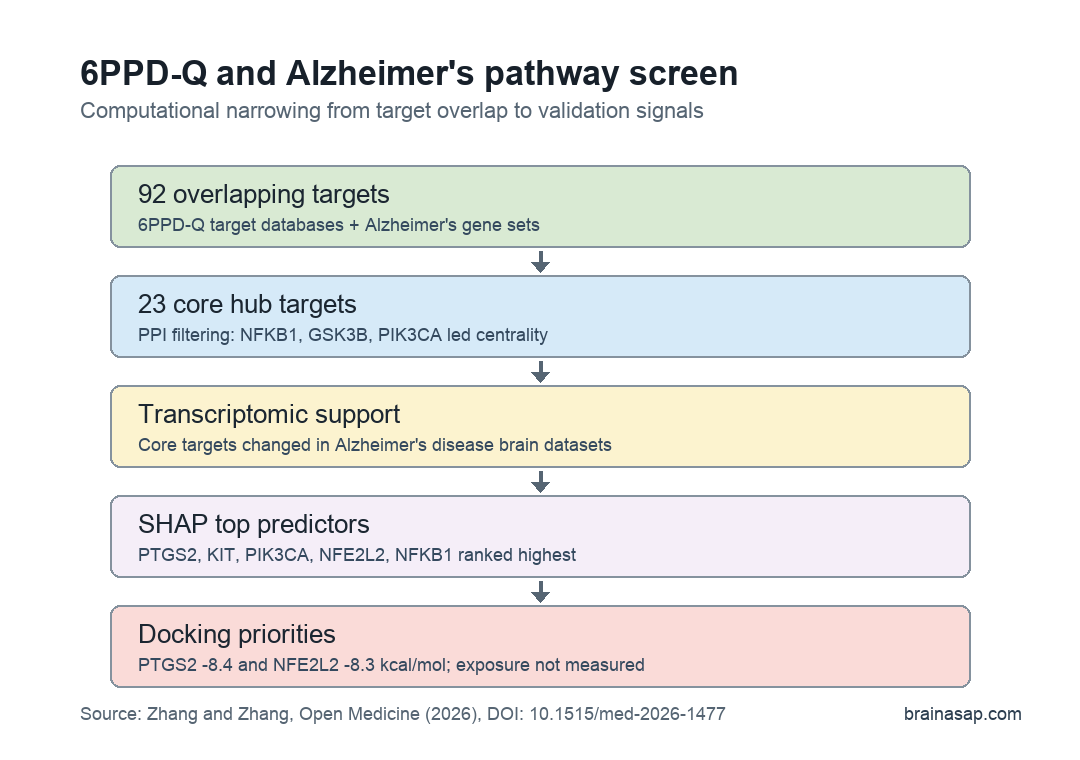
- 92 overlapping targets: Database mining found 92 molecular targets shared between 6PPD-quinone and Alzheimer’s disease gene sets.
- 23 core targets: Protein-interaction filtering narrowed the list to 23 hub targets, led by NFKB1, GSK3B, and PIK3CA.
- Top five predictors: SHAP analysis in an XGBoost model ranked PTGS2, KIT, PIK3CA, NFE2L2, and NFKB1 as the strongest gene contributors to Alzheimer’s classification.
- NFKB1 genetic signal: Mendelian randomization linked brain NFKB1 expression with Alzheimer’s risk (p_SMR=0.032; p_HEIDI=0.513).
- Docking favored PTGS2 and NFE2L2: 6PPD-quinone showed predicted binding affinities of -8.4 kcal/mol for PTGS2 and -8.3 kcal/mol for NFE2L2.
Tire-wear pollution is not proven to cause Alzheimer’s disease. The analysis asks a narrower molecular question: whether 6PPD-quinone (6PPD-Q) intersects with genes and pathways already implicated in Alzheimer’s biology.
The distinction is important because 6PPD-Q is an emerging environmental contaminant, not an established dementia risk factor. The study’s main output is a ranked set of mechanisms that can now be tested in cells, animals, exposure cohorts, and brain tissue.
6PPD-Quinone Was Mapped Against Alzheimer’s Disease Genes
6PPD-Q forms when 6PPD, a tire-rubber antioxidant, reacts in the environment. Researchers framed the compound as a plausible neurotoxicity candidate because quinone compounds can participate in redox chemistry, protein modification, and oxidative stress.
The analysis started with two target lists. Chemical-target databases predicted proteins that 6PPD-Q might affect, while Alzheimer’s disease genes came from GeneCards, DrugBank, and OMIM.
The overlap produced 92 shared targets. Enrichment analysis then connected those genes with synaptic structures, protein kinase activity, neuroinflammation, apoptosis, and pathways such as Alzheimer’s disease, PI3K-Akt signaling, and MAPK signaling.
- Chemical side: The team used SwissTargetPrediction, SEA, and SuperPred 3.0 to estimate possible 6PPD-Q targets.
- Disease side: Alzheimer’s-related genes were pulled from curated disease and drug databases.
- Overlap test: Genes appearing in both pools became the working list for pathway, network, and validation analyses.
NFKB1, GSK3B, and PIK3CA Became the Main Hub Genes
Protein-protein interaction analysis reduced the 92 overlapping genes to 23 core targets. Among them, NFKB1, GSK3B, and PIK3CA ranked highest by network centrality.
NFKB1 had the strongest hub score, with degree centrality of 40 and closeness centrality of 0.917. GSK3B followed with degree 36, while PIK3CA had degree 32.
Those genes are not random Alzheimer’s labels. NFKB1 sits in inflammatory signaling, GSK3B is tied to tau phosphorylation and kinase signaling, and PIK3CA participates in PI3K-Akt pathways involved in survival, metabolism, and stress responses.
Tissue enrichment sharpened the point. The full 92-gene set showed strong enrichment in small intestine, but the 23 hub targets shifted toward brain-related tissues, including cortex, basal ganglia, hypothalamus, amygdala, caudate, nucleus accumbens, anterior cingulate cortex, and frontal cortex.
Alzheimer’s Brain Datasets Supported Several Target Changes
Researchers next tested whether the core genes showed altered expression in Alzheimer’s disease tissue. They used two independent transcriptomic datasets and checked protein expression patterns through the Human Protein Atlas.
In GSE159699, principal component analysis separated disease groups enough for the researchers to examine core-gene behavior. GSK3B and KIT expression was lower in Alzheimer’s disease, while NFKB1 and PIK3CA were highest in the Alzheimer’s group.
Validation in GSE174367 supported several of those patterns. PTGS2 was elevated in Alzheimer’s disease, NFKB1 was higher, and GSK3B was lower.
- Transcriptomic validation: Core target expression differed in Alzheimer’s disease datasets rather than remaining a purely database-mined list.
- Protein context: NFKB1 was detected mainly in cortical neurons, while GSK3B showed strong cortical neuronal staining and moderate glial expression.
- Co-expression structure: GSK3B correlated positively with BRAF, MAPK8, and PTGS2, but negatively with NFKB1.
Machine Learning Highlighted PTGS2, KIT, PIK3CA, NFE2L2, and NFKB1
The machine-learning step used an XGBoost classifier and SHAP values, which estimate how much each gene pushes a model toward a classification. This does not create a diagnostic test by itself, but it ranks which genes contributed most to classification in the dataset.
The top five features were PTGS2, KIT, PIK3CA, NFE2L2, and NFKB1. Mean absolute SHAP values were 0.588 for PTGS2, 0.543 for KIT, 0.438 for PIK3CA, 0.431 for NFE2L2, and 0.404 for NFKB1.
Direction also mattered. High KIT, PIK3CA, and NFKB1 expression pushed predictions toward Alzheimer’s disease, while high PTGS2 and NFE2L2 expression pushed predictions toward control classification in that model.
- PTGS2: The strongest model contributor by mean absolute SHAP value.
- KIT: Another high-ranking feature, though its biological role in this exposure question still needs direct testing.
- NFE2L2: A redox-stress regulator, making it biologically relevant to quinone chemistry.
NFKB1 Had the Clearest Mendelian Randomization Signal
The strongest genetic-support result involved NFKB1 brain expression. Summary-data-based Mendelian randomization linked NFKB1 brain tissue expression with Alzheimer’s disease GWAS signals, with p_SMR=0.032.
The HEIDI test was not significant (p_HEIDI=0.513), which the authors interpreted as evidence against a simple linkage-disequilibrium explanation. The top SNP, rs1005819, was a strong cis-eQTL for NFKB1 expression (p_eQTL=2.39 x 10^-22).
This result should still be read carefully. Mendelian randomization supports a gene-expression relationship with Alzheimer’s risk, not direct proof that environmental 6PPD-Q exposure changes NFKB1 in human brains.
Docking Suggested Strongest Binding at PTGS2 and NFE2L2
Molecular docking tested whether 6PPD-Q could theoretically bind selected target proteins. Lower binding-energy values suggest stronger predicted binding, though docking is still computational and needs biochemical validation.
The strongest conventional predicted binding was for PTGS2 at -8.4 kcal/mol. NFE2L2 followed closely at -8.3 kcal/mol, while GSK3B was -7.63 kcal/mol, KIT was -7.25 kcal/mol, PIK3CA was -7.05 kcal/mol, and NFKB1 was -5.53 kcal/mol.
- PTGS2: Highest predicted binding affinity among tested targets, relevant to inflammatory lipid signaling.
- NFE2L2: Strong predicted binding to a regulator of oxidative-stress responses.
- GSK3B: Predicted binding in the ATP-binding pocket, connecting the chemical screen to kinase biology.
Computational Alzheimer’s Links Need Exposure Validation
The main limitation is built into the design. Network pharmacology, docking, and in silico perturbation analysis can prioritize mechanisms, but they cannot show that realistic human exposure to 6PPD-Q causes Alzheimer’s pathology.
The transcriptomic datasets also came from Alzheimer’s brain tissue, not from people with measured 6PPD-Q exposure. GSE159699 had a relatively small Alzheimer’s group of 12 patients, although GSE174367 provided a larger validation set with n=90.
Future experiments need to test chronic low-dose exposure, blood-brain barrier penetration, cell-type-specific target changes, and behavior or pathology outcomes in relevant models.
The immediate use is target selection. The results point researchers toward NFKB1, GSK3B, PIK3CA, NFE2L2, and PTGS2 as candidate nodes to test when asking whether tire-wear chemistry can influence Alzheimer’s-related biology.
Citation: DOI: 10.1515/med-2026-1477. Zhang and Zhang. 6PPD-quinone exposure and Alzheimer’s disease: insights from integrative network pharmacology, transcriptomics, machine learning, and molecular docking. Open Medicine. 2026;21:20261477.
Study Design: Integrative computational network pharmacology study with transcriptomic validation, SHAP-based machine learning, summary-data Mendelian randomization, molecular docking, and in silico perturbation analysis.
Sample/Model: 92 overlapping 6PPD-Q and Alzheimer’s disease targets, 23 core protein-interaction targets, two Alzheimer’s transcriptomic validation datasets, and docking against six selected proteins.
Key Statistic: NFKB1 brain expression was linked with Alzheimer’s risk in SMR analysis (p_SMR=0.032; p_HEIDI=0.513), while docking predicted strongest 6PPD-Q binding to PTGS2 (-8.4 kcal/mol) and NFE2L2 (-8.3 kcal/mol).
Caveat: The paper prioritizes mechanisms computationally; it does not measure human 6PPD-Q exposure or prove that tire-wear chemistry causes Alzheimer’s disease.