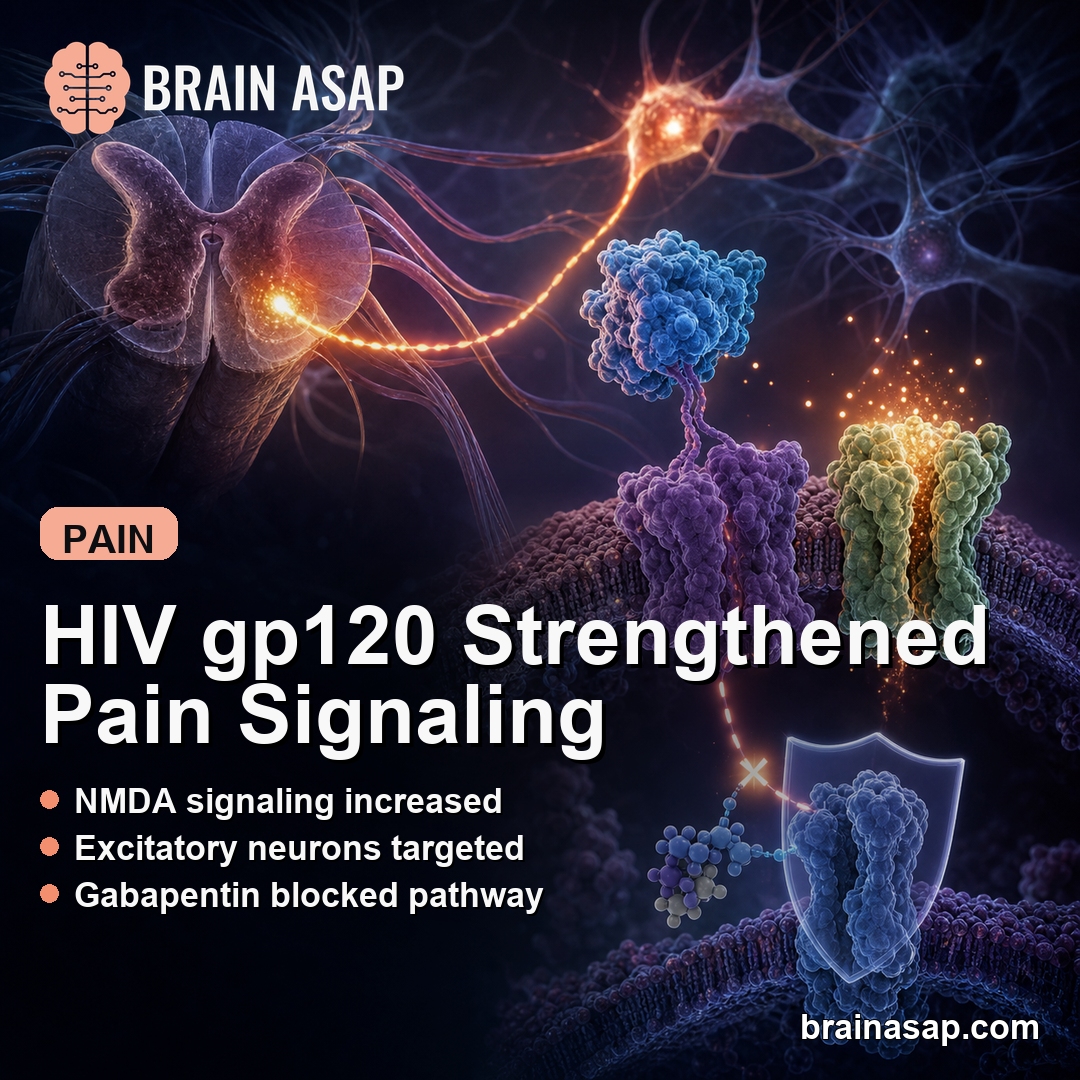
TL;DR: A 2026 mouse study in The Journal of Neuroscience found that the HIV-1 protein gp120 amplified pain signaling through α2δ-1-bound NMDA receptors in spinal excitatory neurons, and blocking that receptor coupling reversed pain-like hypersensitivity.
Key Findings
- More than 60% chronic pain: The source context notes that sensory neuropathy and chronic pain affect more than 60% of people with HIV infection.
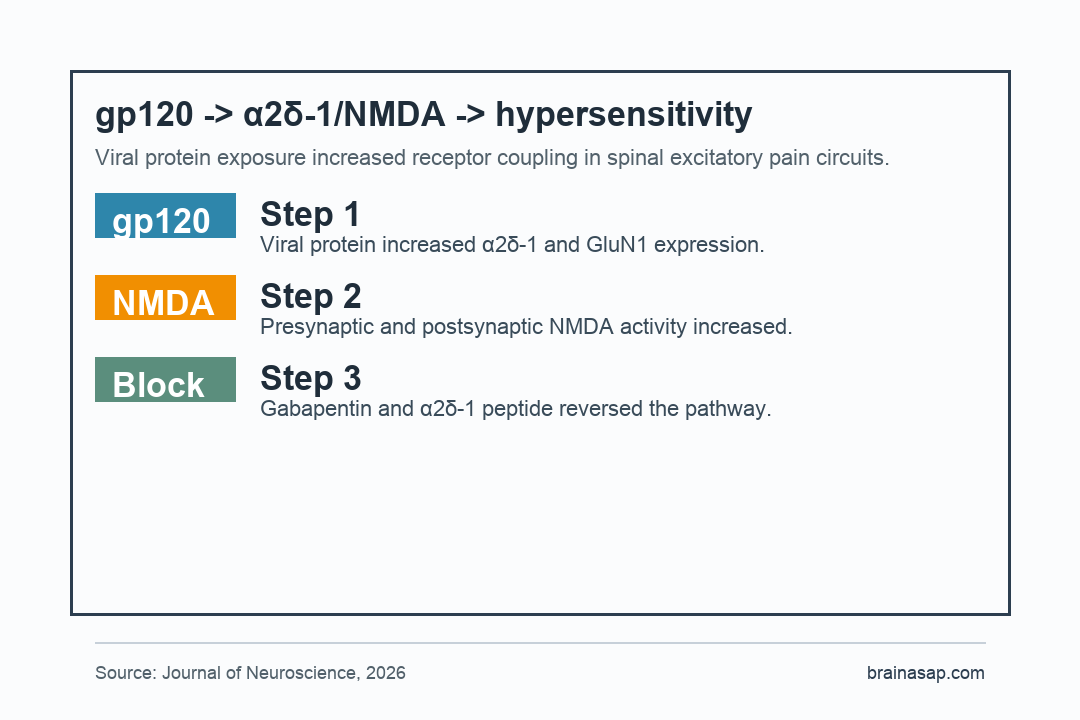
- gp120 raised α2δ-1 and GluN1: Intrathecal gp120 increased expression of α2δ-1 and the NMDA receptor subunit GluN1 in dorsal root ganglion and spinal cord tissue.
- Excitatory neurons were targeted: gp120 enhanced NMDA receptor activity in primary afferent terminals and VGluT2-expressing excitatory dorsal horn neurons, not VGAT-expressing inhibitory neurons.
- Gabapentin reversed the mechanism: Gabapentin and an α2δ-1 C-terminal peptide eliminated gp120-induced presynaptic and postsynaptic NMDA receptor hyperactivity.
- Genetic deletion reduced hypersensitivity: Removing Cacna2d1 or deleting GluN1 in dorsal root ganglion neurons significantly attenuated gp120-induced pain-like behavior.
Source: The Journal of Neuroscience (2026) | Chen et al.
HIV gp120 Amplified Spinal Pain Signaling Through α2δ-1-Bound NMDA Receptors
HIV-1 gp120 is a viral envelope protein that can injure neurons and contribute to neuropathic pain. In this study, researchers used male and female mice to test how gp120 changes synaptic signaling in the spinal dorsal horn, the spinal region where incoming pain signals are processed.
The main result was not simply that gp120 made pain pathways more active. The study traced the effect to α2δ-1-bound NMDA receptors, a receptor complex that helped transmit pain signals from primary sensory afferents into spinal excitatory neurons.
- Viral trigger: gp120 was delivered intrathecally, meaning into the spinal fluid space, to model a direct viral-protein effect on spinal pain circuitry.
- Receptor target: α2δ-1 interacted more strongly with GluN1, a core NMDA receptor subunit, after gp120 exposure.
- Behavioral readout: Persistent nociceptive hypersensitivity served as the pain-like outcome, rather than a self-reported pain measure.
This design is informative because HIV-associated pain is often difficult to treat. A mechanism that links viral proteins, spinal synapses, and a druggable receptor complex gives the finding a clearer biological path than a broad statement about inflammation or nerve injury.
The source context also keeps the clinical problem visible. HIV sensory neuropathy can persist even when infection is medically managed, and pain treatments often work incompletely.
A spinal receptor-coupling mechanism does not solve that treatment problem by itself. It identifies a pathway that can be tested with existing α2δ-1 approaches and newer compounds designed around the receptor interaction.
Excitatory Dorsal Horn Neurons Carried the Main NMDA Receptor Effect
The spinal dorsal horn contains excitatory and inhibitory neurons. gp120 did not affect them equally. It increased NMDA receptor activity in VGluT2-expressing excitatory neurons, while sparing VGAT-expressing inhibitory neurons.
This selectivity is important because pain hypersensitivity can emerge when excitatory transmission is strengthened without a matching inhibitory brake. The study’s synaptic recordings point to a circuit-level imbalance: more drive from primary afferents into excitatory dorsal horn neurons.
The study also separated location from receptor identity. Primary afferent terminals carried the incoming sensory input, while spinal excitatory neurons carried the postsynaptic response.
Both sides of that synapse showed NMDA receptor hyperactivity after gp120 exposure, making the pathway a two-sided amplification point.
- Presynaptic activity increased: NMDA receptors on primary afferent terminals became more active after gp120 exposure.
- Postsynaptic activity increased: NMDA receptor activity also rose in spinal excitatory neurons receiving that input.
- Inhibitory neurons were spared: The same potentiation was not seen in inhibitory dorsal horn neurons.
Gabapentin and α2δ-1 Peptide Blockade Reversed the Pain Pathway
The pharmacology result gives the mechanism practical relevance. Gabapentin, an α2δ-1 inhibitory ligand, eliminated gp120-induced hyperactivity in both presynaptic and postsynaptic NMDA receptor signaling.
The same pattern appeared with an α2δ-1 C-terminal peptide designed to disrupt the α2δ-1-NMDA receptor interaction. The peptide result points more directly to receptor coupling, not only to a general gabapentin effect.
- NMDA antagonist: Direct NMDA receptor antagonism reversed gp120-induced persistent hypersensitivity.
- Gabapentin: Blocking α2δ-1 signaling reversed the synaptic and behavioral effects.
- C-terminal peptide: Disrupting α2δ-1 coupling to NMDA receptors produced a similar reversal.
Genetic tests strengthened the same interpretation. Deleting Cacna2d1, the gene encoding α2δ-1, or selectively removing GluN1 in dorsal root ganglion neurons significantly reduced gp120-induced hypersensitivity.
Those genetic results reduce the chance that the drug findings were only nonspecific sedation or broad neural suppression. When removing the receptor-coupling component or the sensory-neuron NMDA receptor subunit reduced the behavior, the behavioral result lined up with the synaptic mechanism.
Mouse Pain Behavior Narrows a Target for HIV-Associated Neuropathy
The study supports α2δ-1-associated NMDA receptors as a candidate target for HIV-associated chronic neuropathic pain. It does not show that people with HIV pain will respond the same way, because the work was performed in mice and centered on a viral-protein model.
Follow-up work can test whether the same α2δ-1/NMDA receptor coupling appears in human tissue and whether it changes during antiretroviral-treated HIV infection.
Clinical studies would also need to ask whether α2δ-1-directed drugs help the subgroup whose pain biology matches this pathway.
Another follow-up would compare this mechanism with other neuropathic-pain models. If α2δ-1-bound NMDA receptor activity is especially strong in gp120-related pain, it may help distinguish HIV-associated neuropathy from diabetic neuropathy, chemotherapy neuropathy, or traumatic nerve injury.
- Main strength: The study connects protein exposure, receptor trafficking, synaptic electrophysiology, pharmacology, genetics, and behavior.
- Main limit: Mouse nociceptive hypersensitivity is not the same as lived human chronic pain.
- Clinical implication: α2δ-1-bound NMDA receptors may be a more targeted path than treating all HIV neuropathic pain as one mechanism.
Citation: DOI: 10.1523/JNEUROSCI.0368-26.2026. Chen et al. HIV-1 gp120 induces nociceptive hypersensitivity via α2δ-1-bound NMDA receptors at primary afferent-excitatory neuron synapses. The Journal of Neuroscience. 2026.
Study Design: Mouse mechanism study of gp120-induced spinal synaptic signaling and pain-like behavior.
Sample/Model: Male and female mice tested with intrathecal gp120, pharmacological blockers, receptor-coupling disruption, and genetic deletion approaches.
Key Statistic: gp120-induced NMDA receptor hyperactivity and persistent nociceptive hypersensitivity were reversed by gabapentin, NMDA receptor antagonism, and α2δ-1 C-terminal peptide treatment.
Caveat: The study models a viral-protein pain mechanism in mice, so human HIV-associated pain treatment needs clinical validation.