TL;DR: A 2026 preprint in medRxiv from a Dutch comprehensive stroke center found that ischemic stroke patients with a migration background were more likely to arrive outside the treatment time window and less likely to receive endovascular thrombectomy than patients without a migration background.
Key Findings
- 232 first-ever ischemic stroke patients were included: 62 patients, or 26.7%, had a migration background.
- The migration-background group was younger: mean age was 66.6 years versus 71.2 years in patients without migration background.
- Diabetes was more common: diabetes affected 27.4% of patients with migration background versus 15.9% of those without.
- Late presentation was more frequent: patients with migration background presented outside the therapeutic time window more often (53.2% vs 37.1%; OR 1.90; 95% CI 1.05-3.45).
- Endovascular thrombectomy was less common: EVT was performed in 8.1% of patients with migration background versus 22.4% of those without (OR 0.28; 95% CI 0.10-0.75).
Source: medRxiv (2026) | Lee et al.
Acute ischemic stroke is time-sensitive because reperfusion therapies work best when treatment starts quickly after symptoms begin. Intravenous thrombolysis, or IVT, uses medication to dissolve a clot, while endovascular thrombectomy, or EVT, removes a clot through a catheter-based procedure.
This preprint asked whether stroke presentation and reperfusion treatment differed by migration background in a Dutch emergency department. The study is local and observational, but it adds European data to a disparities literature that has often been dominated by United States cohorts and insurance-system comparisons.
Dutch Stroke Cohort Included 62 Patients With Migration Background
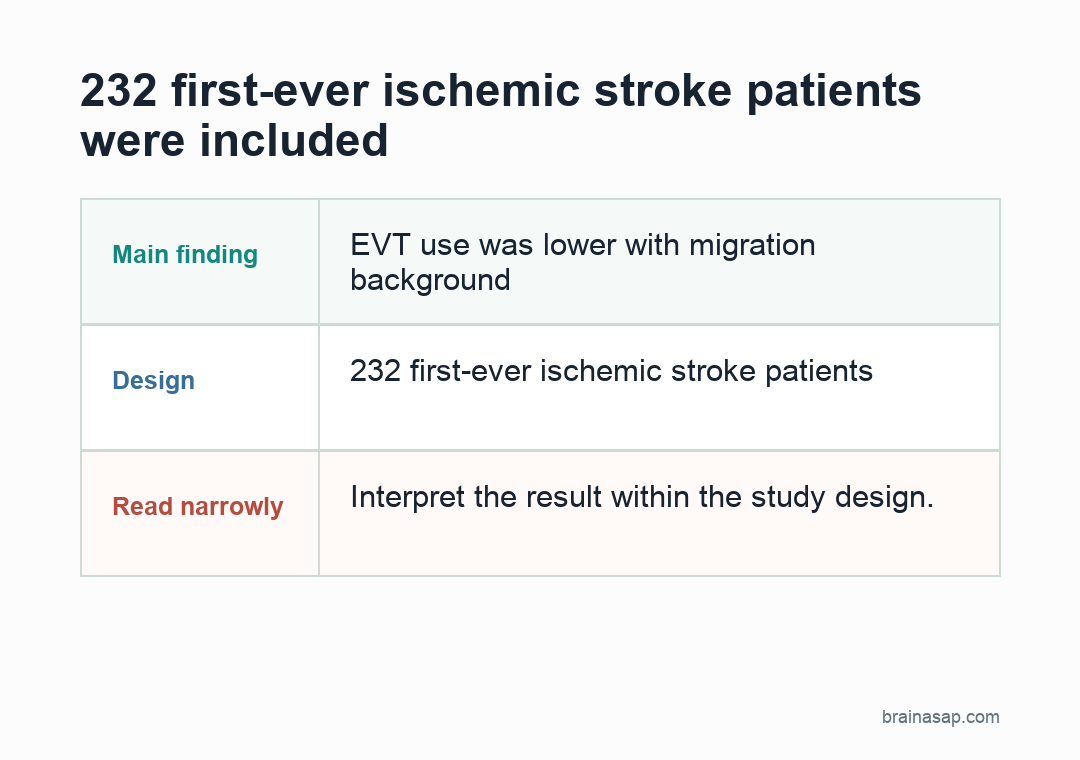
The study included 232 patients with first-ever ischemic stroke between September 2020 and September 2021 at one Dutch comprehensive stroke center. Of these, 62 patients had a migration background and 170 did not.
Patients with migration background were younger on average, at 66.6 years compared with 71.2 years. Sex distribution was similar between groups, with about 60% male in both groups overall.
The authors categorized patients by ethnicity as migration-background or no-migration-background groups, then compared presentation timing, reperfusion treatment, and treatment delays. They adjusted regression models for age, sex, and NIHSS at presentation when appropriate.
- Migration background: the paper’s ethnicity grouping, based on whether the patient had a migration background.
- Therapeutic time window: the time period in which acute reperfusion therapy may be offered.
- NIHSS: the National Institutes of Health Stroke Scale, a common measure of stroke severity at presentation.
Late Arrival Was More Common With Migration Background
The largest access-related difference was time window status. Patients with migration background presented outside the therapeutic time window in 53.2% of cases, compared with 37.1% among patients without migration background.
The reported odds ratio was 1.90, with a 95% confidence interval of 1.05 to 3.45. That means late presentation was nearly twice as likely in the migration-background group in this cohort.
Late presentation is clinically important because it can close the window for reperfusion treatment before the hospital team has a chance to act. The observed gap therefore points to prehospital barriers that need closer clinical study.
EVT Was Less Often Performed in the Migration-Background Group
Endovascular thrombectomy was performed in 8.1% of patients with migration background and 22.4% of patients without migration background. The odds ratio was 0.28, with a 95% confidence interval of 0.10 to 0.75.
That result points to a lower EVT rate in the migration-background group. The study does not prove the mechanism, because EVT eligibility depends on factors such as vessel occlusion, imaging profile, stroke severity, contraindications, and arrival time.
- IVT: clot-dissolving medication given when clinical and timing criteria are met.
- EVT: catheter-based clot removal, usually for selected large-vessel occlusion strokes.
- Door-to-treatment time: the interval from hospital arrival to IVT or EVT start.
In-Hospital Treatment Times Did Not Significantly Differ
The hospital timing measures did not show significant differences between groups. Door-to-treatment time was 38 minutes vs 30 minutes, door-to-needle time was 35 minutes vs 26 minutes, and door-to-groin time was 64 minutes vs 54 minutes.
Those numbers suggest the disparity may not be explained mainly by slower in-hospital treatment after arrival. Instead, the strongest measured difference was that more patients with migration background arrived outside the treatment window and received EVT less often in this dataset.
Stroke etiology also differed. Small-vessel disease was more common in patients with migration background (69.4% vs 48.2%), while cardioembolism was less common (4.8% vs 15.3%).
The Preprint Needs Replication Before Policy Conclusions
The study is useful because it asks a concrete access question in a European stroke-care setting. It does not establish whether language barriers, symptom recognition, ambulance use, referral patterns, comorbidities, imaging eligibility, or social determinants explain the differences.
Several limits are important:
- Preprint status: the paper had not been certified by peer review at posting.
- Single center: the cohort came from one Dutch comprehensive stroke center.
- Small subgroup: the migration-background group included 62 patients.
- Observational design: the analysis can identify disparities but cannot prove why they occurred.
Practical takeaway: in this Dutch cohort, the clearest disparity appeared before or at the point of treatment eligibility: more late presentation and lower EVT use. Understanding prehospital, communication, referral, and eligibility barriers is the next step.
Citation: DOI: 10.64898/2026.04.23.26351631. Lee et al. Ethnic Disparities in Acute Stroke Presentation and Reperfusion Therapy in a Dutch Comprehensive Stroke Center. medRxiv. 2026.
Study Design: Single-center observational cohort study of first-ever ischemic stroke presentation, reperfusion treatment, and treatment timing.
Sample Size: 232 patients, including 62 with migration background and 170 without migration background.
Key Statistic: Patients with migration background more often arrived outside the therapeutic time window (53.2% vs 37.1%) and less often received EVT (8.1% vs 22.4%).
Caveat: This is a single-center preprint, so the disparity signals need peer review and replication before broad policy conclusions.