
TL;DR: A 2026 study in Journal of Neuroinflammation found that people with multiple sclerosis had altered peripheral immunoglobulin repertoires, and several disease-modifying treatments shifted B-cell repertoire patterns after 6 months.
Key Findings
- 33 MS patients: Researchers analyzed peripheral B-cell immunoglobulin heavy-chain repertoires in 33 people with MS and 10 healthy controls.
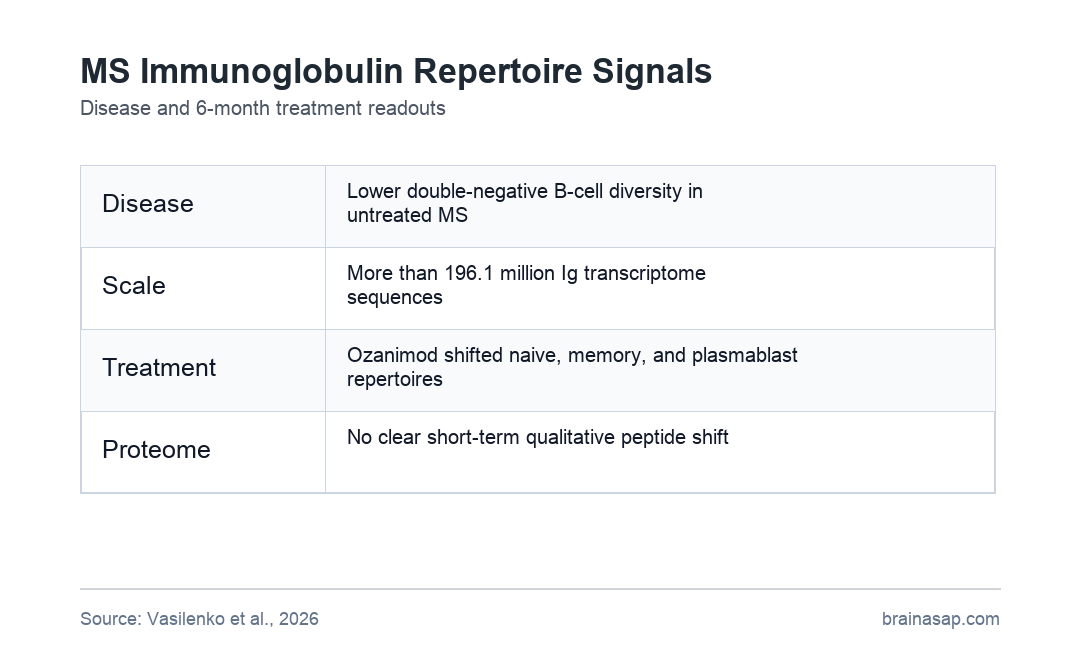
- 196.1 million sequences: The project included more than 196,100,000 immunoglobulin transcriptome sequences for cross-sample repertoire analysis.
- Disease signature: Treatment-naive MS patients showed decreased diversity in double-negative B cells and altered IGHV gene usage compared with healthy controls.
- 6-month treatment shifts: Ozanimod and several other treatments were linked with reduced diversity in naive, memory B cells, and plasmablasts, while natalizumab showed a different profile.
- Proteome boundary: Immunoglobulin peptide analyses did not show a clear qualitative repertoire change at the proteome level during short-term treatment.
Source: Journal of Neuroinflammation (2026) | Vasilenko et al.
Peripheral immunoglobulin repertoires are the antibody-related sequence patterns carried by B cells in blood. In multiple sclerosis, B cells matter because they contribute to immune activity linked with central nervous system inflammation.
This study asked whether blood B-cell repertoires differ in MS and whether common disease-modifying drugs reshape those repertoires over time.
MS Blood B-Cell Repertoires Were Compared With Healthy Controls
Researchers sorted peripheral B-cell populations and sequenced immunoglobulin heavy-chain variable regions. The study included 33 people with MS and 10 healthy controls.
All 33 MS participants were followed longitudinally at baseline and again after 6 months of treatment. Treatment groups included ozanimod, fingolimod, dimethyl fumarate, teriflunomide, cladribine, and natalizumab.
- Naive B cells: B cells that have not yet become antigen-experienced memory cells.
- Memory B cells: Antigen-experienced cells that can preserve immune history.
- Double-negative B cells: A B-cell subset that can expand in autoimmune conditions.
- Plasmablasts: Antibody-producing B-cell lineage cells that can reflect active immune responses.
The analysis went beyond counting B cells. It examined clonal diversity, IGHV gene-family usage, somatic hypermutation, and overlap with immunoglobulin peptides in serum.
Untreated MS Showed Lower Double-Negative B-Cell Diversity
The disease comparison found qualitative repertoire differences even when broad B-cell subset composition was not dramatically altered. Treatment-naive MS patients showed significantly decreased diversity in double-negative B cells compared with healthy controls.
Researchers also reported different IGHV gene usage. IGHV genes help shape antibody binding regions, so changed usage can reflect a shifted B-cell immune repertoire.
- Double-negative diversity: Lower diversity suggested a more restricted repertoire in this subset.
- Gene-family usage: Specific IGHV families differed between untreated MS and controls.
- Somatic hypermutation: Some subset-level mutation differences suggested altered maturation patterns.
- Clinical uncertainty: The direct disease-driving meaning of these repertoire signatures remains unresolved.
The result supports the idea that peripheral B-cell organization can carry an MS-related immune signature, even though MS pathology occurs in the central nervous system.
For biomarker development, blood is easier to sample than cerebrospinal fluid. Peripheral immune patterns still need careful validation before they can stand in for central nervous system disease activity.
Ozanimod Shifted Naive, Memory, and Plasmablast Repertoires
The clearest longitudinal treatment pattern involved ozanimod, a sphingosine-1-phosphate receptor modulator. After 6 months, quantitative B-cell subset shifts were accompanied by qualitative repertoire changes.
Ozanimod treatment was associated with decreased diversity in naive B cells, memory B cells, and plasmablasts. Similar trends appeared for several other treatments, but natalizumab did not follow the same general pattern.
- Naive pool: The study interpreted part of the pattern as activation or reshaping within the naive B-cell pool.
- Memory cells: Antigen-experienced clones became less diverse under several treatment conditions.
- Plasmablasts: IGHV gene-usage changes partly reversed untreated-MS plasmablast patterns during treatment.
- Natalizumab contrast: This treatment was the main exception to the broad reduced-diversity trend.
EBV-Related Antibody Titers Changed Under Some Treatments
Because Epstein-Barr virus is strongly linked with MS risk, researchers also measured antibody responses to EBNA1, an Epstein-Barr nuclear antigen, and several potentially cross-reactive peptides.
After ozanimod treatment, antibody titers against EBNA1 p72, CRYAB, and ANO2 decreased, with trends for GlialCAM and another EBNA1 peptide. Teriflunomide also showed lower EBNA1 p72 titers and a trend for another EBNA1 peptide.
- EBNA1: Epstein-Barr nuclear antigen 1, a viral antigen studied in MS immune research.
- GlialCAM, CRYAB, and ANO2: Candidate molecular-mimicry targets discussed in MS-related antibody studies.
- Interpretive boundary: The pathophysiological role of these antibodies remains uncertain.
Those changes are better read as quantitative immune-treatment effects than as proof that a specific antibody drives MS symptoms.
The antibody findings also show why repertoire studies can become clinically complicated. A treatment may reduce a serum antibody titer while leaving the broader qualitative peptide repertoire mostly stable over the same period.
Proteome Data Did Not Show a Clear Short-Term Qualitative Shift
The study also overlapped immunoglobulin peptides from mass spectrometry with transcriptome-derived B-cell sequences. That tested whether cellular repertoire shifts appeared in circulating immunoglobulin proteins.
The proteome-level result was more limited. Researchers observed stable qualitative overlap between the Ig proteome and transcriptome during short-term treatment, even when some immunoglobulin levels or antibody titers changed.
The main limitation is sample size, especially inside individual treatment groups. The analysis is deep at the sequence level, with more than 196.1 million sequences, but the participant count is modest.
The practical takeaway is that peripheral B-cell repertoire profiling may eventually help characterize MS immune states or treatment effects. It is not yet a diagnostic test or a treatment-selection tool.
For now, the study is strongest as a map of immune remodeling. It identifies where the repertoire changes appeared, which drug groups showed the clearest shifts, and where the protein-level readout stayed more stable.
Citation: DOI: 10.1186/s12974-026-03735-0. Vasilenko et al. Extensive peripheral immunoglobulin repertoire analyses in people with multiple sclerosis reveal disease-specific signatures and distinct treatment effects of disease modifying drugs. Journal of Neuroinflammation. 2026;23:128.
Study Design: Longitudinal immunoglobulin transcriptome and proteome analysis of peripheral B-cell repertoires in multiple sclerosis.
Sample Size: 33 people with MS and 10 healthy controls, with MS participants examined at baseline and after 6 months of treatment.
Key Statistic: More than 196,100,000 immunoglobulin transcriptome sequences were analyzed, revealing lower double-negative B-cell diversity in untreated MS and treatment-linked diversity shifts.
Caveat: Treatment-group sample sizes were limited, and the clinical meaning of specific repertoire signatures remains uncertain.