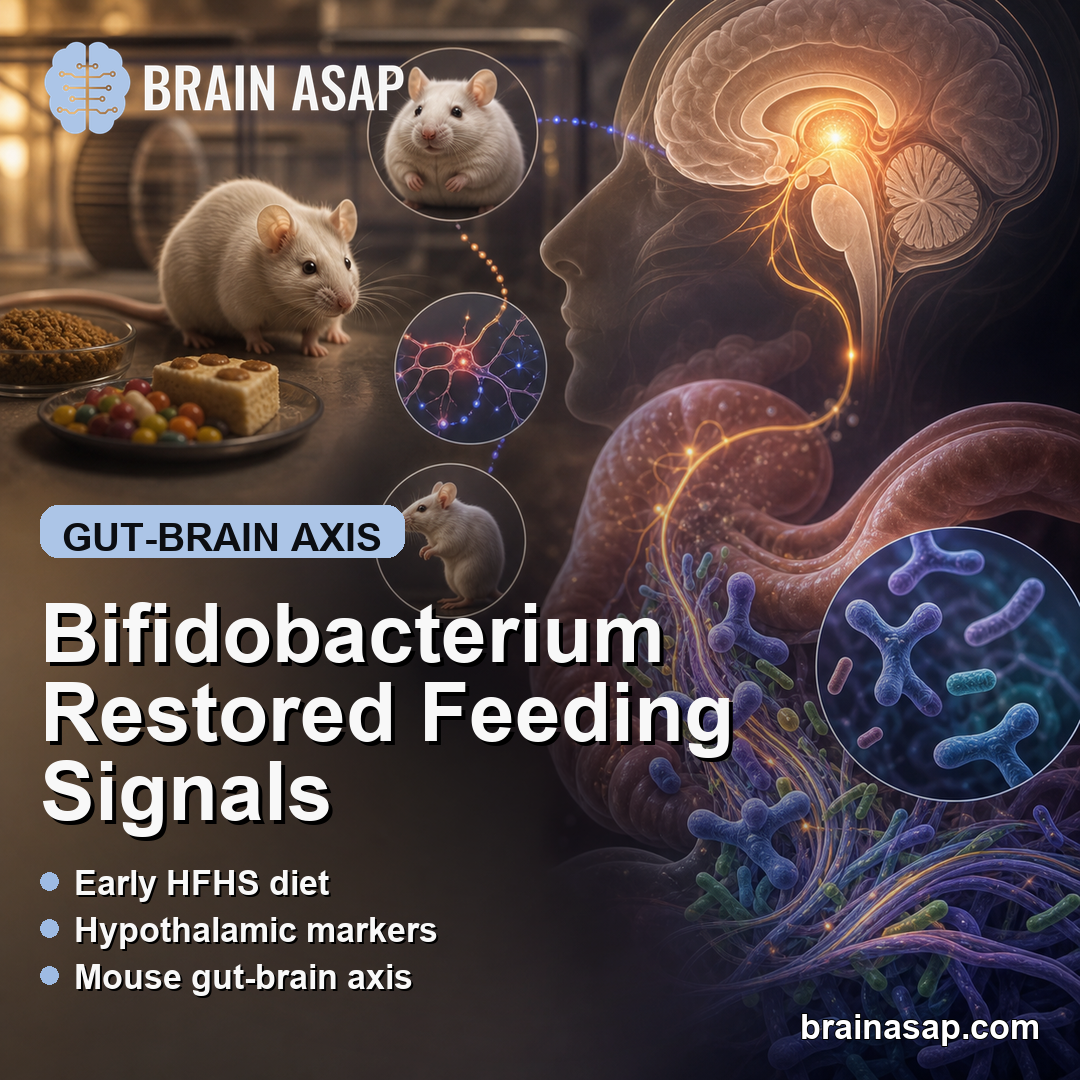
TL;DR: A 2026 mouse study in Nature Communications found that early-life high-fat/high-sugar diet exposure left sex-specific adult feeding and hypothalamic changes, and microbiota-targeted interventions partly restored those effects.
Key Findings
- Early-life HFHS exposure: Mice exposed to a high-fat/high-sugar diet only in early life showed persistent adult feeding changes despite normalized body weight.
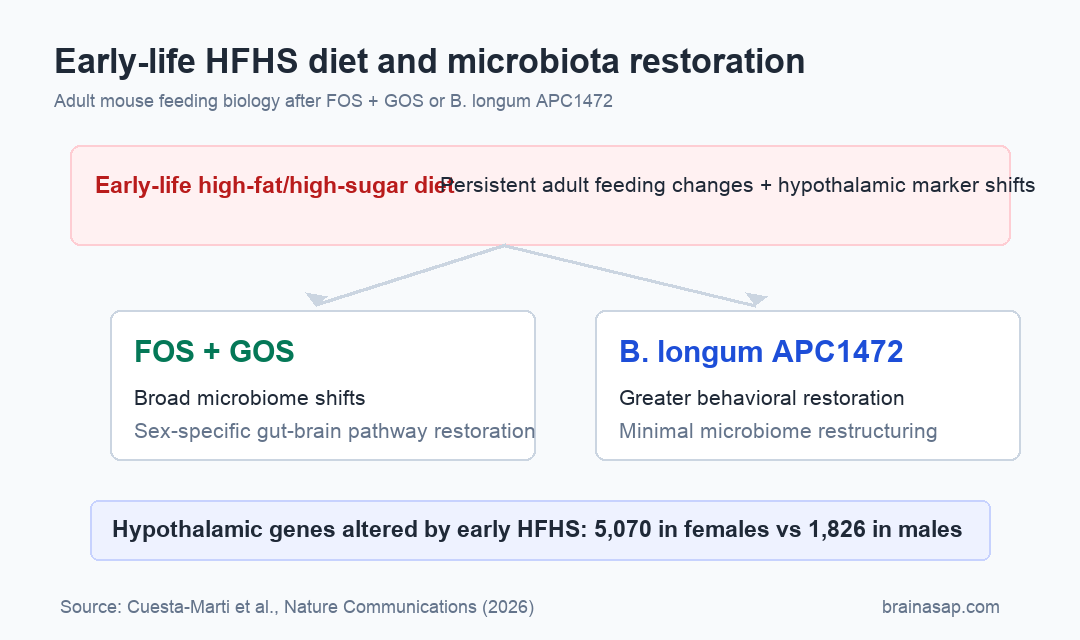
- Sex-specific vulnerability: Females showed broader hypothalamic gene changes than males, with 5,070 altered genes versus 1,826 in adult males.
- Feeding marker loss: Early-life HFHS reduced hypothalamic cells expressing feeding-related markers including POMC, GHSR, PNOC, NOD2, and LEPR.
- Two interventions: FOS + GOS prebiotics produced broad microbiome compositional shifts, while Bifidobacterium longum APC1472 produced stronger behavioral restoration with less microbiome restructuring.
- Small-group experiments: Several metabolomic, transcriptomic, and intervention analyses used n = 6 per group/sex, so the findings are mechanistic mouse evidence.
Source: Nature Communications (2026) | Cuesta-Marti et al.
Early-life diet reaches several developing systems at once: gut microbes, endocrine cues, reward circuits, and hypothalamic appetite pathways. The mouse model used that developmental window to separate early dietary exposure from adult body weight alone.
The researchers also tested two microbiota-targeted interventions: the prebiotic combination FOS + GOS, meaning fructo-oligosaccharides plus galacto-oligosaccharides, and the putative probiotic strain Bifidobacterium longum APC1472.
Early-Life High-Fat/High-Sugar Diet Left Adult Feeding Changes
The study exposed mice to a high-fat/high-sugar diet, abbreviated HFHS, during early life and then examined adult outcomes. The adult effects persisted despite later body-weight normalization.
That design separates early developmental exposure from simple adult obesity. The phenotype was not just heavier adult mice eating more food; it involved altered feeding behavior and biological pathways after the early dietary window had passed.
- Behavioral readouts: Researchers tracked food intake, feeding patterns, and food crumbling in female and male offspring.
- Metabolomics: Blood metabolome analyses identified sex-specific pathway changes after early-life HFHS exposure.
- Hypothalamus: Transcriptomic and marker-cell analyses focused on a brain region central to energy balance and feeding regulation.
The data support a developmental-programming model: diet during a vulnerable period can shape adult feeding systems, even when later body weight looks less remarkable.
Female Mice Showed Broader Hypothalamic and Metabolic Changes
The adult effects were not identical in female and male mice. Females appeared more vulnerable across several measures, including hypothalamic gene expression and metabolic pathway changes.
In the hypothalamus, early-life HFHS altered 5,070 genes in adult females compared with 1,826 genes in adult males. The analysis also reported female disruptions in arginine and tryptophan metabolism and reduced LEPR-positive cells.
- Female metabolic pathways: Arginine/proline, pyrimidine, and glycine/serine/threonine metabolism were significantly altered in adult females.
- Male metabolic pathways: Beta-alanine, arginine/proline, lysine degradation, and steroid-related metabolism were highlighted in adult males.
- Hypothalamic enrichment: Female pathway analyses included mTOR signaling, axon guidance, glutamatergic synapse, FoxO, ErbB, and PI3K-Akt pathways.
The sex-specific pattern is central to the finding. A single pooled male-female result would miss how early diet affected hypothalamic and metabolic systems differently.
Hypothalamic Feeding Markers Were Reduced After Early HFHS Diet
The hypothalamic marker analysis focused on cells expressing feeding-related genes. Early-life HFHS reduced cells expressing markers such as POMC, GHSR, PNOC, NOD2, and LEPR.
POMC neurons help regulate appetite and energy balance. GHSR is the ghrelin receptor, tied to hunger signaling. LEPR marks leptin receptor-expressing cells, which are central to satiety and energy regulation.
- Female ARC changes: Adult females exposed to early-life HFHS had fewer arcuate-nucleus cells expressing Ghsr, Lepr, and Pomc.
- Male ARC changes: Adult males showed reductions in GHSR-positive and POMC-positive cells, but LEPR changes were described as more female-specific.
- Expression intensity: Average Ghsr expression in GHSR-positive cells decreased in both sexes and was restored by interventions only in females.
These cellular readouts give the behavioral findings a brain-level anchor. The study links early diet not only to adult feeding behavior, but also to hypothalamic cell populations involved in appetite regulation.
FOS + GOS and B. longum APC1472 Restored Different Gut-Brain Pathways
The two microbiota interventions did not act the same way. FOS + GOS produced extensive microbiome compositional shifts and sex-specific restoration of gut-brain pathways.
B. longum APC1472 produced greater behavioral restoration with minimal microbiome restructuring. The probiotic-like effect did not require a broad reshaping of the entire microbiome.
- Prebiotic route: FOS + GOS restored metabolites involved in arginine biosynthesis and beta-alanine, arginine, and proline metabolism in early-HFHS adult females.
- Male metabolome route: FOS + GOS restored bile acid and steroid hormone biosynthesis-related metabolites in adult males.
- Bacterial strain route: B. longum APC1472 restored selected genera and behavioral phenotypes while producing less extensive microbiome compositional change.
Both interventions restored some hypothalamic marker-cell alterations. In adult females, both restored Ghsr and Pomc cell-number changes, while B. longum APC1472 also restored the Lepr-expressing cell alteration.
The Mouse Findings Are Mechanistic, Not Human Diet Advice
The design maps gut-brain mechanisms in mice, but it is not a clinical trial.
The source does not show that prebiotics or B. longum APC1472 reverse childhood diet effects in people.
Several experimental layers used small group sizes. The figure captions report n = 6 per group/sex for metabolomic and hypothalamic gene analyses, and n = 11-13 per group/sex for some intervention comparisons.
- Species limit: Mouse developmental feeding circuits are useful models but do not map directly onto human eating behavior.
- Sex-specific results: Male and female patterns differed, so future work needs enough power to test sex differences directly.
- Intervention timing: The study tested defined microbiota interventions in a controlled mouse design, not everyday supplement use.
Early diet, gut microbiota, and hypothalamic feeding systems may interact for longer than body weight alone suggests. Microbiota-targeted interventions could become tools for testing those pathways, but translation requires human evidence.
Citation: DOI: 10.1038/s41467-026-68968-2. Cuesta-Marti et al. Bifidobacterium longum and prebiotic interventions restore early-life high-fat/high-sugar diet-induced alterations in feeding behavior in adult mice. Nature Communications. 2026;17:1653.
Study Design: Mouse early-life diet exposure study with adult feeding behavior, metabolomics, microbiome, hypothalamic transcriptomics, marker-cell analysis, and microbiota-targeted interventions.
Sample/Model: Female and male mice exposed to early-life high-fat/high-sugar diet, then treated with FOS + GOS or B. longum APC1472 in adult analyses.
Key Statistic: Early-life HFHS altered 5,070 hypothalamic genes in adult females and 1,826 in adult males, with several analyses using n = 6 per group/sex.
Caveat: The study is mouse evidence and does not establish that prebiotic or probiotic interventions reverse human early-life diet effects.