TL;DR: In 792 people with stable multiple sclerosis, a blood marker of nerve damage more often placed them in an older age band than their actual age, compared with 302 people without MS. The gap was larger in people with more disability or progressive MS, but it did not predict who got worse over about 2 years.
Key Findings
- Older on the blood test: People with MS had 1.44 times the odds of a blood-based age above their actual age band.
- Disability mattered: Each extra point on the disability scale went with a bigger gap.
- Progressive MS: Larger gap than relapsing MS.
- More past treatments: Each previous MS drug added slightly to the gap.
- No early warning: The gap did not predict disability worsening during follow-up.
Source: Journal of Neurology (2026) | Nicolella et al.
Multiple sclerosis is often thought of as a disease of flare-ups. But even when relapses and new brain lesions stop, slow nerve damage can continue, and many people with MS wonder whether their brains are aging faster.
Researchers at Federico II University of Naples in Italy used a common blood test to put a rough “brain age” on more than 1,000 people and compare it with their real age.
Turning a Nerve-Damage Marker Into an Age Estimate
Neurofilament light chain, or NfL, is a protein from nerve fibers. It leaks into the blood when nerve fibers are damaged, and levels also rise naturally with age.
Earlier research set cutoffs for normal NfL in different age bands: 18 to 50, 51 to 60, 61 to 70 and over 70. In this study:
- Blood-based age: The age band whose normal range matched a person’s NfL
- Age gap: How many bands that was above or below their real age band
A positive gap means NfL looked like that of someone older. The cutoffs sit near the top 5% of normal values, so they flag unusually high NfL rather than everyday aging.
Stable MS Compared With People Getting Routine Blood Work
The study compared two groups:
- People with stable MS (792): No relapses, new MRI lesions or disability worsening in the year before the blood test, and no relapses or new lesions afterward
- Comparison group (302): Adults without neurological disease who came for routine preventive blood tests
Choosing stable patients was deliberate. It let the researchers look at slow, ongoing damage rather than the NfL spikes that come with active inflammation.
The comparison group was older on average (50.6 vs 47.4 years) and had higher raw NfL levels, as expected with age. Yet people with MS still had 1.44 times the odds of landing in an older NfL age band than their real one.
Bigger Gaps With More Disability and Progressive MS
Within the MS group, the age gap, adjusted for age and sex, was linked to:
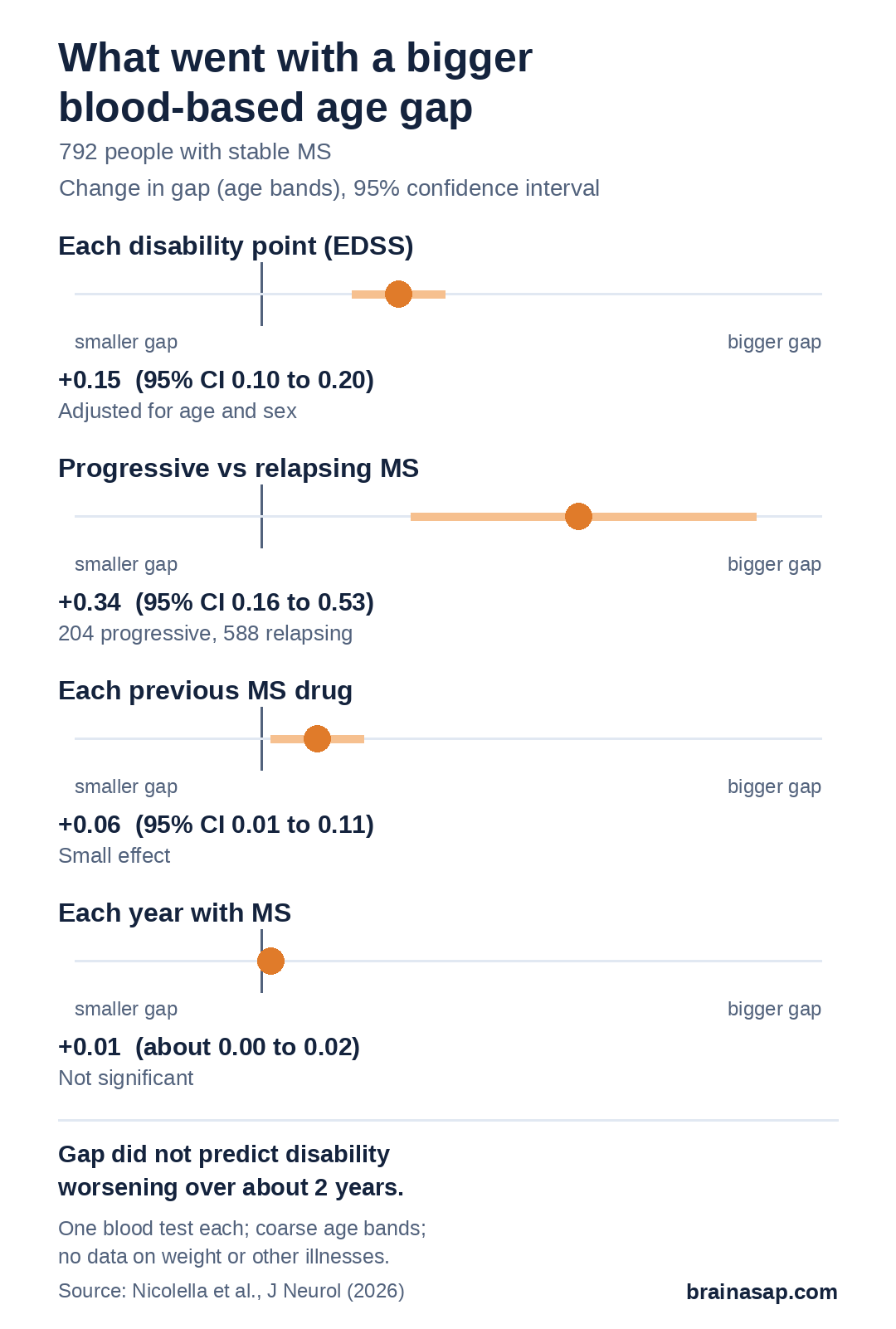
When disability, disease length and disease type were considered together, only disability stayed clearly linked to the gap.
The type of current treatment did not matter, and neither did how long people had lived with MS.
The Gap Did Not Predict Who Got Worse
About 1 in 8 people with MS (100 of 792) had disability worsening during roughly 2 years of follow-up. A larger age gap at the start did not raise the chances of that happening.
Results held when people with worsening disability were left out.
A Rough Measure With Open Questions
- Coarse bands: The 18-to-50 band spans 32 years, so the gap is blunt
- One blood test each: No tracking over time
- Uneven groups: Comparison group older and not matched
- Missing factors: No data on body weight or conditions like heart disease, which also affect NfL
- Circular link: NfL rises with nerve damage, which also drives disability
- Brain-specific only: NfL reflects nerve damage, not whole-body aging
- One center: Naples, Italy
Whether the Gap Can Guide Care Is Still Untested
The study supports the idea that people with stable MS can still carry extra nerve damage that a blood test can pick up, especially as disability grows. It does not show that MS speeds up aging in every part of the body.
The open question is whether tracking someone’s NfL age gap over several years can flag silent progression early enough to change treatment.
Citation: DOI: 10.1007/s00415-026-14157-6. Nicolella V, Polito C, Criscuolo V, et al. Evaluating the neurofilament light chain-derived gap between biological and chronological age in multiple sclerosis and controls. J Neurol. 2026;273:625.
Study Design: Retrospective real-world study at one MS center, with a comparison group from routine blood testing.
Sample Size: 792 people with stable MS and 302 controls.
Key Statistic: Odds of an NfL-derived age above chronological age: OR 1.44 (95% CI 1.10 to 1.87) for MS vs controls.
Caveat: Single blood measure; coarse age bands; controls older and unmatched; no comorbidity or BMI data; gap did not predict disability worsening.