TL;DR: A 2026 preprint in medRxiv found that brain-derived p-tau217%, a blood marker designed to isolate central nervous system tau, classified Alzheimer disease pathology better than standard plasma p-tau217 in several Alzheimer cohorts.
Key Findings
- CNS-selective ratio: The proposed marker, brain-derived p-tau217%, estimates the share of circulating tau that is both brain-derived and phosphorylated at threonine 217.
- 131-protein screen: Researchers compared the marker against a NULISA CNS disease panel covering amyloid, tau, neurodegeneration, neuroinflammation, synaptic, and vascular proteins.
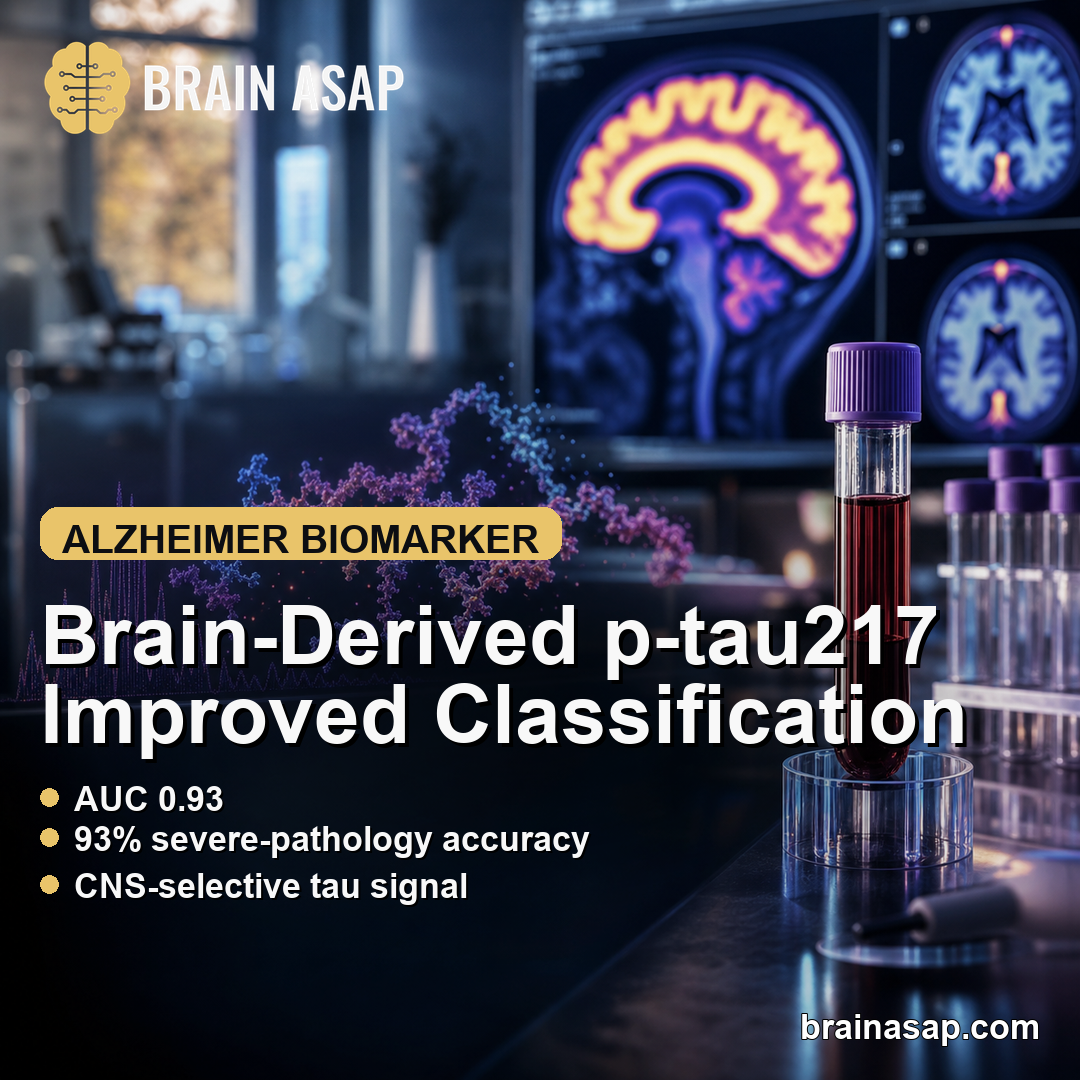
- Severe pathology accuracy: In neuropathology comparisons, brain-derived p-tau217% classified low versus severe Alzheimer disease neuropathologic change correctly in 93% of individuals, versus 85% for standard p-tau217.
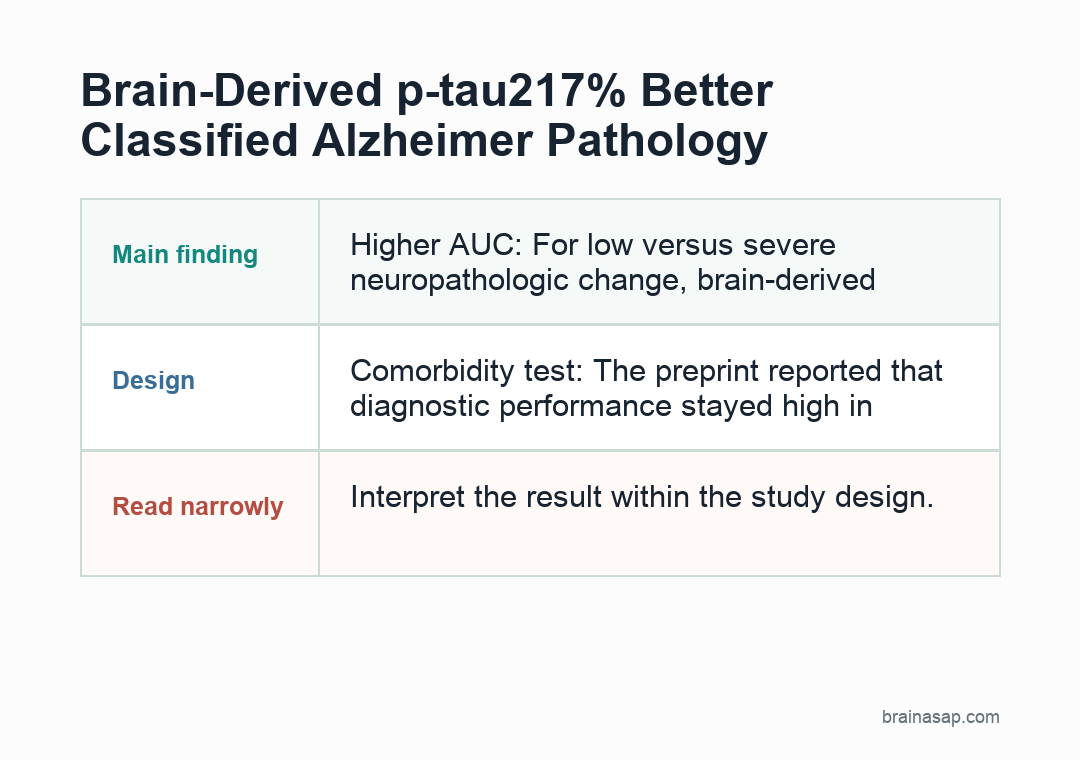
- Higher AUC: For low versus severe neuropathologic change, brain-derived p-tau217% reached AUC 0.93, compared with AUC 0.90 for standard p-tau217.
- Comorbidity test: The preprint reported that diagnostic performance stayed high in older adults with diabetes and cardiovascular disease, where standard p-tau217 showed reduced specificity.
Source: medRxiv (2026) | Zeng et al.
Brain-derived p-tau217% is a refinement of a familiar Alzheimer blood-test idea. Standard plasma p-tau217 measures tau phosphorylated at threonine 217, but some circulating tau may come from outside the central nervous system (CNS), especially in older adults with common medical comorbidities.
The analysis tested whether a CNS-selective version of the marker could preserve Alzheimer-related information while reducing peripheral noise. It is not a commercial diagnostic rule yet; it is a preprint-stage biomarker comparison.
Brain-Derived p-tau217% Was Built to Reduce Peripheral Tau Noise
The central measurement is a ratio. Researchers measured brain-derived p-tau217 relative to brain-derived tau, then expressed that relationship as brain-derived p-tau217%.
The source question is important because blood p-tau217 has become one of the strongest Alzheimer biomarkers, but the measured tau is not always cleanly brain-derived. The preprint frames the problem this way:
- Standard p-tau217: Captures phosphorylated tau in plasma, but not all tau in blood necessarily reflects brain Alzheimer pathology.
- Brain-derived tau: Uses an assay strategy intended to preferentially detect the CNS-abundant tau form rather than peripheral high-molecular-weight tau.
- Brain-derived p-tau217%: Asks how much of the brain-derived tau readout is phosphorylated at threonine 217, the Alzheimer-relevant tau site.
The study used the NULISA proximity-ligation proteomic platform and evaluated 131 CNS disease-related proteins. Those proteins covered amyloid and tau pathology, neurodegeneration, neuroinflammation, synaptic dysfunction, and vascular dysregulation.
Neuropathology Comparisons Favored the CNS-Selective Marker
The clearest numeric comparison came from the neuropathology cohort. For low versus severe Alzheimer disease neuropathologic change, brain-derived p-tau217% showed the largest adjusted effect size among the reported markers.
The preprint reported Cohen’s d = 2.53 for brain-derived p-tau217%, compared with 1.77 for standard p-tau217 and 1.86 for p-tau217/A-beta42. On the classification side, the CNS-selective ratio reached AUC 0.93, versus AUC 0.90 for standard p-tau217.
For the easier severe-pathology contrast, brain-derived p-tau217% correctly classified 93% of individuals, compared with 85% for standard p-tau217. The analysis also examined the harder low-versus-intermediate neuropathology comparison.
That secondary contrast still favored the CNS-selective marker. Brain-derived p-tau217% had AUC 0.85 and 82% correct classification, while standard p-tau217 had AUC 0.74 and 71% correct classification.
Neuroimaging and Memory Clinic Cohorts Tested Clinical Usefulness
The study did not rely only on postmortem pathology. The abstract describes additional testing in A-beta and tau neuroimaging cohorts and in memory clinic cohorts, where the question is closer to real diagnostic use.
The clinical cohort described in the indexed PDF text included a mixed diagnostic distribution:
- 29.7% clinically unimpaired: A group that tests whether the marker simply separates advanced dementia from everyone else.
- 20.7% mild cognitive impairment: A clinically important middle zone where prognosis and etiology are often uncertain.
- 34.6% Alzheimer dementia: Probable or possible Alzheimer disease dementia cases.
- 14.9% non-Alzheimer dementia: A comparison group for specificity, not just Alzheimer severity.
Across these settings, brain-derived p-tau217% outperformed conventional non-CNS-selective p-tau217, p-tau217/A-beta1-42, p-tau217%, and brain-derived p-tau217 alone.
The longitudinal claim was also clinically relevant. The preprint says the CNS-selective marker predicted future clinical progression more robustly in people followed for up to two decades.
Diabetes and Cardiovascular Disease Were an Important Stress Test
One practical reason to separate CNS tau from peripheral tau is that older memory-clinic patients rarely have a single clean condition. Diabetes, cardiovascular disease, kidney disease, vascular brain injury, and other chronic problems can complicate interpretation of blood biomarkers.
The abstract specifically states that performance remained high in older adults with diabetes and cardiovascular disease, while standard p-tau217 showed reduced specificity.
That is a meaningful clinical stress test because a blood marker that works only in unusually healthy research volunteers may not transfer well to routine dementia evaluation.
- Rule-in value: Higher specificity helps reduce false-positive Alzheimer interpretations when peripheral disease may affect the blood measurement.
- Referral value: A cleaner blood marker could help decide who needs confirmatory amyloid positron emission tomography (PET), tau PET, or cerebrospinal fluid testing.
- Trial value: Better pathology classification could improve screening for Alzheimer trials, especially when samples include medically complex older adults.
The preprint should not be read as saying that blood testing replaces clinical judgment or confirmatory biomarkers today. It suggests that the next generation of p-tau217 testing may need to pay attention to where the tau measurement comes from.
Preprint Status and Assay Availability Limit Immediate Translation
The strongest caveat is straightforward: this is a medRxiv preprint, so the work had not been certified by peer review at the time of posting. The assay approach also depends on specialized proteomic measurement, not a routine clinic lab test.
Several boundaries matter before this becomes a practical Alzheimer test:
- Independent replication: Other cohorts and laboratories need to confirm the same gain over standard p-tau217.
- Clinical thresholds: AUC and percent-correct values help compare markers, but clinics need validated cutoffs, gray-zone handling, and confirmatory-test workflows.
- Diverse comorbidity testing: Diabetes and cardiovascular disease are important, but kidney disease, vascular brain disease, inflammatory illness, and medication effects also matter.
- Implementation cost: Specialized platforms can limit access even when biomarker performance is strong.
For now, the paper’s practical message is narrow. If plasma p-tau217 is moving toward clinical Alzheimer assessment, then CNS selectivity may be one way to make that marker more specific in medically complex patients.
Citation: DOI: 10.64898/2026.05.18.26353208. Zeng et al. CNS-selective plasma p-tau217 accurately captures Alzheimer’s disease pathology and progression. medRxiv. 2026.
Study Design: Preprint biomarker comparison across neuropathology, neuroimaging, memory clinic, longitudinal progression, and plasma proteomic analyses.
Sample/Model: Human Alzheimer disease cohorts, including neuropathology-defined, A-beta/tau neuroimaging-characterized, and memory clinic groups.
Key Statistic: Brain-derived p-tau217% classified low versus severe Alzheimer disease neuropathologic change with AUC 0.93 and 93% accuracy, compared with AUC 0.90 and 85% accuracy for standard p-tau217.
Caveat: The work is a preprint and needs independent peer-reviewed replication, clinical cutoffs, and implementation testing before routine diagnostic use.