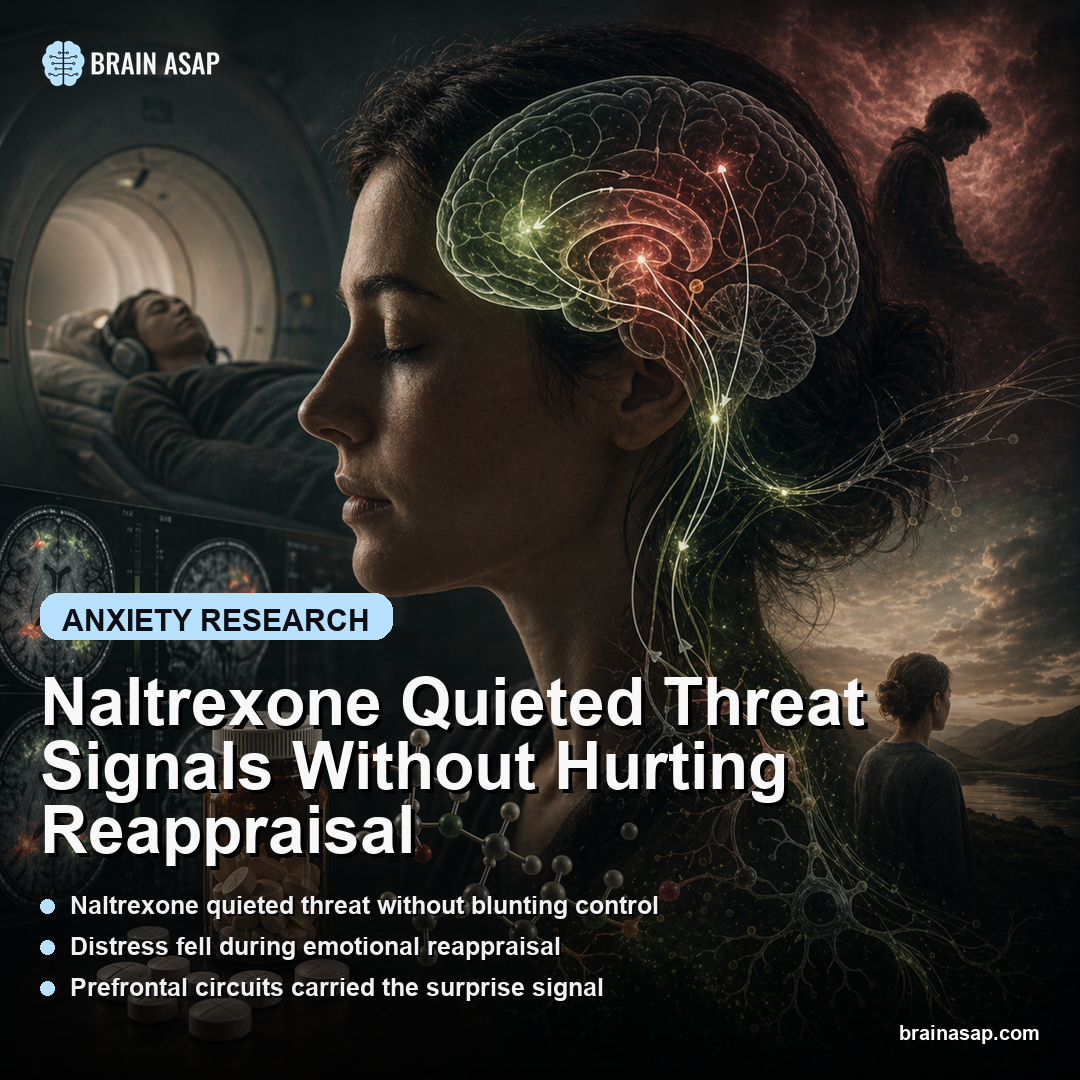
TL;DR: A 2026 study in The British Journal of Psychiatry found that a single 50 mg dose of naltrexone reduced distress and shifted threat-related brain activity without blocking people’s ability to reappraise negative images.
Key Findings
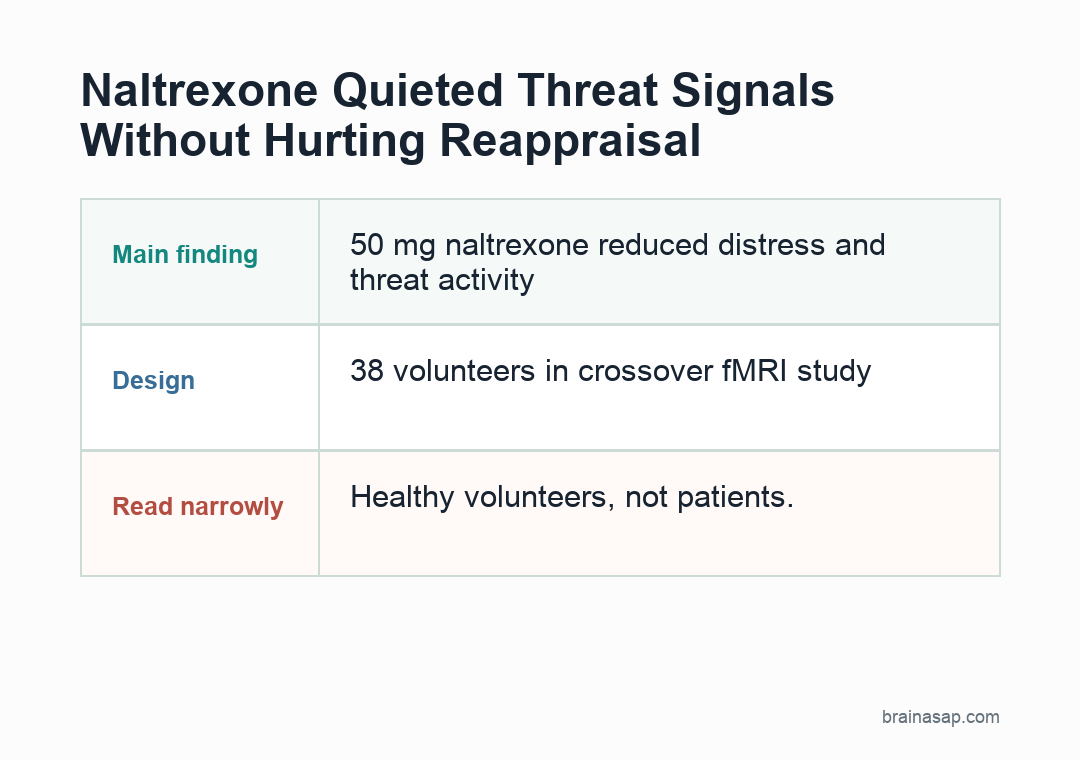
- 38 healthy volunteers completed a placebo-controlled crossover: Participants received naltrexone 50 mg and placebo on separate visits, then performed both an emotional reappraisal task and an emotional face-viewing task during functional MRI (fMRI).
- Distress dropped from -11.24 to -9.08 under naltrexone: Across negative-image blocks, opioid antagonism significantly reduced subjective distress compared with placebo (p = 0.044, d = 0.57).
- Reappraisal still worked: Participants could still regulate negative images successfully under naltrexone, and explicit regulation continued to engage lateral prefrontal regions rather than collapsing under the drug.
- Threat-viewing activity fell in vmPFC, thalamus, and caudate: During passive viewing of negative versus neutral images, placebo produced greater activation than naltrexone in the left ventromedial prefrontal cortex and bilateral medial thalamus extending into the left caudate.
- Automatic threat processing shifted: In the face task, naltrexone increased frontal activity to fearful faces, fitting a stronger effect on implicit emotional processing than on deliberate reappraisal.
Source: The British Journal of Psychiatry (2026) | Huneke et al.
This was a mechanistic experiment, not a prescribing study.
If blocking opioid signaling changes how the brain handles threat automatically but leaves explicit emotion regulation intact, the opioid system may sit closer to automatic threat processing than to deliberate reappraisal.
Why Anxiety Research Keeps Circling Back to the Opioid System
The endogenous opioid system usually enters public conversation through pain, addiction, and overdose.
Study details:
- 38 healthy volunteers completed a placebo-controlled crossover: Participants received naltrexone 50 mg and placebo on separate visits, then performed both an emotional reappraisal task and an emotional face-viewing task during functional MRI (fMRI)
- Distress dropped from -11.24 to -9.08 under naltrexone: Across negative-image blocks, opioid antagonism significantly reduced subjective distress compared with placebo (p = 0.044, d = 0.57)
- Reappraisal still worked: Participants could still regulate negative images successfully under naltrexone, and explicit regulation continued to engage lateral prefrontal regions rather than collapsing under the drug
- Threat-viewing activity fell in vmPFC, thalamus, and caudate: During passive viewing of negative versus neutral images, placebo produced greater activation than naltrexone in the left ventromedial prefrontal cortex and bilateral medial thalamus extending into the left caudate
But neuroscientists have been quietly interested in it for another reason: it can help tune how the brain handles threat, stress, and emotional salience.
That idea has always been plausible, but hard to localize in humans.
Animal work suggests opioid receptors shape aversion and anxiolysis.
Human evidence has been thinner, especially when the test is not “Does someone feel different?” but “Which parts of emotional regulation actually change when opioid signaling is blocked?”
This study approached that test with naltrexone, a non-specific opioid antagonist better known from alcohol and opioid use treatment.
The authors were not testing it as an anxiety treatment.
They were using it as a probe to ask whether endogenous opioids matter more for deliberate reappraisal or for the faster, more automatic processing of emotional stimuli.
What a Two-Task fMRI Design Could Separate That Symptom Scales Cannot
The design was clever because it split emotion regulation into two very different jobs.
In one task, participants saw emotional pictures and were explicitly instructed either to attend to them or to reappraise them.
In the other, they simply viewed fearful, happy, and neutral faces while making judgments that probed implicit processing.
The distinction is important. Explicit reappraisal leans on conscious, effortful control.
Implicit threat processing is faster and more automatic.
If opioids are involved, they may not sit in the reflective, therapist-friendly part of regulation at all.
They may instead operate in the background, shaping how emotionally important a stimulus feels before a person starts talking themselves down.
The crossover imaging sample included 38 healthy participants who completed the key analyses, with a few exclusions for motion or image-quality issues in specific tasks.
Each person served as their own control, which makes readout changes more interpretable than a simple between-group comparison.
The Most Surprising Behavioral Result Was Less Distress, Not More
One reasonable expectation was that naltrexone would intensify threat processing or make regulation harder. Instead, the behavioral result moved in the opposite direction.
On the negative-image task, distress ratings were actually lower under naltrexone than placebo, shifting from -11.24 to -9.08 overall.
That effect was not huge, but it was statistically significant at p = 0.044 with an effect size of d = 0.57.
At the same time, participants still showed the expected difference between attend and regulate conditions.
Reappraisal worked. People felt worse when they simply attended to negative pictures than when they actively regulated them.
That combination is important because it argues against a simplistic explanation in which opioid antagonism just blunts regulatory capacity. The behavioral split was specific:
- Subjective distress: negative-image distress was lower under naltrexone than placebo.
- Reappraisal: participants still reduced distress when instructed to regulate.
- Interpretation: naltrexone nudged automatic threat processing without collapsing explicit control.
How Threat Processing Shifted in vmPFC, Thalamus, and Caudate
The imaging results help explain why the authors focus on automatic emotional regulation rather than top-down reappraisal.
During passive viewing of negative versus neutral images, placebo produced greater activation than naltrexone in the ventromedial prefrontal cortex and in the bilateral medial thalamus extending into the left caudate.
Those regions are not random. The vmPFC is deeply involved in valuation, affective meaning, and integrating emotional significance with goals and memory.
The thalamus and caudate sit inside circuits that influence salience, response selection, and motivational tagging.
A drug effect there suggests the opioid system is helping tune how emotionally relevant a threat readout feels, not just how people describe it afterward.
Crucially, the classic explicit-regulation network did not fall apart.
The reappraisal task still engaged lateral prefrontal regions across conditions, and the main explicit regulation effect looked similar under placebo and naltrexone.
That preserved reappraisal response is why the authors separated automatic from deliberate regulation in their conclusion.
Fearful Faces Triggered More Middle-Frontal Engagement Under Naltrexone
The face-viewing task pushed the result a little further.
Naltrexone altered activity in task-positive regions including the right frontal pole and left middle frontal gyrus, especially when participants viewed fearful faces.
The authors interpreted this pattern cautiously: opioid antagonism may increase reliance on lateral frontal control when emotional salience changes.
That does not show naltrexone “improved” fear processing in any straightforward clinical sense. Reaction times trended slower under the drug, and the sample was healthy rather than anxious.
But the pattern is still informative. If vmPFC valuation readouts drop while frontal control regions rise, the brain may be shifting from effortless affective tuning toward a more effortful processing mode.
The happy-face findings point in the same general direction.
The authors observed condition differences in other task-positive regions too, suggesting the opioid system is probably not only about dampening negative emotion.
It can help fine-tune the salience of emotionally important stimuli more broadly, whether negative or positive.
The Anxiety-Treatment Link Is Mechanistic, Not Clinical Yet
The most important limitation is obvious: these were healthy volunteers, not patients with panic disorder, PTSD, or generalized anxiety disorder.
A mechanistic probe in a lab scanner is not the same thing as a treatment trial in a clinic.
Even so, the findings sharpen one question for anxiety research.
It suggests the opioid system may matter less for the kind of deliberate reframing therapists teach and more for the early, automatic assignment of emotional weight to a stimulus.
That is a very different therapeutic target.
If that model holds up, the opioid system may be relevant not because it replaces SSRIs or CBT, but because it sits upstream of both, shaping which stimuli hit the brain as especially salient in the first place.
The next steps are the right ones the authors mention: dose-response work, receptor-specific studies, and testing whether the same circuitry shifts appear in clinical populations where threat processing is genuinely dysregulated.
This study does not make naltrexone an anxiety drug.
What it does do is sharpen the map.
It places endogenous opioids closer to the brain’s automatic threat-tuning machinery than to its explicit cognitive control toolkit.
Citation: DOI: 10.1192/bjp.2026.10605. Huneke Huneke et al. Effects of opioid antagonism on functional MRI correlates of explicit and implicit threat processing in healthy volunteers. The British Journal of Psychiatry. 2026. The British Journal of Psychiatry. 2026.
Study Design: Crossover clinical study
Sample/Model: 38 healthy volunteers completed a placebo-controlled crossover: Participants received naltrexone 50 mg and placebo on separate visits, then performed both an emotional reappraisal task and an emotional face-viewing task during fMRI.
Key Statistic: Distress dropped from -11.24 to -9.08 under naltrexone: Across negative-image blocks, opioid antagonism significantly reduced subjective distress compared with placebo (p = 0.044, d = 0.57).
Caveat: Single-study evidence; interpret with the source design and sample.