TL;DR: A 2026 study in European Journal of Social Psychology found that adding flattering Nazi-era propaganda images to atrocity photographs reduced several immediate negative emotions in German viewers across the combined evidence, even though the clearest guilt effect did not replicate in the online sample.
Key Findings
- Mixed-image condition: Participants saw atrocity photographs alone or atrocity photographs mixed with glorifying Nazi-era propaganda images.
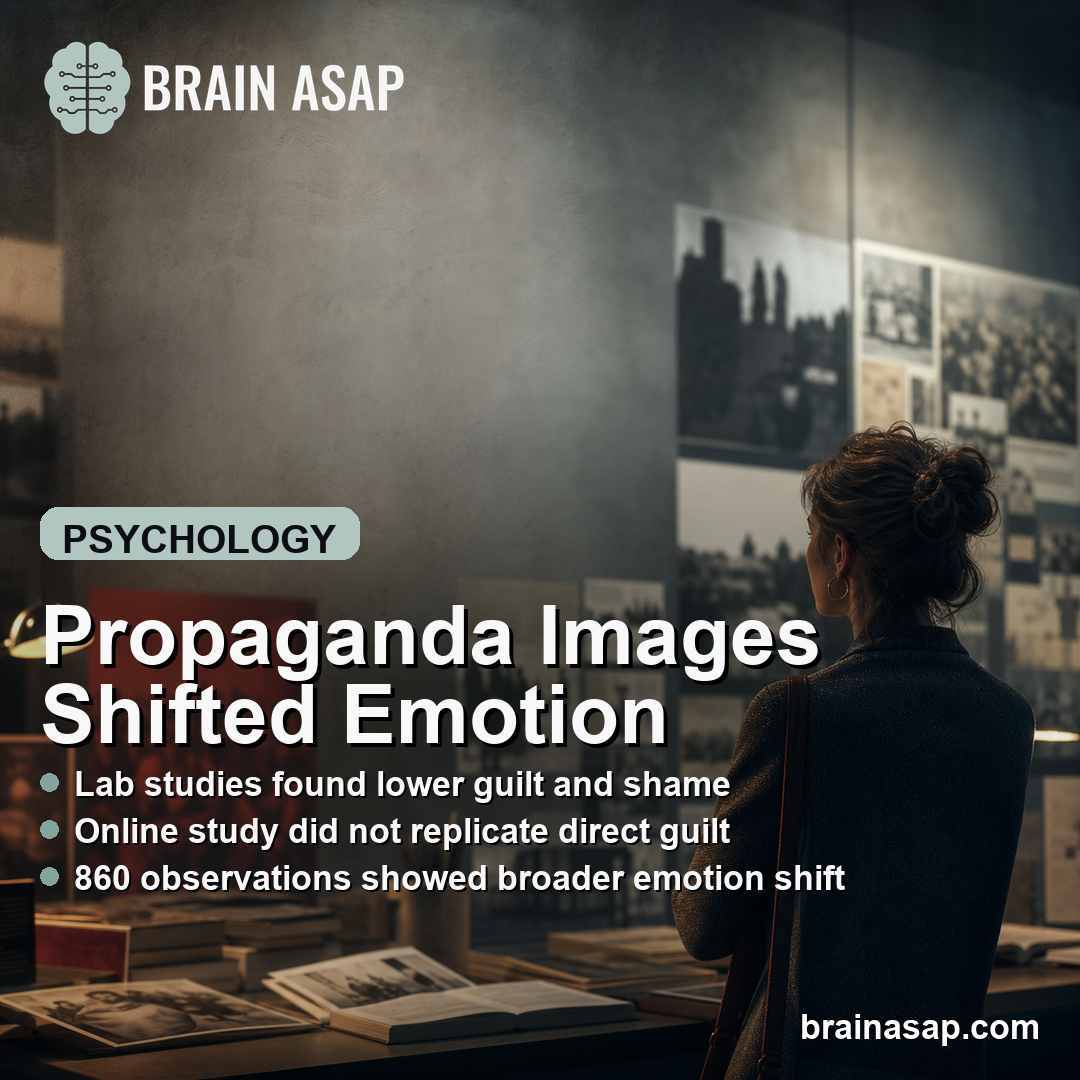
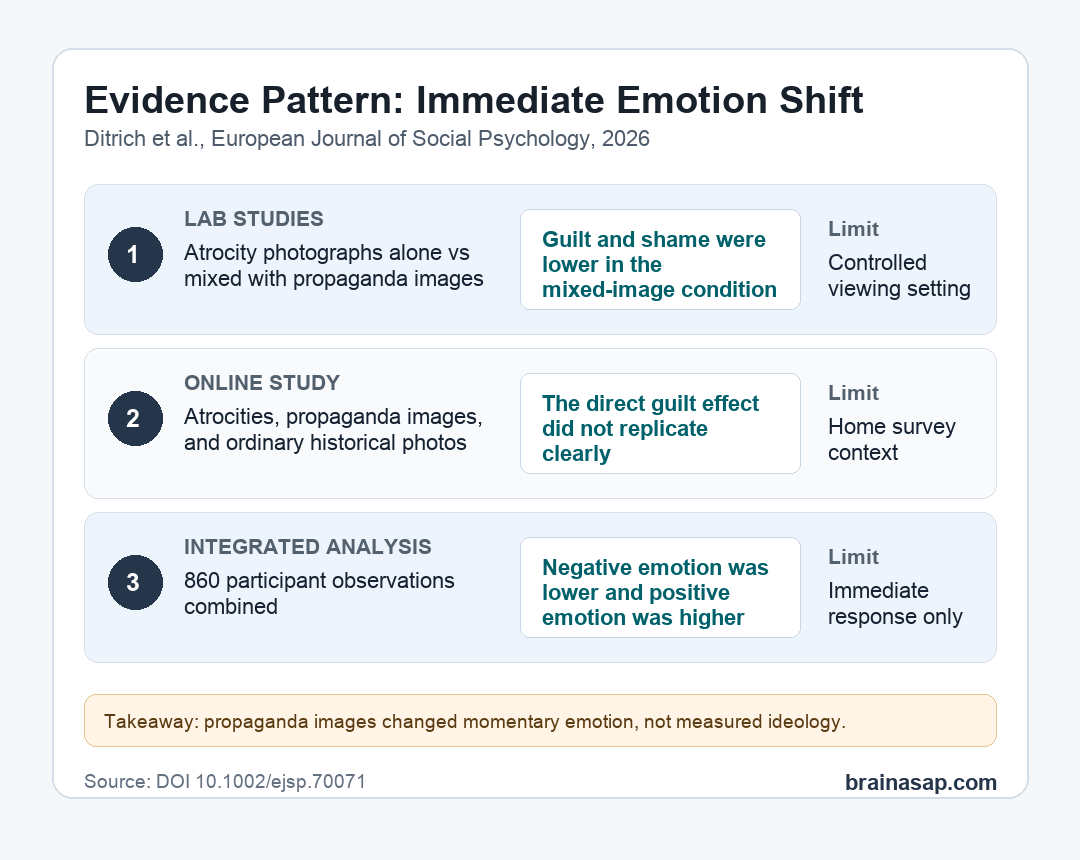
- Laboratory pattern: In two controlled lab studies, the mixed presentation reduced guilt-related emotions compared with atrocity images alone.
- Online replication limit: A larger representative online study did not show the same direct guilt reduction across conditions.
- Combined evidence: The integrated analysis of 860 observations found lower negative emotions and higher positive emotions after propaganda images were added.
- Main caution: The study measured immediate emotional responses, not endorsement of National Socialism or durable attitude change.
Source: Ditrich et al. studied how historical images that glorified Adolf Hitler changed emotional responses to Nazi-era atrocity reminders.
Historical propaganda can be dangerous even when it looks ordinary. The psychological question in this study was not whether modern viewers became supporters of National Socialism.
Researchers tested a narrower emotional effect: whether positive, humanizing images of a dictator could soften the feelings produced by photographs of atrocities.
The distinction is practical for museums, classrooms, documentaries, and online archives. A photograph can be historically real and still affect how viewers emotionally process the surrounding evidence.
Researchers Tested How Propaganda Images Changed Emotional Response
The paper focused on glorifying propaganda, not only the better-studied category of derogatory propaganda. Derogatory propaganda dehumanizes targeted groups. Glorifying propaganda makes a leader look warm, ordinary, powerful, or admirable.
Researchers asked whether flattering historical images could change how German participants felt while viewing evidence of Nazi atrocities. The key comparison was simple:
- Atrocity-only condition: Participants viewed photographs depicting Nazi-era atrocities.
- Mixed propaganda condition: Participants viewed atrocity photographs together with images that glorified Hitler.
- Ordinary-photo comparison: In the online study, one group saw atrocity images mixed with positive non-Hitler historical photographs matched for ordinary content.
The outcome was also emotional rather than ideological. Participants rated feelings such as guilt, shame, sadness, happiness, calmness, excitement, and relaxation after the image exposure.
Group-based guilt was central because it describes guilt people feel because they belong to a group linked to past wrongdoing, even when they did not personally commit the act. Here, the relevant group was modern German viewers responding to reminders of Nazi atrocities.
Lab Studies Found Less Guilt After Mixed Propaganda Images
The first two preliminary lab experiments included 66 and 77 participants. Those early studies suggested that mixing atrocity photographs with glorifying propaganda images reduced guilt-related emotion.
A larger controlled laboratory experiment then tested the pattern in 172 participants. One group viewed 16 atrocity photographs. Another group viewed 32 photographs: the same atrocity set plus 16 glorifying propaganda images.
Participants in the mixed-image group reported less guilt and shame than participants who viewed atrocity images alone. A second confirmatory laboratory study with 114 participants again found lower individual guilt and shame in the mixed condition.
Researchers also tested whether the images changed blame attribution. That analysis did not show a clear shift.
In other words, the propaganda images changed immediate emotion more clearly than they changed explicit explanations about who was responsible.
The Online Study Did Not Reproduce the Direct Guilt Effect
The strongest caution came from the largest individual study. Researchers ran an online experiment with 643 German participants selected to be representative by age and gender.
This online study added the ordinary-photo comparison group. The extra comparison separated a specific propaganda effect from a general distraction effect caused by adding positive historical images to a disturbing slideshow.
In the online setting, the different image sets did not produce significant differences in reported guilt or subconscious guilt-related measures. The likely reason was not settled, but researchers noted plausible context differences:
- Attention setting: Laboratory participants sat in controlled cubicles, while online participants completed the task at home.
- Engagement level: Online viewers may have looked less closely or felt less pressure to process the images deeply.
- Replication boundary: The direct guilt result was not equally visible across every format.
For that reason, the finding should not be oversold as a universal propaganda effect. The cleaner claim is that the laboratory studies showed guilt reductions, while the broader dataset supported a wider immediate emotional shift.
Combined Data Showed Lower Negative Emotion and More Positive Emotion
Researchers then combined all experiments into an integrated analysis with 860 participant observations. Across that combined evidence, adding glorifying propaganda images was associated with lower negative emotions and higher positive emotions.
The emotional shift was broader than guilt. Participants exposed to mixed propaganda images tended to report more positive states such as happiness, calmness, excitement, and relaxation, while negative emotions were softened.
A practical interpretation is that positive dictator imagery can redirect attention away from atrocity evidence. The paper discusses attentional deployment, a process in which people manage emotion by shifting attention toward less upsetting material.
This mechanism fits the design: smiling or approachable images can dilute the emotional weight of atrocity photographs without requiring viewers to consciously change their beliefs.
- What changed: Momentary emotional response after image exposure.
- What did not clearly change: Explicit attitudes toward National Socialism in the measures reported.
- What remains uncertain: Whether similar effects occur with modern political imagery, different audiences, or repeated exposure.
Historical Image Context Can Shift Emotional Memory
The study does not argue that museums should hide historical propaganda. It suggests that presentation context can change how viewers emotionally process a display.
Images made to glorify a leader can still carry emotional design, even when viewers know they are looking at propaganda.
Educational use may need framing that exposes the manipulation. A flattering image placed beside atrocity documentation can change the emotional balance of the display, so captions and sequencing are part of the evidence environment.
The same logic applies beyond the 1930s and 1940s. Modern audiences encounter political images, AI-generated visuals, campaign clips, and archival fragments stripped from their original setting.
The BrainASAP-relevant point is about emotion regulation and media psychology: visual material can change affect before it changes belief.
The study’s boundary is important. It measured short-term emotional ratings after image exposure, not long-term memory, historical understanding, policy attitudes, or sympathy for extremist ideology.
The practical warning is direct: propaganda does not have to persuade viewers openly to shape a response. It can work more quietly by making a disturbing evidence set feel less disturbing in the moment.
Citation: DOI: 10.1002/ejsp.70071. Ditrich et al. Vicious Pictures? How National Socialist Propaganda Glorifying Adolf Hitler Affects Contemporary Viewers’ Emotions. European Journal of Social Psychology. 2026.
Study Design: Four experimental image-exposure studies plus an integrated analysis of the combined evidence.
Sample Size: 66, 77, 172, 114, and 643 participants across the reported studies, with 860 participant observations in the integrated analysis.
Key Statistic: The mixed propaganda condition reduced guilt-related emotions in laboratory studies, while the integrated analysis found lower negative emotion and higher positive emotion across the combined dataset.
Caveat: The largest online study did not reproduce the direct guilt effect, and the research measured immediate emotional response rather than long-term attitude change.