TL;DR: When 35 adults got fake feedback saying they were making more mistakes, they slowed down slightly, and they slowed most when told the buttons were faulty. Errors blamed on the machine also triggered a stronger brain “alert” signal than errors blamed on…
Read article ↗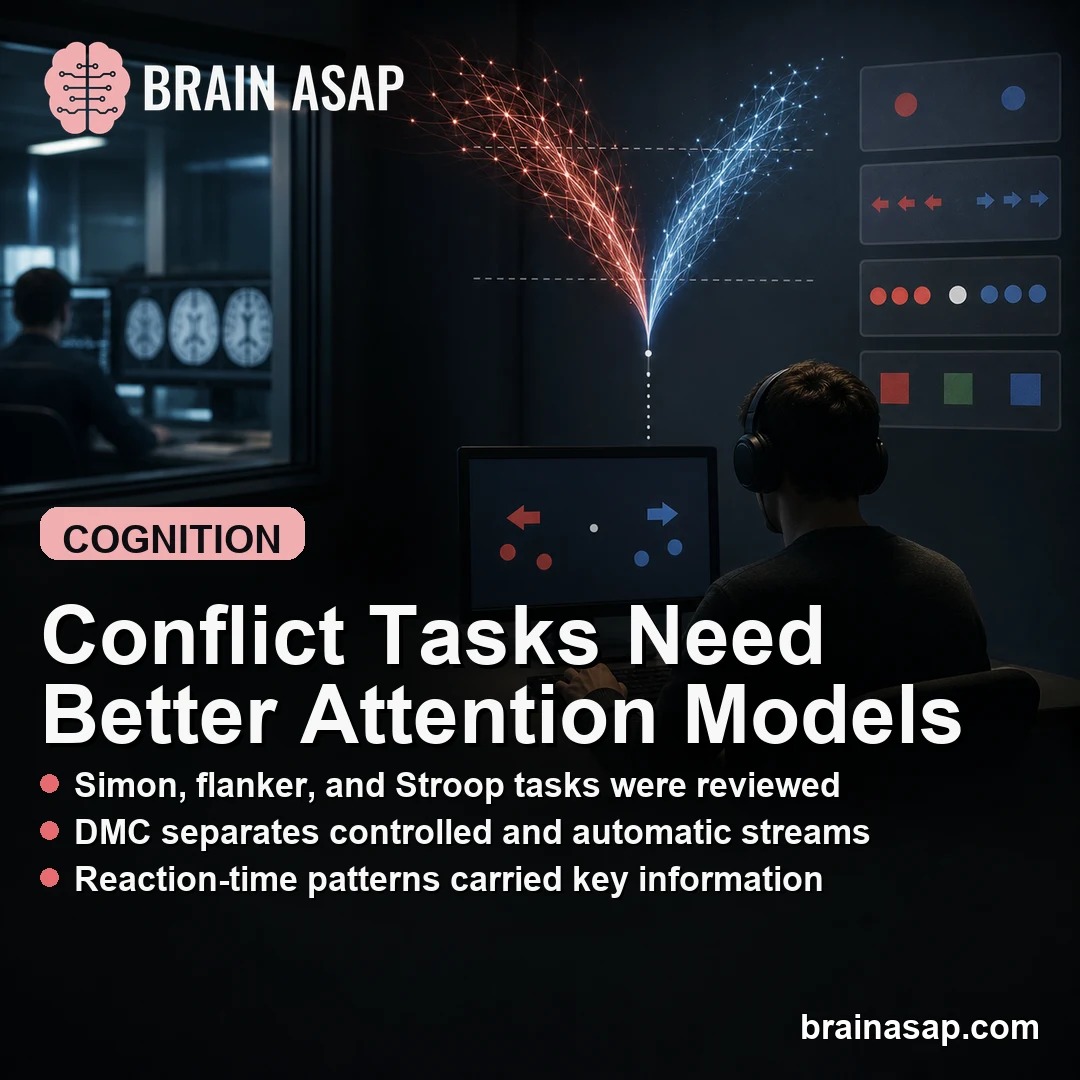
TL;DR: A 2026 review in Psychonomic Bulletin & Review explained how the Diffusion Model for Conflict tasks (DMC) models attention and cognitive control in Simon, Eriksen flanker, and Stroop tasks. Key Findings 3 classic tasks: The review focused on Simon, Erik…
Read article ↗
TL;DR: A 2026 study in Cognitive, Affective, & Behavioral Neuroscience found that lower frontal midline theta, an EEG marker of cognitive-control engagement, partly explained why young adults with higher negative emotionality performed worse on a Go/No-Go inhi…
Read article ↗
TL;DR: Across 4,000+ people, the relationship between brain activity and cognitive control flipped direction depending on whether researchers compared people to each other or tracked the same person over time. The finding is called nonergodicity — and it means…
Read article ↗