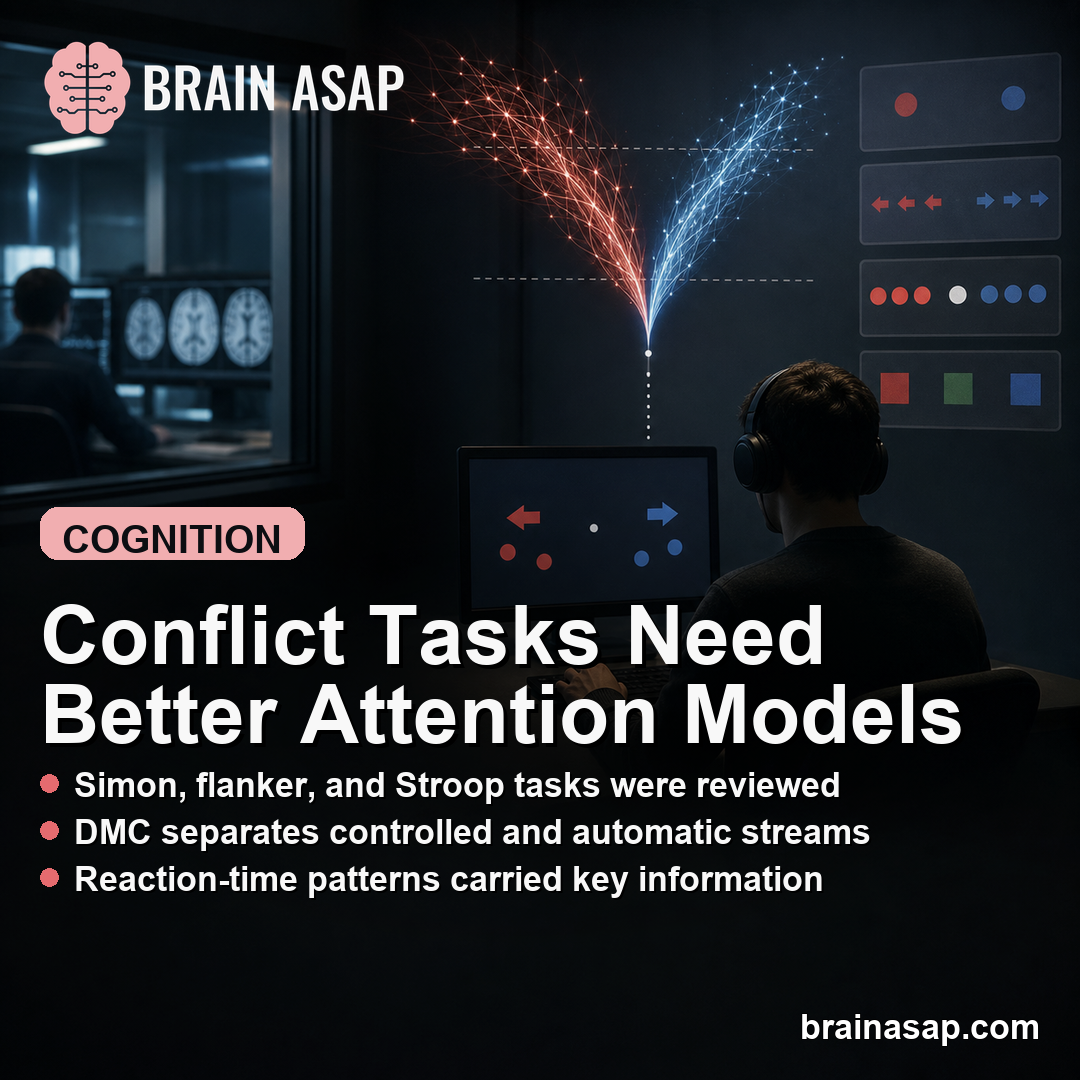
TL;DR: A 2026 review in Psychonomic Bulletin & Review explained how the Diffusion Model for Conflict tasks (DMC) models attention and cognitive control in Simon, Eriksen flanker, and Stroop tasks.
Key Findings
- 3 classic tasks: The review focused on Simon, Eriksen flanker, and Stroop conflict tasks.
- 2 evidence streams: DMC combines a linear controlled stream for task-relevant information with a pulse-like automatic stream for task-irrelevant information.
- Congruency effect: All conflict tasks show better performance when relevant and irrelevant stimulus features point to the same response.
- Reaction-time distributions: DMC was built to model the full reaction-time pattern, not only average response speed.
- Standardization gap: The review concluded that DMC is useful but still needs more standardized application and extension to other conflict tasks.
Source: Psychonomic Bulletin & Review (2026) | Janczyk et al.
Diffusion Model for Conflict tasks (DMC) is a cognitive model for situations where the brain must follow the relevant instruction while suppressing a competing cue. The review explains why average reaction time is not enough to describe that process.
Conflict tasks are simple in the lab but important for cognitive psychology. They test selective attention, response selection, and the timing of automatic impulses that can briefly pull behavior away from the intended response.
Simon, Flanker, and Stroop Tasks Separate Relevant From Irrelevant Cues
The review starts with a shared structure across the main conflict tasks. Participants respond to 1 stimulus feature and ignore another feature that may support or interfere with the correct response.
In congruent trials, the relevant and irrelevant features point toward the same response. In incongruent trials, they point in different directions, producing the congruency effect: slower or less accurate responses when conflict is present.
- Simon task: A person responds to a stimulus identity while ignoring its spatial location.
- Eriksen flanker task: A person responds to a central target while ignoring surrounding distractors.
- Stroop task: A person responds to ink color while ignoring the written word when the word names a different color.
These tasks all produce conflict, but they do not produce identical timing patterns. That is why DMC focuses on reaction-time distributions and accuracy patterns, not just 1 mean score.
DMC Adds Controlled Evidence to an Automatic Pulse
DMC builds on diffusion models, which treat two-choice decisions as noisy evidence accumulation over time. The distinctive DMC move is to add 2 independent streams before the response threshold is reached.
The controlled stream is linear and reflects task-relevant processing. The automatic stream is pulse-like: it rises quickly in response to task-irrelevant information, reaches a maximum, and then fades.
- Controlled processing: Evidence steadily accumulates for the instructed response.
- Automatic processing: Irrelevant stimulus information briefly activates the response it is associated with.
- Combined decision path: The 2 streams are superimposed, so the automatic pulse can help or hinder the final response depending on congruency.
This architecture lets the model represent why an irrelevant cue can have a strong early effect but less influence later in a trial.
Delta Functions Show When Conflict Changes During a Response
The review emphasizes delta functions, which plot the size of the congruency effect across different reaction-time levels. A delta function can show whether conflict grows, shrinks, or even reverses among slower responses.
Simon, flanker, and Stroop tasks can have different distributional shapes. A model that fits only average reaction time may miss the timing signature that separates one task from another.
- Positive slope: The congruency effect grows for slower responses, a pattern often seen in flanker and Stroop tasks.
- Negative slope: The congruency effect shrinks for slower responses, a pattern often discussed in Simon-task data.
- Conditional accuracy: Accuracy can also change across reaction-time bins, which adds another constraint on the model.
DMC’s automatic pulse gives the model a way to explain these timing patterns. A fast pulse can strongly affect early responses and then fade before later responses are made.
DMC Has Been Used Beyond One Laboratory Paradigm
Janczyk et al. describe DMC as a framework that has been applied across psychological domains, not as a single-task curve-fitting trick.
Its appeal is that it connects observed reaction-time distributions to a process account of selective attention.
The review also discusses technical issues such as parameter estimation, parameter recovery, and the need to check whether a fitted parameter can be reliably recovered from the available data.
- Application strength: DMC can formalize whether conflict effects arise from controlled evidence, automatic activation, or their timing.
- Modeling strength: It uses both reaction time and accuracy, which gives more information than mean response time alone.
- Interpretation risk: Parameters can look meaningful even when the data do not support stable recovery.
Parameter recovery is important for cognitive modeling. A model can fit behavior well while still leaving uncertainty about the psychological interpretation of individual parameters.
The Review Calls for More Standardized DMC Use
The review’s conclusion is balanced. DMC is presented as a powerful tool for selective attention and cognitive-control research, but not as a finished standard for every conflict task.
The review notes limited standardization in how DMC is applied. It also calls for more work extending the model to other conflict-task classes and improving practical use around estimation and validation.
- Current value: DMC gives researchers a formal way to model conflict dynamics instead of describing only average congruency effects.
- Current boundary: Applications need careful parameter checks and transparent reporting.
- Next step: Broader task coverage and stronger standardization would make DMC easier to compare across studies.
The review’s main contribution is conceptual clarity: cognitive conflict is not a single delay, but a time-varying interaction between instructed control and automatic activation.
Citation: DOI: 10.3758/s13423-026-02878-8. Janczyk et al. 10 years Diffusion Model for Conflict (DMC) tasks: Theoretical foundations, applications, practical recommendations, and open challenges. Psychonomic Bulletin & Review. 2026;33:150.
Study Design: Theoretical review of the Diffusion Model for Conflict tasks and its applications.
Sample/Model: Cognitive-modeling framework for Simon, Eriksen flanker, Stroop, and related conflict tasks.
Key Statistic: Not an outcome trial; DMC models conflict behavior through 2 superimposed evidence-accumulation streams.
Caveat: DMC applications still need stronger standardization and careful parameter-recovery checks.