TL;DR: A 2026 study in Cognitive, Affective, & Behavioral Neuroscience found that lower frontal midline theta, an EEG marker of cognitive-control engagement, partly explained why young adults with higher negative emotionality performed worse on a Go/No-Go inhibition task.
Key Findings
- 106 young adults completed EEG testing: U.S. Army National Guard recruits performed a Go/No-Go task while researchers measured frontal midline theta at frontocentral scalp electrodes.
- Negative emotionality predicted poorer discrimination: Higher negative emotionality was linked to lower d-prime performance on the inhibition task (beta = -0.234; 95% CI, -0.392 to -0.076).
- Frontal midline theta carried the main brain result: The theta measure mediated the relationship between negative emotionality and task discrimination (indirect effect ab = -0.105; 95% bootstrapped CI, -0.207 to -0.009).
- Alpha activity did not explain the same link: Occipital alpha desynchronization changed with task difficulty but did not mediate the negative-emotionality performance relationship.
- The study is about vulnerability, not diagnosis: The sample was not a clinical patient group, so the finding is best read as a brain-behavior clue for stress-related risk and self-regulation.
Source: Cognitive, Affective, & Behavioral Neuroscience (2026) | Teich et al.
Negative emotions can make cognitive control harder in ordinary life. A person under stress may still know what to do, but inhibition, attention, and response timing can become less steady.
The researchers tested one possible brain pathway for that problem: frontal midline theta, a low-frequency EEG rhythm often seen when the frontal control system is working.
The researchers focused on negative emotionality (NEM), a personality measure tied to anxiety, fear, stress reactivity, and transdiagnostic mental-health risk. The question was concrete: when people high in NEM perform a task that requires stopping a response, does frontal theta help explain why performance suffers?
Go/No-Go Testing Measured Inhibitory Control Under Demand
The study included 106 young adult U.S. Army National Guard recruits preparing for basic combat training. Early adulthood is also a period when many mental-health conditions emerge.
Military training also adds a real-world stress context, which made the sample relevant to stress-vulnerability research.
Participants completed a Go/No-Go task while EEG was recorded. In a Go/No-Go task, most cues require a button press, but some cues require the person to withhold that response.
The task therefore measures inhibitory control, the ability to stop an action that has become automatic.
The researchers varied task difficulty across three blocks. The middle block was the most demanding, and performance reflected that pressure:
- Block 1 standard condition: mean d-prime was 1.44, with Go accuracy of 86.9% and No-Go accuracy of 58.5%.
- Block 2 challenging condition: mean d-prime dropped to 1.30, and No-Go accuracy fell to 50.7%.
- Block 3 standard condition: mean d-prime rose to 1.53, possibly reflecting practice after the harder block.
Those values show that the task was not a simple reaction-time exercise. It created enough control demand to expose individual differences in response inhibition.
Frontal Midline Theta Tracked Control Engagement
Frontal midline theta refers to EEG activity in the 3-8 Hz range over frontocentral scalp regions, near the FCz electrode location. It is commonly linked to cognitive control, conflict monitoring, and the effort needed to stop or adjust behavior.
In this study, theta activity was stronger for correct No-Go trials than for correct Go trials. That fits the basic task logic: withholding a response requires more control than pressing the button when expected.
The researchers also measured occipital alpha activity, a posterior rhythm related to visual attention and task engagement. Alpha desynchronization changed with task difficulty, especially in the more difficult block.
That alpha measure did not explain the NEM-performance relationship. The central pathway belonged to frontal theta.
Higher Negative Emotionality Predicted Lower Task Discrimination
The behavioral result was direct. People with higher NEM had lower Go/No-Go discrimination across task blocks. The reported association was beta = -0.234, with a 95% confidence interval from -0.392 to -0.076.
Recruits who reported more chronic negative emotionality were less able to separate press trials from stop trials. The finding is not a claim about carelessness or motivation.
The measured control system performed less efficiently when trait-level emotional reactivity was higher.
The same analysis also found that higher constraint was associated with slower response times. That result is separate from the NEM finding, but it helps interpret the task: speed, caution, and discrimination were not the same thing.
Frontal Theta Partly Explained the Emotion-Control Link
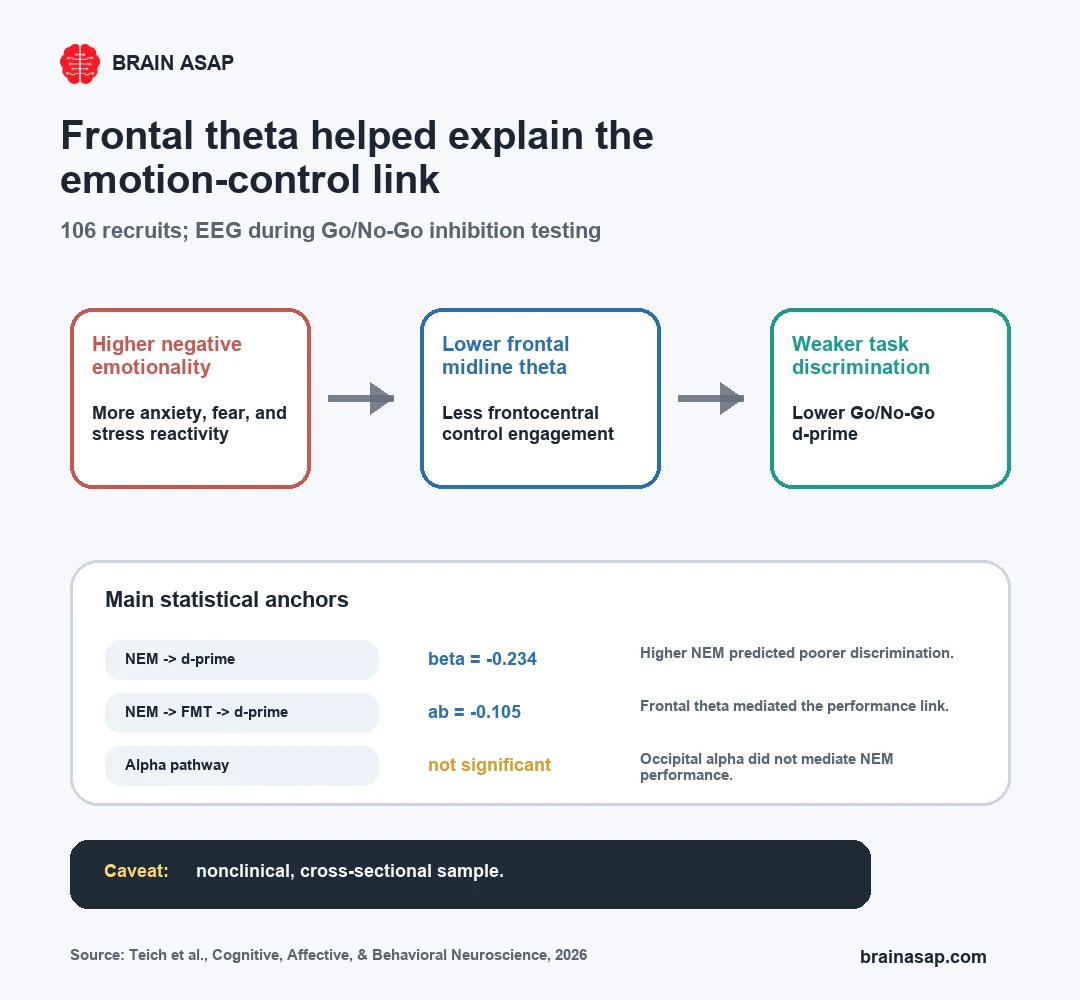
The mediation analysis was the main result. Frontal midline theta mediated the association between NEM and d-prime performance, with an indirect effect of ab = -0.105 and a bootstrapped 95% confidence interval from -0.207 to -0.009.
The component paths pointed in the expected direction:
- Higher NEM related to lower frontal theta: the NEM-to-theta path was negative (a = -0.200).
- Higher frontal theta related to better discrimination: the theta-to-d-prime path was positive (b = 0.527).
- Alpha did not carry the same pathway: the alpha indirect effect confidence interval crossed zero.
Frontal theta also mediated links between NEM and two response-time measures: mean Go reaction time and reaction-time variability. That broader pattern suggests the issue was not only accuracy.
Higher negative emotionality was tied to a less stable control profile, and frontal theta helped account for the response-timing and accuracy profile.
The Result Fits Stress-Vulnerability Science
This study does not diagnose anyone, and it does not prove that frontal theta causes anxiety, depression, or later stress symptoms. The participants were a nonclinical recruit sample, and the design was cross-sectional.
The useful interpretation is narrower and stronger. A brain rhythm associated with cognitive control appeared to be one pathway between trait negative emotionality and poorer inhibition-task performance.
Frontal theta is therefore a candidate marker for how emotional vulnerability can affect self-regulation under demand.
For mental-health research, the finding is practical because many conditions share the same control problem. Anxiety, depression, trauma symptoms, and substance-use risk can all involve difficulty pausing, shifting attention, or keeping behavior aligned with longer-term goals during stress.
What This EEG Study Adds
The result’s value is not that EEG can read someone’s personality. It cannot. The value is that EEG can help separate different pieces of a broad behavioral problem.
Negative emotionality was linked to task performance. Frontal midline theta helped explain that link. Occipital alpha changed with task demand but did not explain the same emotion-control pathway.
Those distinctions matter because they point future studies toward a specific frontocentral control process rather than a generic claim that stress affects the brain.
The next step is longitudinal work. If frontal theta measured before a stressor predicts who later develops cognitive-control problems or mental-health symptoms, the marker would become much more useful.
For now, the study gives a focused readout: emotional reactivity, frontal control engagement, and response inhibition are connected in measurable EEG data.
Citation: DOI: 10.3758/s13415-026-01434-0. Teich et al. Neural mechanisms of negative emotionality and cognitive control: The role of frontal midline theta. Cognitive, Affective, & Behavioral Neuroscience. 2026.
Study Design: Cross-sectional EEG study using a Go/No-Go cognitive-control task and personality measures.
Sample Size: 106 young adult U.S. Army National Guard recruits.
Key Statistic: Frontal midline theta mediated the association between negative emotionality and lower task discrimination (indirect effect ab = -0.105; 95% bootstrapped CI, -0.207 to -0.009).
Caveat: The sample was nonclinical and cross-sectional, so the result identifies an association pathway rather than proving later mental-health risk.