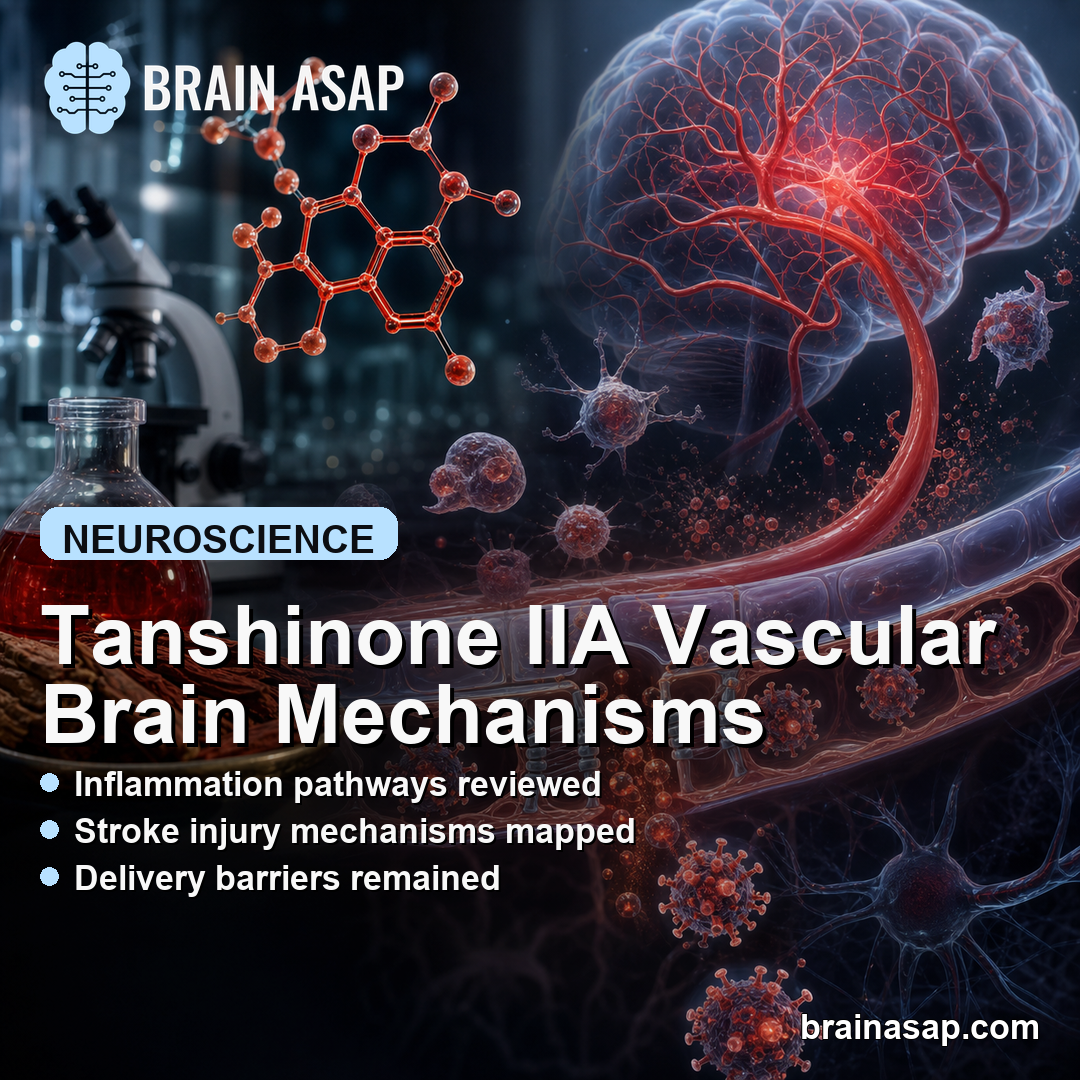
TL;DR: A 2026 review in International Journal of Molecular Medicine summarized how tanshinone IIA, a compound from Salvia miltiorrhiza, may protect cardiovascular and cerebrovascular tissue through anti-inflammatory, antioxidant, anti-apoptotic, and nanodelivery-linked mechanisms.
Key Findings
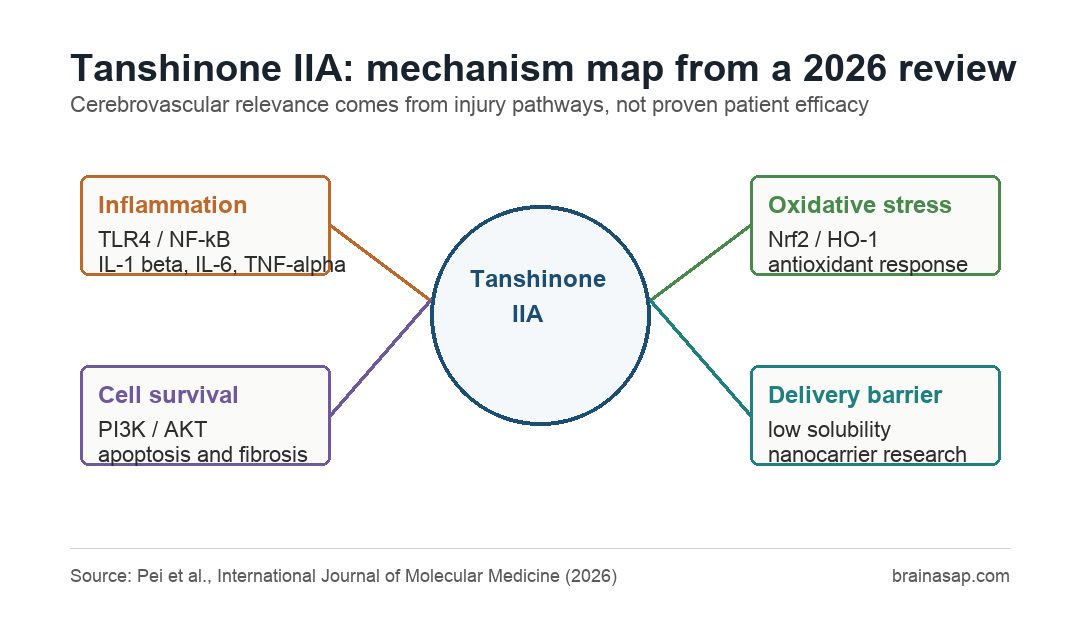
- Four mechanism families: The review grouped tanshinone IIA activity around inflammation, oxidative stress, apoptosis/fibrosis, and pathway regulation.
- Three named pathways: TLR4/NF-kB, PI3K/AKT, and Nrf2/HO-1 were repeatedly highlighted as signaling routes tied to vascular protection.
- Stroke biology included: The cerebrovascular section discussed ischemia-hypoxia, calcium overload, oxidative stress, inflammation, blood-brain barrier disruption, and neuronal injury.
- Delivery remains a bottleneck: The authors emphasized low solubility and bioavailability as reasons for interest in rHDL, TPP-TPGS/LPNs, and cBSA-PEG-TSA-NPs.
- Clinical translation is not settled: The source is a narrative mechanistic review, so it does not prove a treatment effect for stroke, dementia, or heart disease patients.
Source: International Journal of Molecular Medicine (2026) | Pei et al.
Tanshinone IIA is an active compound isolated from Salvia miltiorrhiza, also known as Danshen. The new review asked why this molecule keeps appearing in cardiovascular and cerebrovascular disease research.
No single target explained the review’s rationale. The review described tanshinone IIA as a multi-pathway compound whose possible value depends on whether lab mechanisms can be translated into stable, targeted, clinically workable delivery.
Tanshinone IIA Was Framed Around Cardiovascular and Cerebrovascular Disease Mechanisms
The review used the umbrella term cardiovascular and cerebrovascular diseases for conditions that share vascular injury, inflammation, oxidative stress, and tissue remodeling. That includes atherosclerosis, myocardial infarction, heart failure, hypertension, and stroke-related biology.
The cerebrovascular section is the clearest brain-health link. The review described ischemic stroke as a chain that begins with vascular occlusion and cerebral hypoperfusion, then extends into energy failure, calcium overload, oxidative stress, inflammation, and neuronal injury.
The review also noted secondary injury after stroke, including cerebral edema and blood-brain barrier disruption. Those are not small details: barrier injury can worsen inflammation and alter how drugs or inflammatory molecules reach brain tissue.
The paper organized tanshinone IIA around several recurring biological jobs:
- Inflammation control: Suppression of inflammatory cytokines and Toll-like receptor/NF-kB signaling.
- Oxidative-stress control: Support for antioxidant pathways, including Nrf2-linked gene expression.
- Cell-survival signaling: Modulation of apoptosis, mitochondrial dysfunction, fibrosis, and PI3K/AKT-related pathways.
- Delivery engineering: Nanocarrier systems intended to improve solubility, circulation time, and targeting.
TLR4/NF-kB and Cytokines Were Central to the Inflammation Argument
Inflammation is one of the review’s main links between vascular disease and brain injury. One recurring pathway was TLR4/NF-kB signaling, which can increase pro-inflammatory gene activity after cellular stress.
Several cited experiments connected tanshinone IIA with lower inflammatory markers. The review described reductions in cytokines such as IL-1 beta, IL-6, IL-8, and TNF-alpha in different cell or disease models.
The point is not that every inflammatory disease should be treated with this compound. The narrower conclusion is that tanshinone IIA repeatedly appears in models where vascular inflammation, macrophage activation, or endothelial injury is part of the disease process.
In cerebrovascular disease, inflammation after ischemia can worsen vascular leakage, immune-cell recruitment, and downstream neuronal damage. A compound that changes those pathways becomes a plausible research candidate for stroke-related injury.
Nrf2/HO-1 and PI3K/AKT Linked the Review to Oxidative Stress and Cell Survival
Oxidative stress was the second major theme. The review described tanshinone IIA as increasing antioxidant defenses and reducing injury caused by reactive oxygen species in cardiovascular and neuronal models.
One pathway stood out: Nrf2/HO-1. Nrf2 is a transcription factor that helps turn on antioxidant-response genes, while HO-1 is one downstream enzyme often used as a marker of that protective response.
The review also discussed PI3K/AKT signaling, a cell-survival pathway that can influence apoptosis, mitochondrial stress, and tissue repair. In this framing, tanshinone IIA is not just an antioxidant; it appears to influence signaling systems that decide whether stressed cells survive or deteriorate.
The mechanism evidence can be read in three layers:
- Cell stress: Studies cited lower oxidative injury and altered antioxidant enzyme activity.
- Mitochondrial injury: The review connected tanshinone IIA with reduced caspase activation and mitochondrial dysfunction in stress models.
- Tissue remodeling: Anti-fibrotic and anti-apoptotic effects were discussed as possible routes to vascular and cardiac protection.
Stroke Relevance Came From Injury Pathways, Not a Proven Patient Trial
The cerebrovascular section discussed stroke because ischemic injury creates the same pressure points that appeared elsewhere in the review: oxidative stress, inflammation, calcium overload, blood-brain barrier damage, and neuronal death.
The review cited work in primary rat cortical neurons where tanshinone IIA reduced hydrogen peroxide-induced cytotoxicity. That kind of evidence helps map mechanism, but it is still preclinical evidence.
A careful read separates what the review supports from what it does not:
- Supported: Tanshinone IIA has been studied across vascular, cardiac, inflammatory, oxidative-stress, and neuronal-injury models.
- Not established: The review does not show that tanshinone IIA improves stroke recovery in a large randomized patient trial.
- Research implication: The strongest rationale is pathway convergence, especially where cerebrovascular injury depends on inflammation and oxidative stress.
This distinction keeps the clinical interpretation grounded. Compounds with many lab mechanisms often sound more clinically mature than they are, and this source is best read as a mechanism map rather than a treatment recommendation.
Nanodelivery Systems Tried to Solve the Solubility and Targeting Problem
The review repeatedly returned to formulation. Tanshinone IIA has pharmacologic promise, but poor solubility and limited bioavailability make ordinary delivery difficult.
That is why the review highlighted nanodelivery systems such as rHDL, TPP-TPGS/LPNs, and cBSA-PEG-TSA-NPs. These platforms were presented as ways to improve circulation, tissue targeting, mitochondrial delivery, or vascular transport.
For brain and vascular applications, delivery is not a technical afterthought. A compound has to reach the relevant tissue at a biologically active concentration without creating avoidable toxicity, and blood-brain barrier disruption can change both opportunity and risk.
The interpretation should stay restrained. Tanshinone IIA remains a plausible research candidate because its mechanisms overlap with vascular and cerebrovascular injury pathways, but delivery, dosing, safety, and human efficacy remain unresolved.
Citation: DOI: 10.3892/ijmm.2026.5791. Pei et al. Research progress on the molecular mechanisms of tanshinone IIA in the treatment of cardiovascular and cerebrovascular diseases (Review). International Journal of Molecular Medicine. 2026;57:120.
Study Design: Narrative mechanistic review of tanshinone IIA studies across cardiovascular and cerebrovascular disease models.
Sample/Model: Published cell, animal, pathway, and drug-delivery studies; not a new patient cohort or randomized trial.
Key Statistic: The review highlighted four main mechanism categories and three recurring pathways: TLR4/NF-kB, PI3K/AKT, and Nrf2/HO-1.
Caveat: Mechanistic and preclinical support does not establish clinical benefit for stroke or cardiovascular patients without human efficacy trials.