A Visual Autism Subtype Left a Fusiform Lipid Signature
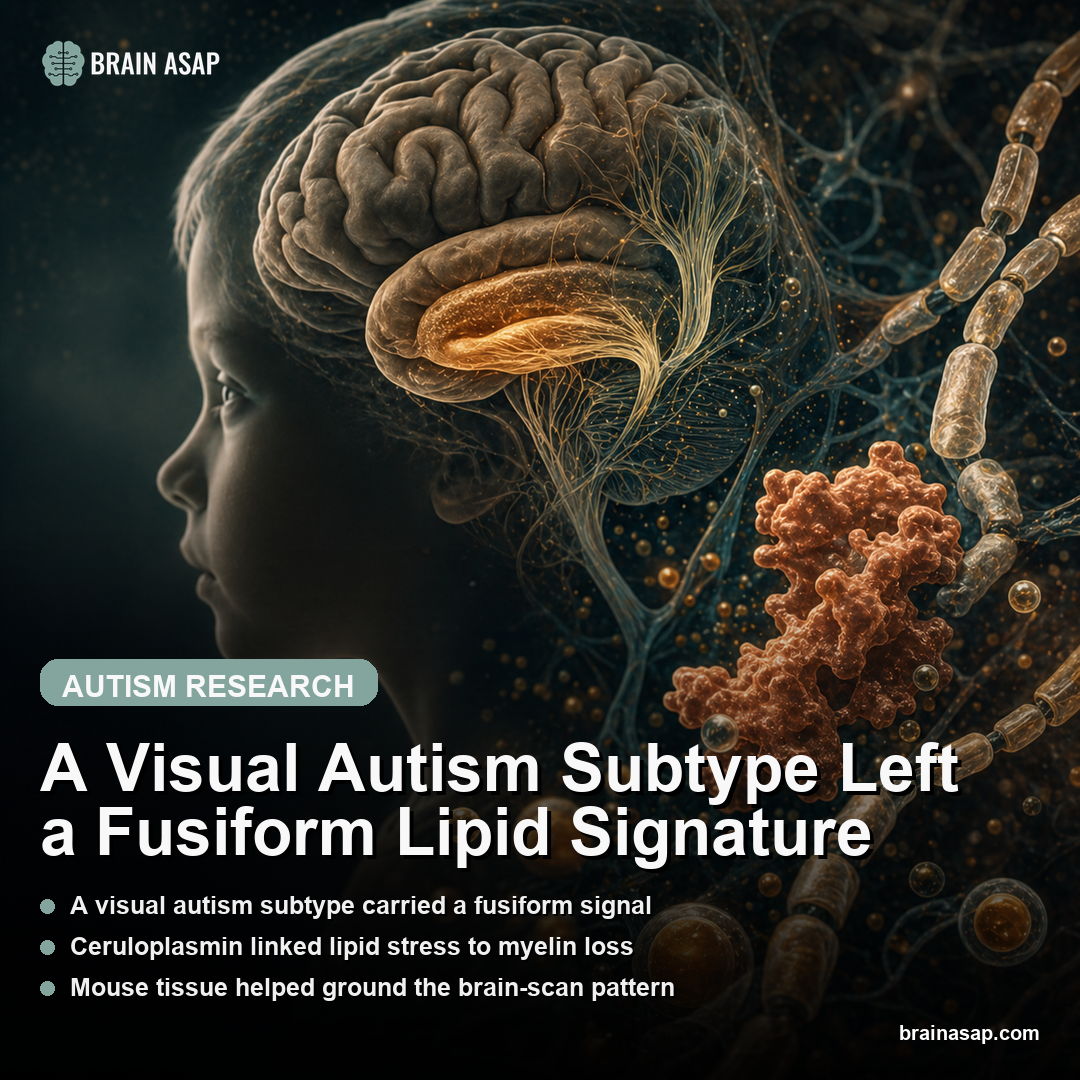
TL;DR: A Molecular Psychiatry study suggests that autistic children with atypical visual processing carry a distinct fusiform gyrus lipid-myelin signature, tied to low ceruloplasmin and strong MRI-based subtype discrimination.
Key Findings
- Fusiform subtype emerged in 288 children: The study included 90 autistic children with atypical visual processing, 89 autistic children without it, and 109 typically developing controls, then paired multimodal MRI with serum biomarker testing.
- The fusiform gyrus carried the clearest co-pathology: The ASD-AVP subgroup showed elevated lipid and myelin measures centered on the fusiform gyrus, with a positive lipid-myelin correlation on both sides of the brain (left r = 0.47, right r = 0.41).
- Ceruloplasmin and iron were low while lead was high: The same subgroup had reduced serum ceruloplasmin and iron, plus elevated lead, linking a brain-imaging phenotype to a peripheral biomarker profile.
- Mediation analysis tied ceruloplasmin to myelination through lipid pathways: The authors estimate that lipid-related mediation explained 35% to 55% of the ceruloplasmin effect on fusiform myelination.
- The MRI signature classified the subtype well: A combined fusiform lipid-myelin signature distinguished ASD-AVP from controls at AUC 0.93 and from autistic children without AVP at AUC 0.87.
- BTBR mice partly recapitulated the pattern: In a mouse validation arm, AVP-like BTBR mice showed disorganized hypermyelination, giving the human imaging result at least one mechanistic foothold.
Source: Molecular Psychiatry (2026) | Deng et al.
Autism biomarkers often promise subtypes and deliver blur. This paper is more specific. It argues that one clinically recognizable subgroup, children with atypical visual processing, carries a measurable lipid-and-myelin pathology centered on the fusiform gyrus.
Why the Fusiform Gyrus Keeps Showing Up in Autism’s Visual Phenotypes
Autism is full of sensory findings that are real but frustratingly broad. Visual hypersensitivity, local-processing bias, gaze avoidance, and face-processing differences all show up often enough to matter, but not cleanly enough to define a biological subgroup. This paper tries to cut through that fog by focusing on one phenotype: atypical visual processing, or AVP.
The logic of the target is strong. The fusiform gyrus sits at the crossroads of higher-order visual processing, especially faces and socially relevant visual information. If one autism subgroup has a genuinely distinct visual-cognitive profile, the fusiform region is a plausible place to look for structural and biochemical clues.
What makes this paper more than another MRI catalog is the multimodal pairing. The authors measured brain lipid content and myelin content, then linked those readouts to serum ceruloplasmin, iron, and lead. That turns a regional imaging difference into a candidate biological pathway.
What 288 Children Revealed About a Fusiform Lipid-Myelin Co-Pathology
The human cohort included 179 children with autism and 109 typically developing controls. Within the autism group, the key split was clinical:
- ASD-AVP group: 90 autistic children with atypical visual processing.
- ASD-no-AVP group: 89 autistic children without atypical visual processing.
- Control group: 109 typically developing children.
That distinction mattered more than simply comparing “autism” against “control.”
The ASD-AVP subgroup showed a striking co-pattern in the fusiform gyrus: elevated lipid measures and elevated myelin measures that moved together. The within-region correlations were not tiny side notes. The paper reports r = 0.47 on the left and r = 0.41 on the right, suggesting that the two tissue signals were coupled rather than coincidentally abnormal.
This is an interesting twist because more myelin is not automatically better. The authors frame the pattern as a potentially maladaptive pseudo-compensation, not as efficient neural insulation.
This corrects an important misconception. In neurodevelopment, apparent excess can reflect disorganization just as much as strength.
The paper therefore argues for a subtype model in which visual dysfunction in autism is not only behavioral. It may be rooted in a regionally focused tissue abnormality centered on a brain area already known to matter for face and object processing.
Ceruloplasmin May Sit Upstream of the Myelin Signal
The peripheral biomarker data are what give the imaging result extra bite. Children in the ASD-AVP subgroup had lower ceruloplasmin and iron, plus higher lead, compared with the other groups.
Ceruloplasmin matters because it helps regulate iron metabolism and redox balance. If it is low, lipid handling and myelin integrity can both become unstable.
The mediation analysis is where the paper makes its boldest mechanistic claim. According to the authors, lipid pathways mediated roughly 35% to 55% of the relationship between ceruloplasmin deficiency and fusiform myelination. That does not prove the full causal chain, but it is more than a loose association.
The proposed mechanism is that low ceruloplasmin shifts lipid biology, those lipid changes alter myelin organization in the fusiform gyrus, and that tissue-level change contributes to an atypical visual-processing phenotype.
Even if future work revises the exact steps, it is a much more concrete subtype model than the usual autism-biomarker handwaving.
The lead finding also deserves notice, though cautiously. Elevated lead in the AVP subgroup is plausibly biologically relevant, environmentally confounded, or both.
The paper cannot settle that question. But it does underline that the subtype may be shaped by a broader metabolic exposure context, not only by intrinsic neurodevelopmental differences.
The Mouse Validation Helps but Does Not Fully Rescue the Claim
The study added an animal arm using BTBR mice stratified by visual phenotype. The reason is MRI biomarkers often stop at pattern recognition. Here, the AVP-like mice showed disorganized hypermyelination, whereas non-AVP-like animals showed a different myelin profile.
That is helpful because it supports the idea that the human imaging signal reflects real tissue architecture rather than only scanner math. It also gives the authors room to argue that the lipid-myelin pattern is not a trivial consequence of broader autism severity.
But the validation is not a full translation bridge. Mouse visual-social processing is not human fusiform function, and autism subgrouping in animals always involves approximation.
The mouse data strengthen the paper. They do not convert it into settled causality.
Still, the overall structure is unusually coherent: human subgroup, region-specific imaging, peripheral biomarker profile, mediation analysis, and animal histology all point in the same direction. That is stronger than most subtype papers manage.
What This Could Mean for Autism Subtyping and Treatment Design
The most important thing this paper offers is not a near-ready biomarker test. It is a candidate way to stop treating autism as a single biological bucket. If children with pronounced visual-processing differences carry a distinct fusiform lipid-myelin phenotype, then stratified studies suddenly make more sense.
That has implications for both diagnostics and intervention research. A brain-and-blood signature that reaches AUC 0.93 versus controls and 0.87 versus other autistic children is strong enough to justify replication in independent cohorts. If it holds, future trials could enroll based on the subtype instead of averaging across biologically mismatched participants.
The therapeutic angle is more speculative but not empty. Ceruloplasmin-linked iron and lipid handling could eventually point toward interventions aimed at myelin stability, oxidative balance, or environmental-exposure mitigation. The paper’s preliminary longitudinal note, that improving ceruloplasmin tracked lower fusiform lipid content and more stable myelin, is especially provocative.
The caution is that this is still the beginning of a subtype model, not the end. But it is a better beginning than most. Instead of saying “autism is heterogeneous,” the paper says something narrower and more useful: one visible phenotype may map onto one measurable brain-tissue signature, and that signature can have a biochemical driver worth testing.
Paper: Ceruloplasmin deficiency drives a fusiform-centric lipid-myelin pathology underlying a visual subtype in autism. Molecular Psychiatry. 2026.. DOI: 10.1038/s41380-026-03613-4
Authors: Deng et al.
Study Design: Cohort study
Sample Size: 288 children in the human cohort: The study included 90 autistic children with atypical visual processing, 89 autistic children without it, and 109 typically developing controls, then paired multimodal MRI with serum biomarker testing.
Key Statistic: The fusiform gyrus carried the clearest co-pathology: The ASD-AVP subgroup showed elevated lipid and myelin measures centered on the fusiform gyrus, with a positive lipid-myelin correlation on both sides of the brain (left r = 0.47, right r = 0.41).