150 mg Caffeine Did Not Trigger Panic Disorder Anxiety
TL;DR: A normal coffee-sized caffeine dose did not trigger a subjective anxiety surge in panic disorder, but it did make people more physiologically aroused, more avoidant, and more distracted by bodily sensations.
Key Findings
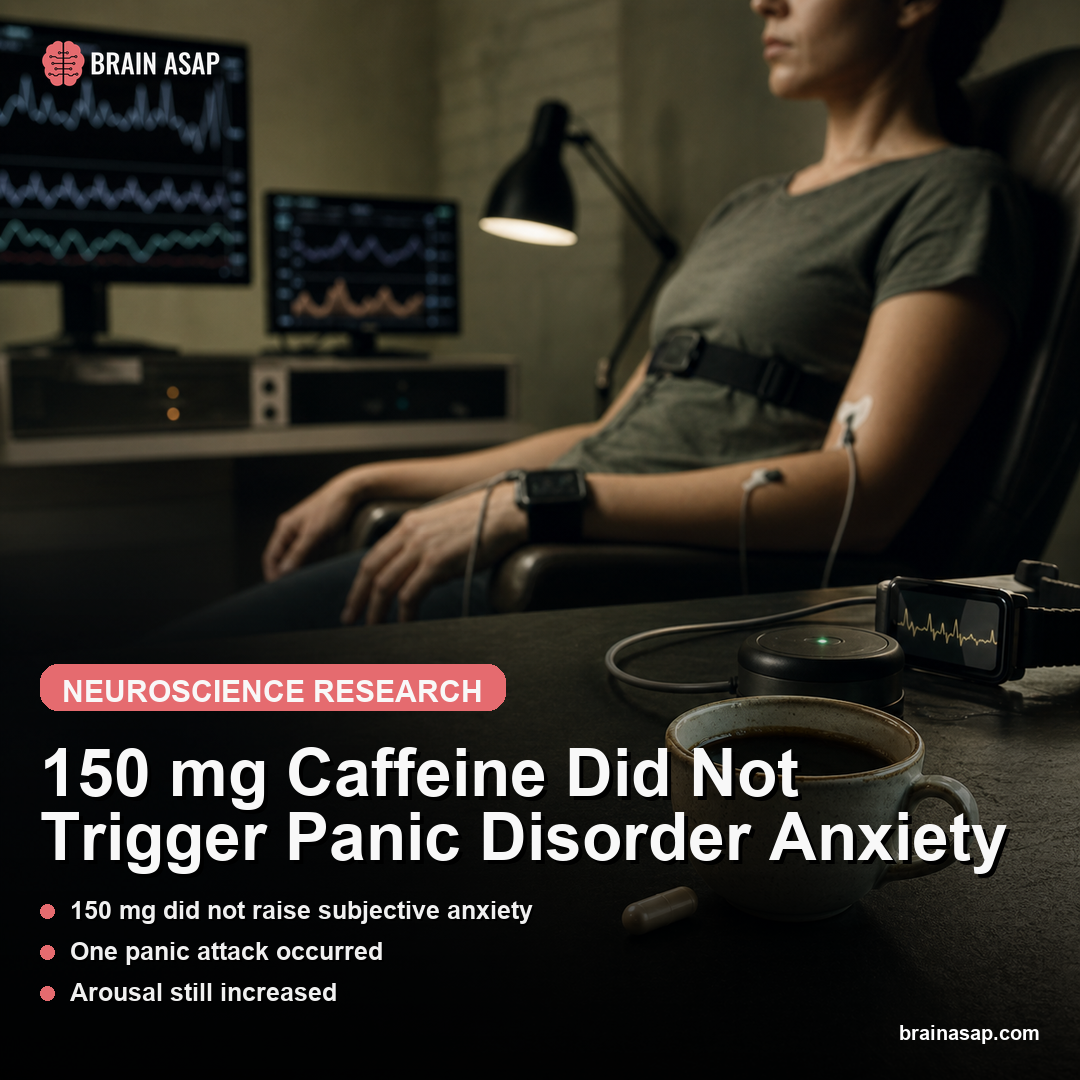
- 150 mg did not raise subjective anxiety: The primary outcome did not support an acute anxiety spike from caffeine in panic disorder or controls.
- One panic attack occurred: Across both sessions and 82 participants, only one panic attack was observed, in a panic-disorder patient after caffeine during the emotional-reactivity task.
- Arousal still increased: Caffeine increased skin conductance responses to neutral and emotional faces in both groups.
- Avoidance rose under caffeine: Participants showed more costly avoidance, meaning they gave up more points to avoid aversive or panic-related stimuli.
- External attention suffered: Caffeine made bodily sensations interfere more with attention to the task, even without increasing interoceptive anxiety.
- High-dose rules should not become blanket rules: The authors argue that caffeine-abstinence advice in panic disorder should depend on higher doses and individual response.
Source: Journal of Psychopharmacology (2025) | Hoppe et al.
Caffeine has a reputation problem in panic disorder for a good reason. At high doses, it can provoke panic attacks in a large share of patients. This trial asked the more practical question: what happens at 150 mg, a dose closer to an ordinary strong coffee than a laboratory stress test?
150 mg Caffeine Tested a Moderate Dose in Panic Disorder
The scary caffeine data in panic disorder mostly comes from larger challenges. Prior placebo-controlled work suggests that doses above 400 mg can trigger panic attacks in about half of patients with panic disorder, while only a small fraction of healthy controls panic at those levels.
That does not automatically mean every cup of coffee is dangerous. The clinical problem is that patients often get broad abstinence advice without much evidence about everyday serving sizes.
Hoppe and colleagues tested the missing middle: a 150 mg caffeine capsule after 36 hours without caffeine, compared with placebo in the same participants.
Twenty-Nine Panic Disorder Patients Crossed Over Against Placebo
The study included 29 adults with panic disorder and 53 healthy controls. All were low habitual caffeine consumers, capped at 300 mg per week, so tolerance and withdrawal would not dominate the result.
Each participant completed two blinded sessions, 2 to 14 days apart:
- Caffeine session: one capsule containing 150 mg caffeine, followed by rest, anxiety ratings, an emotional-reactivity task, and an approach-avoidance conflict task.
- Placebo session: the same procedure with an identical capsule containing microcrystalline cellulose.
- Within-person comparison: each participant served as their own control, which made the caffeine-placebo contrast cleaner.
The researchers measured subjective anxiety, panic attacks, skin conductance, costly avoidance, and interoceptive processing. They asked whether caffeine made people feel anxious, made their body more reactive, changed their decisions, or pulled attention inward toward body sensations.
The Panic Result Was Surprisingly Quiet
The primary result cut against the authors’ hypothesis. Caffeine did not increase subjective anxiety relative to placebo in a way that differed across time or group. Panic disorder patients remained more anxious overall than controls, but 150 mg caffeine did not uniquely push them into a caffeine-driven anxiety spike.
The panic-attack count was also low. Only one panic attack occurred in the whole study, and it happened in a patient with panic disorder after caffeine during the emotional-reactivity task.
That does not make caffeine irrelevant for every patient. It means the common jump from “high-dose caffeine can provoke panic” to “panic disorder patients should avoid all caffeine” is too blunt.
The Body Still Reacted Even When Anxiety Did Not
The quiet subjective-anxiety result did not mean caffeine did nothing. Skin conductance responses increased when participants viewed neutral and emotional faces. That pattern fits caffeine’s stimulant profile: the body was more activated even if people did not report more fear.
The distinction is important for panic disorder. Panic attacks often begin when normal bodily arousal gets interpreted as danger. The study suggests that at 150 mg, extra arousal alone was usually not enough to create that full cognitive feedback loop.
The result is a useful reminder: arousal is not the same thing as panic. A faster internal signal can be uncomfortable or distracting without becoming a panic attack.
Caffeine Shifted Decisions Toward Avoidance
The behavioral result may matter more than the anxiety rating. In the approach-avoidance task, participants could choose safe options with no reward or riskier options with points plus unpleasant images or panic-related sounds. Under caffeine, they showed more costly avoidance.
That means caffeine made people more willing to give up reward to avoid discomfort. The effect appeared in both panic disorder patients and healthy controls, so it was not a panic-disorder-specific vulnerability.
Still, it could matter clinically. Exposure therapy depends on approaching feared situations long enough to learn that they are survivable. If caffeine nudges a person toward avoidance, it could make a hard therapy assignment feel harder even when it does not directly create panic.
The attention result points in the same direction. Caffeine did not make interoceptive anxiety surge, but bodily sensations interfered more with attention to the outside task. For panic disorder, that distinction is clinically useful because patients often struggle less with arousal itself than with what arousal captures and interrupts.
In everyday terms, a moderate caffeine dose may not create a panic attack, yet it may still make the body louder. A louder body can pull attention inward, make uncertainty feel more urgent, and increase the appeal of avoidance. That is a subtler risk than the old caffeine-panic story, but it may be closer to what patients actually notice.
The result also explains why individual advice should be personal. Someone who uses caffeine before an exposure exercise, a public talk, or a high-stakes commute may care about arousal, avoidance, and attentional distraction even if the formal anxiety score does not rise.
Blanket Coffee Bans Look Too Simple
The authors’ practical conclusion is measured: recommendations for caffeine abstinence in panic disorder should be based on higher doses and individual assessment. That is the right level of specificity for this dataset.
The caveats are real. The sample was modest, low-caffeine users were intentionally selected, the panic-disorder group was mostly female, and the study tested one acute 150 mg dose. It cannot tell us what happens after repeated daily caffeine, higher moderate doses, energy drinks, sleep deprivation, or people who already drink several coffees a day.
It also cannot replace patient-level pattern tracking. The useful clinical question is not whether caffeine is universally good or bad, but whether it predictably changes a person’s avoidance, attention, sleep, or exposure practice.
That is more publishable than a blanket rule because it gives patients something observable to test with their clinician.
It also keeps the conclusion honest: moderate caffeine was not inert, just less panic-provoking than feared.
That is a better clinical sentence than either reassurance or alarm.
But the main result is still useful. For low habitual caffeine users with panic disorder, one 150 mg caffeine dose did not behave like a panic switch. It behaved more like a stimulant that increased arousal, avoidance, and inward distraction without reliably turning those signals into panic.
Paper: Acute effects of 150 mg caffeine on subjective, physiological, and behavioral components of anxiety in panic disorder and healthy controls: A randomized placebo-controlled crossover trial. Journal of Psychopharmacology. 2025;39(8):836-846. DOI: 10.1177/02698811251344692
Authors: Hoppe et al.
Study Design: Double-blind, randomized, placebo-controlled crossover trial.
Sample Size: 29 panic disorder patients and 53 healthy controls with low habitual caffeine use.
Key Statistic: 150 mg caffeine did not increase subjective anxiety versus placebo, while increasing skin conductance, costly avoidance, and impaired exteroceptive attention.