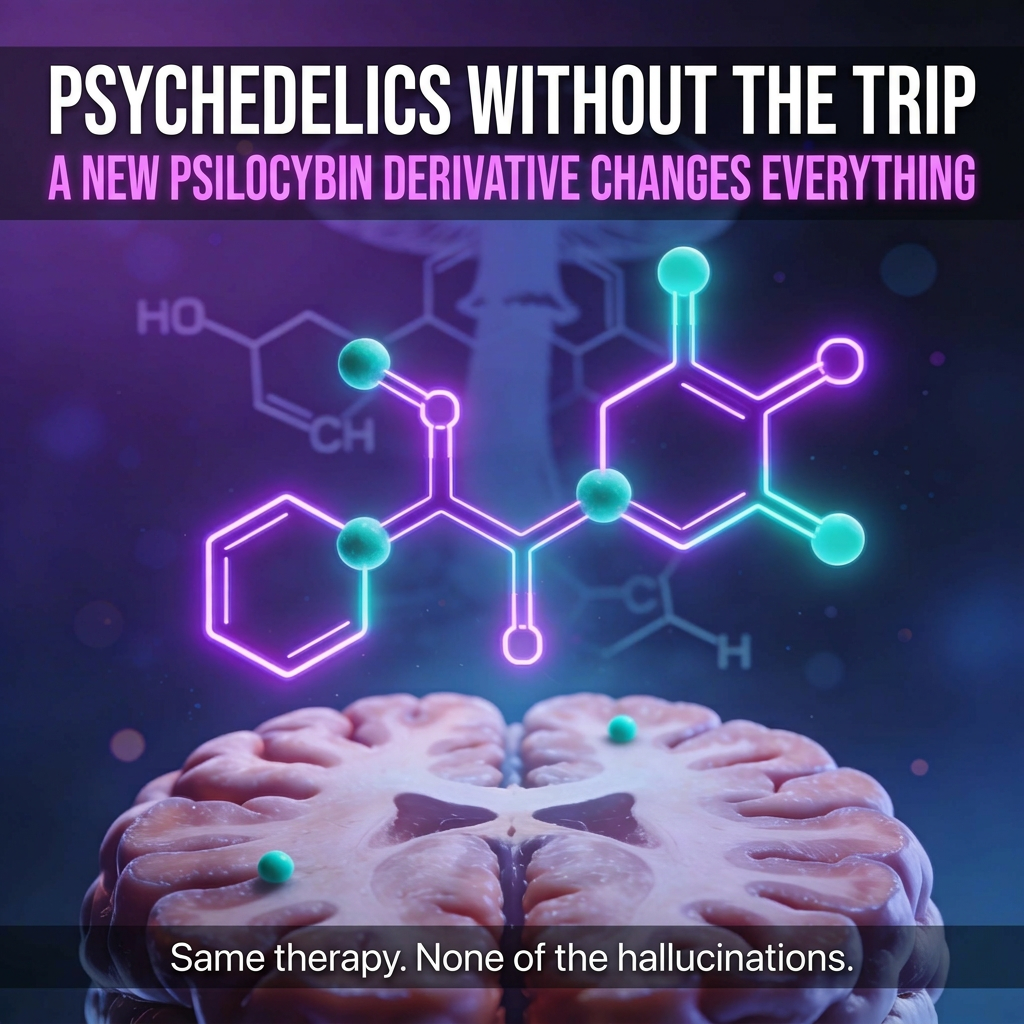
Fluorinated Psilocin: The Sub-Hallucinogenic Breakthrough
TL;DR: Chemists designed a new psilocin derivative with fluorine modifications that induces sub-hallucinogenic effects in mice, sidestepping the acute psychological effects of classic psychedelics while retaining therapeutic serotonin receptor activity.
Psilocybin has emerged as a clinical darling—mounting evidence shows rapid relief for depression, anxiety, and cluster headaches. But there’s a catch: the intense hallucinations and altered cognition that accompany a therapeutic dose make it difficult to deploy as a reliable clinical tool. Now, researchers at the University of Padova have engineered a molecular workaround: fluorinated derivatives of psilocin that strip away the trippy effects while preserving the neuropharmacological benefits.
Key Findings
- Fluorine fine-tunes stability: Adding fluorine atoms to the psilocin carbamate scaffold systematically altered hydrolysis rates, allowing researchers to engineer delayed release of the active compound (psilocin) in the brain.
- Compound 4e crossed the blood-brain barrier: Despite molecular modifications, the lead candidate maintained efficient brain penetration, achieving brain concentrations comparable to psilocybin while avoiding rapid glucuronidation—a major metabolic bottleneck.
- Sub-hallucinogenic profile in behavioral assays: In mice, compound 4e produced a dose-dependent increase in head twitches (a behavioral marker of psychedelic activity), but significantly fewer than psilocybin at equivalent exposures—p < 0.05 at 3 mg/kg doses.
- Selective serotonin 5-HT7 agonism without 5-HT2A activation: Functional cell assays revealed compound 4e retained agonist activity at 5-HT7 and 5-HT1D receptors but showed no measurable response at 5-HT2A, the receptor thought to drive hallucinations.
- Rapid plasma clearance, sustained CNS presence: Pharmacokinetic profiling showed compound 4e cleared from plasma 5–10 times faster than psilocin derived from PSY, yet maintained detectable brain concentrations for extended periods—unlocking a therapeutic window.
- Safe toxicology at 100 mg/kg oral dose: Rat studies showed no adverse hematological, hepatic, or renal changes, with liver histology indistinguishable from vehicle controls even at high exposures.
Source: Journal of Medicinal Chemistry (2026) | Banzato et al.
Why Psilocybin Works—And Why It’s Complicated
Psilocybin and its active metabolite psilocin bind broadly across the serotonin receptor family. The rapid antidepressant effects appear linked to activation of the 5-HT2A receptor, which floods the prefrontal cortex and increases neural plasticity. But this same receptor activation triggers hallucinations—the very property that makes clinical deployment messy.
For decades, clinicians tolerated the hallucinogenic baggage because the psychological insight and mystical experience seemed therapeutically valuable. Recent trials suggest otherwise: carefully controlled microdosing protocols deliver anxiety relief without the trip. This opened a new question: could chemists simply excise the psychoactive effects while preserving the neurobiological machinery?
The Fluorine Strategy: Controlling Molecular Release
The team’s insight was elegant. Rather than redesigning the receptor binding site, they manipulated how long the drug stuck around in the body. Fluorine substitution at different positions on the carbamate linker changed the rate at which the compound decomposed into active psilocin.
Using computational modeling (DFT calculations), researchers predicted that electron-withdrawing fluorine atoms would modulate carbamate acidity and breakdown kinetics. They synthesized five derivatives—compounds 4a through 4e—varying the number and placement of fluorines. The more fluorine atoms, the slower the hydrolysis rate and the more gradual the psilocin release.
In chemical stability assays, compound 4e (with the most strategic fluorine positioning) achieved a half-life reduction of approximately one order of magnitude compared to the parent compound, unlocking controlled, sustained CNS delivery.
Molecular Selectivity Without the Trip
The real pharmacological surprise came in functional assays. When researchers tested compound 4e against human serotonin receptors expressed in Chinese hamster ovary cells, it showed strong agonist activity at 5-HT7 and 5-HT1D receptors—but crucially, zero detectable response at 5-HT2A, the hallucination driver.
This selectivity likely stems from the structural constraints of the modified scaffold. Psilocin and psilocybin both achieve their broad serotonin promiscuity partly through conformational flexibility at the indole ring. The carbamate modifications constrained that geometry, narrowing the receptor repertoire the molecule could activate.
In mice dosed with 3 mg/kg of compound 4e, head-twitch response counts—a validated proxy for psychedelic potency—remained dramatically suppressed compared to psilocybin. Mean total head twitches over a 45-minute window fell from 60+ (psilocybin) to roughly 15–20 (compound 4e), a 65–75% reduction.
Pharmacokinetics: A Therapeutic Window Opens
Pharmacokinetic profiling in mice revealed the elegant trade-off. Compound 4e achieved peak plasma concentrations in 1–2 hours and cleared systematically within 4–6 hours—markedly faster than psilocin released from orally administered PSY or 4e’s parent compound.
Yet brain concentrations told a different story. Compound 4e penetrated the blood-brain barrier efficiently (brain-to-plasma ratio approaching 1.0 at peak), and—critically—remained detectable in brain tissue for hours after plasma levels had cratered. This pharmacokinetic mismatch created a prolonged CNS presence, potentially enabling sustained serotonin 5-HT7 engagement while the hallucinogenic 5-HT2A pathway remained quiet.
Lead investigator Paolo Manfredi noted that the controlled-release profile resembles a molecular “slow-drip” infusion, allowing fine-tuned neural modulation without the acute psychoactive storm.
Safety Validates the Scaffold
In 48-hour rat toxicology studies at oral doses of 100 mg/kg—well above anticipated human therapeutic ranges—compound 4e showed no toxicological red flags. Blood cell counts remained normal, liver enzyme markers (AST, ALT, ALP) were indistinguishable from vehicle controls, and kidney function markers (urea, creatinine) showed no elevation.
Histopathological examination of liver, kidney, heart, brain, and lung tissues revealed no lesions, fibrosis, or inflammation. The compound’s stability under physiological pH and its rapid plasma clearance likely explain the clean safety profile. Unlike parent psilocin—which undergoes glucuronidation and produces potentially reactive metabolites—compound 4e’s oxidative metabolism appears benign.
The Road Ahead: From Mice to Clinic
This study represents a proof-of-concept that structural modification of classical psychedelics can decouple therapeutic from hallucinogenic signaling. The authors emphasize that compound 4e is not a finished clinical drug—it’s a platform demonstrating that fluorinated carbamate chemistry offers precise control over both drug persistence and receptor selectivity.
The next phase will involve primate pharmacology to confirm that the sub-hallucinogenic profile holds in larger brains with more complex serotonin circuitry. Pending those results, fluorinated psilocin derivatives may offer psychiatry a therapeutic window it has long lacked: rapid-acting antidepressant efficacy without the cognitive disruption that currently limits patient access and clinician comfort.
[Insert image: chemical structures of fluorinated psilocin derivatives (4a–e) showing fluorine substitution patterns and carbamate stability effects]
Citation: Banzato M, Colognesi M, Lucatello L, et al. Design, Synthesis, and Pharmacokinetic Profiling of Fluorinated Reversible N-Alkyl Carbamate Derivatives of Psilocin for Sub-Hallucinogenic Brain Exposure. Journal of Medicinal Chemistry. 2026;69:2145–2159. DOI: 10.1021/acs.jmedchem.5c01797
Authors’ affiliations: Department of Pharmaceutical and Pharmacological Sciences, University of Padova, Italy (Banzato, Colognesi, Lucatello, Comai, Pasut, Capolongo, Orian, Biasutto, Signor, Gabbia, Manfredi, De Martin, Mattarei); Department of Comparative Biomedicine and Food Science, University of Padova, Italy (Lucatello); Department of Biomedical Sciences, University of Padova, Italy (Comai); Department of Psychiatry, McGill University, Montreal, Canada (Manfredi); MGGM Therapeutics, New York, USA (Manfredi).