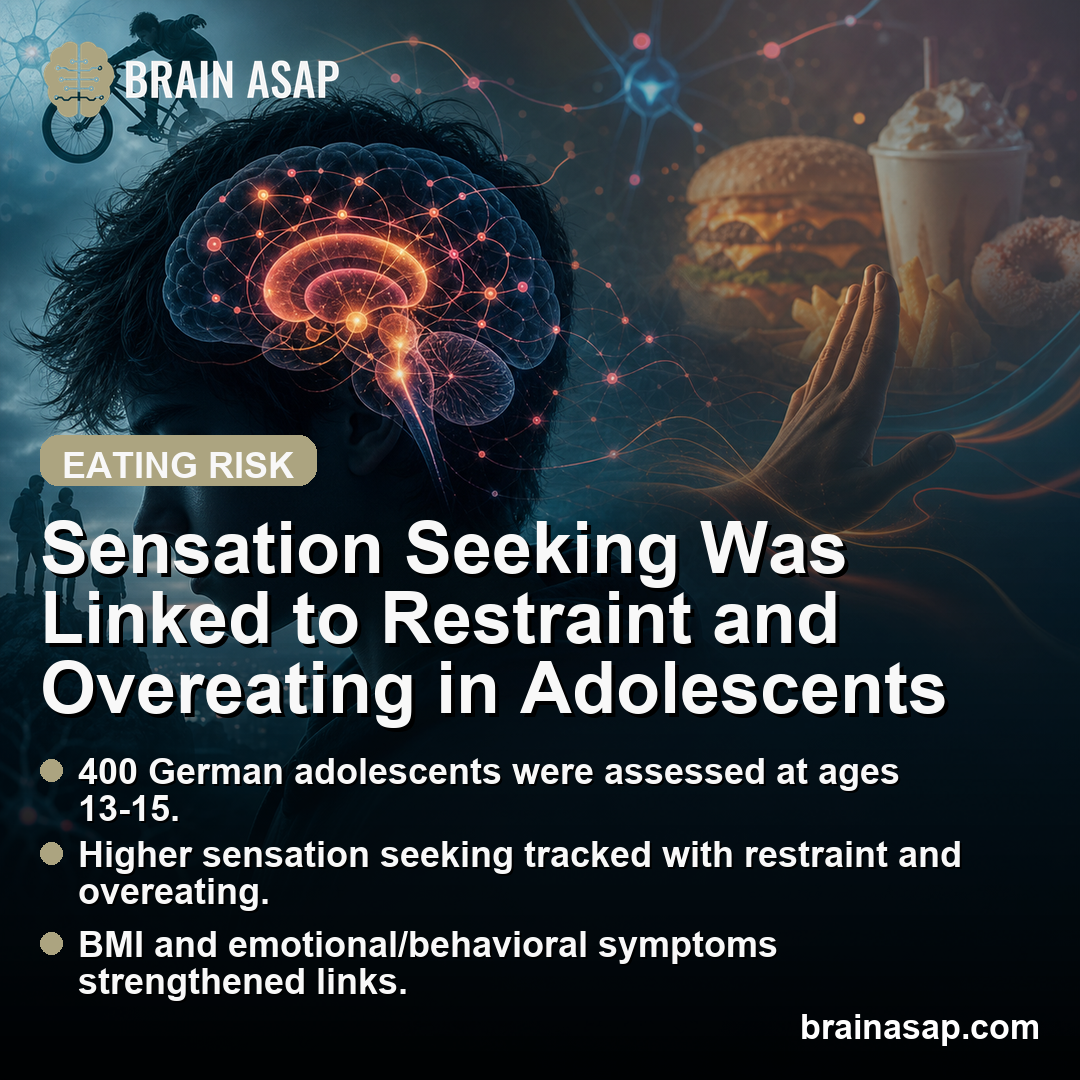
TL;DR: A 2026 study in the Journal of Eating Disorders found that higher sensation seeking, a personality trait involving pursuit of novel or intense experiences, was linked to more restraint and overeating in 400 German adolescents, with stronger disordered-eating links in teens with higher BMI, hyperactivity/inattention, emotional symptoms, or peer problems.
Key Findings
- 400 adolescents: The sample included 13- to 15-year-olds from the LIFE Child study in Leipzig, Germany, with 190 boys and 210 girls.
- Sensation seeking was defined directly: Researchers measured the tendency to seek novel or intense experiences using the German Arnett Inventory of Sensation Seeking.
- Two links survived correction: Higher sensation seeking was associated with higher restraint and more episodes of overeating after false-discovery-rate correction.
- Binge-eating links weakened: Associations with eating concern, loss-of-control eating, and objective binge eating did not remain significant after multiple-testing correction.
- Risk was not evenly distributed: Higher BMI, hyperactivity/inattention, emotional symptoms, and peer problems strengthened several sensation-seeking/disordered-eating associations.
Source: Journal of Eating Disorders (2026) | Bogner et al.
Sensation seeking is not a diagnosis; in adolescence it can describe normal drives toward novelty, intensity, and stimulation. The clinical issue in this paper is whether that trait travels with eating patterns that can become harmful, especially when emotional or behavioral difficulties are already present.
Adolescent Sensation Seeking Was Tested Against Eating-Disorder Symptoms
The study focused on 13- to 15-year-olds, an age range when both sensation seeking and eating-disorder vulnerability can change quickly. Participants came from the LIFE Child study, a longitudinal child-development cohort in Leipzig, Germany.
The researchers included adolescents only when they had data on sensation seeking, body mass index, socioeconomic status, behavioral difficulties, and disordered eating. The final sample was 400 adolescents, with a mean age of 14.70 years.
The sample was balanced by sex and included a body-weight spread useful for moderation testing:
- Sex: 210 female adolescents and 190 male adolescents.
- Weight group: 305 participants were classified as underweight or normal weight; 95 were classified as overweight or obese.
- Socioeconomic status: 62.8% were in the medium-SES group, while high-SES families were somewhat overrepresented compared with the general German population.
Sensation seeking was measured with the AISS-D, the German version of the Arnett Inventory of Sensation Seeking. The scale captures intensity seeking and novelty seeking, then combines them into a total score. In plain terms, it asks how strongly a teen identifies with wanting intense, varied, or new experiences.
ChEDE-Q and SDQ Measured Eating Patterns and Behavioral Symptoms
The eating-disorder measure was the ChEDE-Q, the Eating Disorder Examination-Questionnaire for Children. It is a self-report version of a widely used eating-disorder assessment, adapted for children and adolescents.
The ChEDE-Q separates thoughts and behaviors that can otherwise get blurred together:
- Restraint: attempts or intentions to restrict eating, rather than proof that calories were actually reduced.
- Eating concern: worry, preoccupation, or distress around eating.
- Weight and shape concern: body-image-related concerns tied to weight or shape.
- Overeating: episodes of eating an unusually large amount of food.
- Loss-of-control eating: eating episodes where the person feels unable to stop or control eating.
- Objective binge eating: large eating episodes with loss of control.
Behavioral and emotional symptoms were measured with the SDQ, the Strengths and Difficulties Questionnaire. In this paper, the relevant SDQ domains were hyperactivity/inattention, emotional symptoms, conduct problems, and peer problems.
Sensation Seeking Linked Most Clearly to Restraint and Overeating
The clearest result was not binge eating. After controlling for age, sex, and socioeconomic status, and after correcting for multiple tests, the robust links were restraint and overeating.
The regression results were:
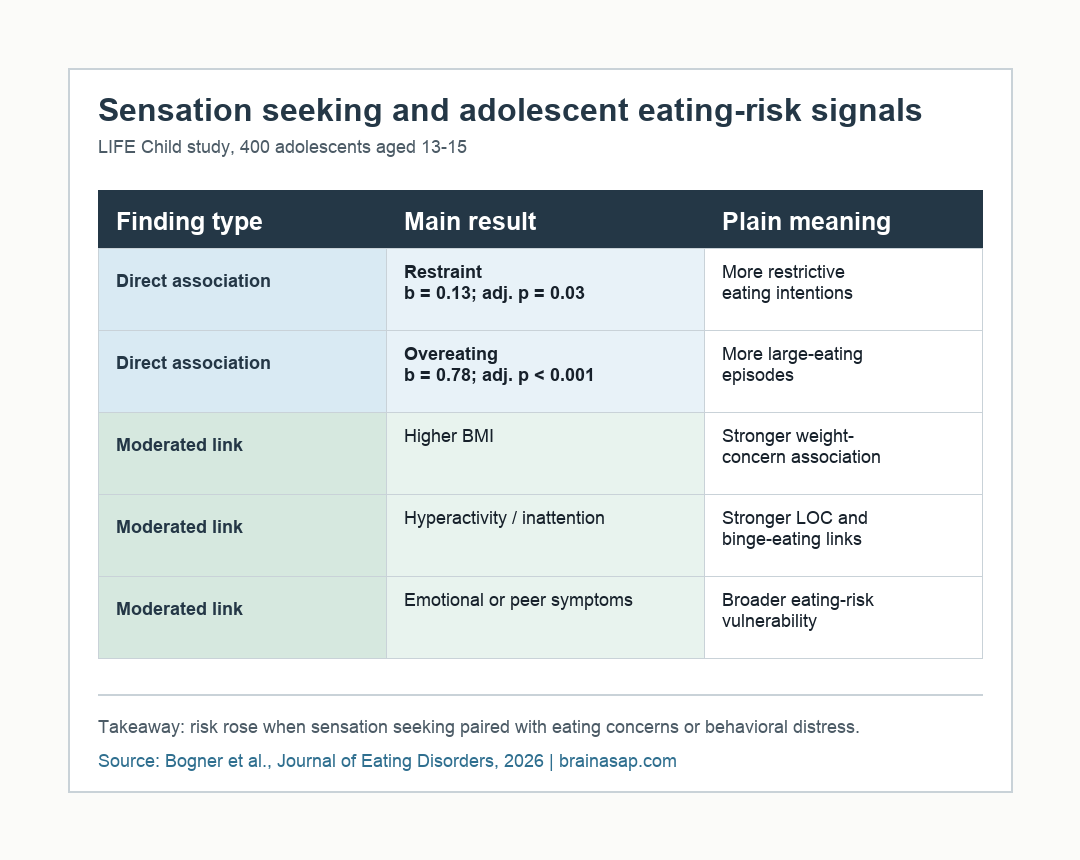
- Restraint: higher sensation seeking was associated with higher ChEDE-Q restraint scores, with b = 0.13 and adjusted p = 0.03.
- Overeating: higher sensation seeking was associated with more overeating episodes over the prior 28 days, with b = 0.78 and adjusted p < 0.001.
- Eating concern and global score: these were positive before correction, but did not remain significant after adjustment.
- Loss-of-control and binge eating: these were also positive before correction, but did not survive correction.
Overeating, loss-of-control eating, and objective binge eating are related but not interchangeable. In this nonclinical adolescent sample, sensation seeking mapped more reliably onto large eating episodes and restraint thinking than onto full binge-eating symptoms.
One interpretation offered by the authors is that restraint may sometimes represent an attempted compensation for overeating. A teen high in sensation seeking might pursue rewarding food experiences, then respond with restrictive intentions afterward. The data cannot prove that sequence, but the pairing of restraint and overeating makes it a plausible target for longitudinal research.
Higher BMI Strengthened the Weight-Concern Association
Weight status did not predict overall sensation seeking. Adolescents with overweight or obesity did not simply score higher on the sensation-seeking total score.
The BMI result was more targeted: among adolescents with overweight or obesity, sensation seeking was more strongly associated with weight concern. The interaction had b = 0.54, f2 = 0.20, and adjusted p = 0.02, which the paper treats as a moderate effect.
The BMI result does not say higher BMI causes sensation seeking, or that sensation seeking causes weight gain. It says the link between sensation seeking and weight-related concern was stronger in teens already living in a higher-BMI category.
Hyperactivity, Emotional Symptoms, and Peer Problems Raised the Risk Context
The moderator findings are where the paper becomes more practical. Sensation seeking had stronger links to disordered eating when certain behavioral or emotional difficulties were present.
The most consistent amplifiers were:
- Hyperactivity/inattention: stronger associations appeared for restraint, loss-of-control eating, and objective binge eating.
- Emotional symptoms: stronger associations appeared across restraint, eating concern, weight concern, shape concern, global ChEDE-Q score, loss-of-control eating, and objective binge eating.
- Peer problems: stronger associations appeared for restraint, eating concern, weight concern, shape concern, and the global ChEDE-Q score.
- Conduct problems: these did not significantly change the sensation-seeking/disordered-eating associations.
Emotional symptoms included worries, unhappiness, fears, and somatic complaints. Peer problems included loneliness, bullying, or difficulty with peers. Those domains matter because eating behavior can become a short-term regulator of distress, stimulation, or control.
The hyperactivity/inattention result also fits a broader neurobehavioral framework. Hyperactivity and attention problems are often discussed alongside reward sensitivity, response inhibition, and emotional regulation. In a high-sensation-seeking teen, eating may become another route toward stimulation or short-term relief.
Sex differences did not explain the eating-risk pattern. Boys had higher overall sensation-seeking scores than girls, mainly because boys scored higher on intensity seeking. Novelty seeking did not differ by sex.
Even so, sex did not significantly modify the relationship between sensation seeking and disordered eating. Boys and girls with higher sensation seeking may deserve similar screening attention when restraint, overeating, emotional symptoms, or peer distress are also present.
The balanced sample helps with interpretation because eating-disorder research has often leaned heavily toward female clinical samples. A community sample with 190 boys gives the analysis more room to detect whether the trait-eating association is sex-specific; here, it was not.
Cross-Sectional Design Keeps the Causal Claim Limited
These data should not be read as proof that sensation seeking causes disordered eating. The design was cross-sectional, meaning all main variables were assessed at one analysis point. It cannot tell whether sensation seeking came first, whether early eating problems shaped self-report, or whether a third factor drove both.
The main limitations are straightforward:
- No causality: cross-sectional regression can identify associations and interactions, but not developmental direction.
- Nonclinical sample: loss-of-control eating and binge eating were relatively infrequent, which may have reduced power for those outcomes.
- High-SES overrepresentation: the sample did not perfectly mirror the German adolescent population.
- Subgroup size: moderator analyses depended on smaller high-symptom groups.
- Scale reliability: the authors note low internal consistency for the sensation-seeking measure, though values were comparable to prior adolescent work.
The prevention angle is narrow. Sensation seeking alone is not pathology, but when it appears alongside hyperactivity/inattention, emotional distress, peer problems, or higher BMI, clinicians and researchers may want to ask specific questions about restraint, overeating, and loss-of-control eating.
Future longitudinal work should test whether these combinations predict later eating-disorder symptoms, and whether emotion-regulation or attention-focused interventions reduce that risk. The strongest contribution is a screening frame for adolescents whose novelty- and intensity-seeking traits occur in a higher-risk emotional or behavioral context.
Citation: DOI: 10.1186/s40337-026-01620-y; Bogner et al.; Disordered eating in adolescence: the roles of sensation seeking, weight status, and behavioral difficulties; Journal of Eating Disorders; 2026;14:96.
Study Design: Cross-sectional analysis of LIFE Child cohort data testing sensation seeking, disordered eating, BMI group, and behavioral-difficulty moderators.
Sample Size: 400 adolescents aged 13 to 15 years in Leipzig, Germany.
Key Statistic: Sensation seeking remained associated with restraint (b = 0.13; adjusted p = 0.03) and overeating (b = 0.78; adjusted p < 0.001) after correction for multiple testing.
Caveat: Cross-sectional design, nonclinical sample, relatively infrequent binge-eating symptoms, and subgroup analyses with smaller high-symptom groups.