Body Roundness Index Flagged Depression Risk in Dementia
TL;DR: Body roundness index, not BMI, flagged a dementia subgroup with more than threefold higher odds of depressive symptoms.
Key Findings
- Highest BRI tripled odds: Among people with dementia, those in the highest body-roundness quartile had more than threefold greater odds of depressive symptoms than those in the lowest quartile.
- BMI missed the signal: No obesity measure was associated with depression in the overall sample, and traditional measures such as BMI and waist circumference did not carry the key dementia-subgroup signal.
- Dementia changed the pattern: The association emerged inside the 239-person dementia subgroup rather than across all 601 older memory-clinic patients.
- GDS-15 defined depression: Depressive symptoms were measured with the 15-item Geriatric Depression Scale, using a score of five or higher as the cutoff.
- Central adiposity is the clue: BRI uses waist and height, making it a closer proxy for abdominal body shape than weight-based BMI.
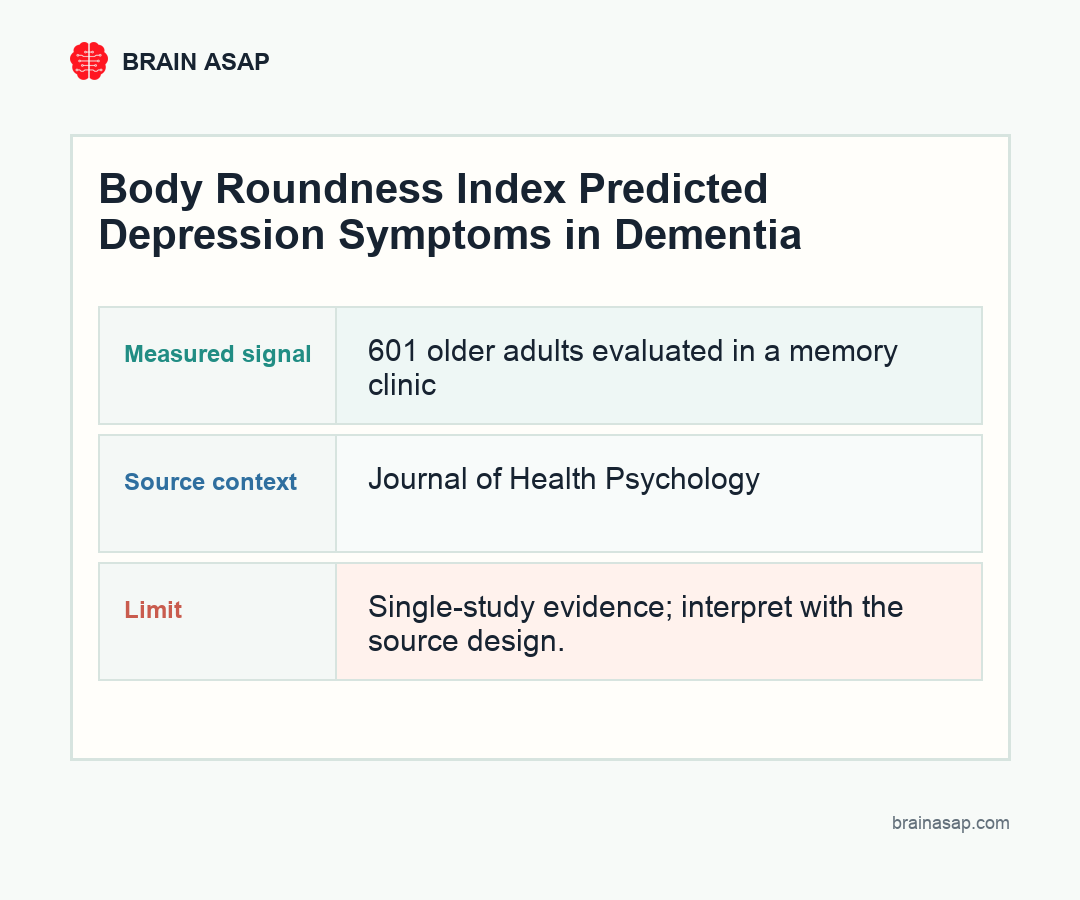
Source: Journal of Health Psychology (2026) | Fernandes et al.
Depression in dementia is easy to miss because it can look like withdrawal, apathy, sleep disruption, or another step in cognitive decline. This study suggests that body roundness index, a waist-and-height measure of central adiposity, captured a depression-risk signal that BMI and waist circumference did not. The association appeared specifically among participants with dementia, where the highest BRI quartile was linked to more than threefold higher odds of depressive symptoms.
BMI Was the Familiar Measure, Not the Best One
BMI is easy to calculate, but aging makes it a blunt tool. Older adults can lose muscle and bone while accumulating abdominal fat, so height and weight alone often miss the body-composition pattern most relevant to mood and brain health.
Body roundness index uses height and waist measurements to estimate body shape and central adiposity. That waist-based signal is relevant because abdominal fat is more metabolically active than body weight alone suggests, and dementia patients are already vulnerable to inflammatory, vascular, and endocrine stress.
The Signal Appeared Only After Dementia Was Separated Out
Across the entire sample of 601 older adults, the researchers found no relationship between any body-fat measure and depression, so the headline should not be read as a broad obesity-depression claim.
The signal emerged in the 239 participants with dementia. In that subgroup, about 36% had depression, and higher BRI was consistently associated with depressive symptoms.
Central Adiposity is the Relevant Biology
This study cannot explain why BRI was a more effective marker of depression in dementia than BMI. The likely explanation is that BRI better reflects central adiposity, which is linked to low-grade inflammation, hormonal stress, insulin resistance, and cardiometabolic strain.
Those pathways are already relevant to dementia care. A waist-based shape measure can therefore capture a body-brain risk profile that weight divided by height cannot see clearly.
A Threefold Odds Signal Is Clinically Interesting, Not Causal Proof
The most important number is the highest BRI quartile: more than threefold greater odds of depression compared with the lowest quartile among participants with dementia. For a measurement that only needs height and waist circumference, that is a clinically noticeable association.
The design was cross-sectional, so the study cannot show which direction the relationship runs. Three possibilities remain on the table:
- Central adiposity is one possible driver through inflammation, vascular strain, or hormonal stress.
- Depression can change body composition by reducing activity, disrupting sleep, or altering appetite.
- A third factor can drive both, including frailty, medication burden, dementia severity, or cardiometabolic disease.
The clinical reading is therefore narrower: BRI can help flag dementia patients who need closer mood screening, not diagnose depression by body shape.
A Longitudinal Dementia Study Should Test Whether BRI Predicts Depression
The next test is whether BRI predicts depression over time. If higher BRI comes before new depressive symptoms, persistent symptoms, or poorer response to treatment, the measure becomes more clinically relevant than a one-time association.
For now, BRI should not be treated as a diagnostic tool. It is better understood as a low-cost clue that metabolic health and emotional symptoms are tightly linked in dementia care.
Why Dementia Changes the Meaning of a Body Measure
In younger or middle-aged adults, BMI can be a rough shortcut for body size. In older adults with cognitive decline, the shortcut becomes weaker. Muscle loss, frailty, inflammation, appetite change, and reduced activity can all change weight without capturing the same visceral-fat signal.
The dementia-specific pattern is the key result: the association did not appear across everyone, but it did appear when the analysis focused on people with dementia. In that group, central adiposity can carry different biological and clinical meaning.
In that context, body roundness index is less about appearance and more about metabolic stress around a vulnerable brain.
Depression Screening Is the Clinical Opening
The study does not imply that BRI diagnoses depression. It suggests BRI can help clinicians decide who needs more careful mood screening, which is a narrower and more realistic use case.
Depression in dementia can present as withdrawal, irritability, apathy, sleep disruption, appetite change, or worsening function. It is often misread as dementia progression, caregiver stress, or normal aging.
A simple anthropometric marker cannot solve that problem. But if higher BRI reliably identifies a subgroup with elevated depressive-symptom odds, it gives clinicians one more reason to ask about mood directly instead of assuming every behavioral change is cognitive decline.
Inflammation Is Plausible but Not Proven Here
The central-adiposity hypothesis has a plausible biological basis. Visceral fat can contribute to inflammatory signaling, insulin resistance, vascular dysfunction, and endocrine stress, and all four pathways can intersect with mood and cognition.
This study did not show that inflammation caused depressive symptoms. It used body measurements and symptom screening at one point in time, so the mechanism remains a hypothesis.
Dementia patients often have multiple medical problems, medications, mobility changes, and nutritional shifts. A body-shape index can summarize risk without being the direct cause of that risk.
Longitudinal BRI Tracking Is the Needed Dementia Test
A strong next study would follow dementia patients over time, measuring BRI, depressive symptoms, inflammatory markers, activity, diet, and medication changes. That would test whether BRI predicts new depression, persistent depression, or treatment response.
It would also show whether BRI adds information beyond what clinicians already know from frailty, diabetes, cardiovascular disease, or dementia severity. The goal is not another formula for its own sake. The goal is a cheap signal that helps clinicians notice emotional suffering sooner.
For now, the result is a good reminder that dementia care is not only about memory. Mood, metabolism, and body composition are part of the same clinical picture.
BRI Is Useful Because It Is Easy to Collect
The most clinically attractive part of BRI is not that it is mathematically fancy. It is that it uses measurements clinics already know how to collect: height and waist. No scanner, blood test, or cognitive algorithm is required.
That still leaves BRI as a practical screening clue rather than a definitive answer. In dementia care, where time is limited and depression can hide inside cognitive symptoms, a simple risk flag has value if it reliably points clinicians toward patients who need a deeper mood assessment.
The finding also fits a broader theme in neurodegenerative care: the brain is not isolated from the body. Vascular risk, metabolic stress, inflammation, nutrition, sleep, and mood all feed into the same clinical trajectory.
Paper: Body roundness index as a predictor of depression in dementia: A cross-sectional study. Journal of Health Psychology. 2026. DOI: 10.1177/13591053261430499
Authors: Fernandes et al.
Study Design: Cross-sectional memory-clinic study comparing anthropometric indices as predictors of depressive symptoms.
Sample Size: 601 community-dwelling adults aged 60-91; 239 diagnosed with dementia.
Key Statistic: In the dementia subgroup, the highest body roundness index quartile had more than threefold greater odds of depressive symptoms than the lowest quartile.
Important Caveat: Cross-sectional data cannot show whether central adiposity contributes to depression, depression changes body composition, or another factor drives both.