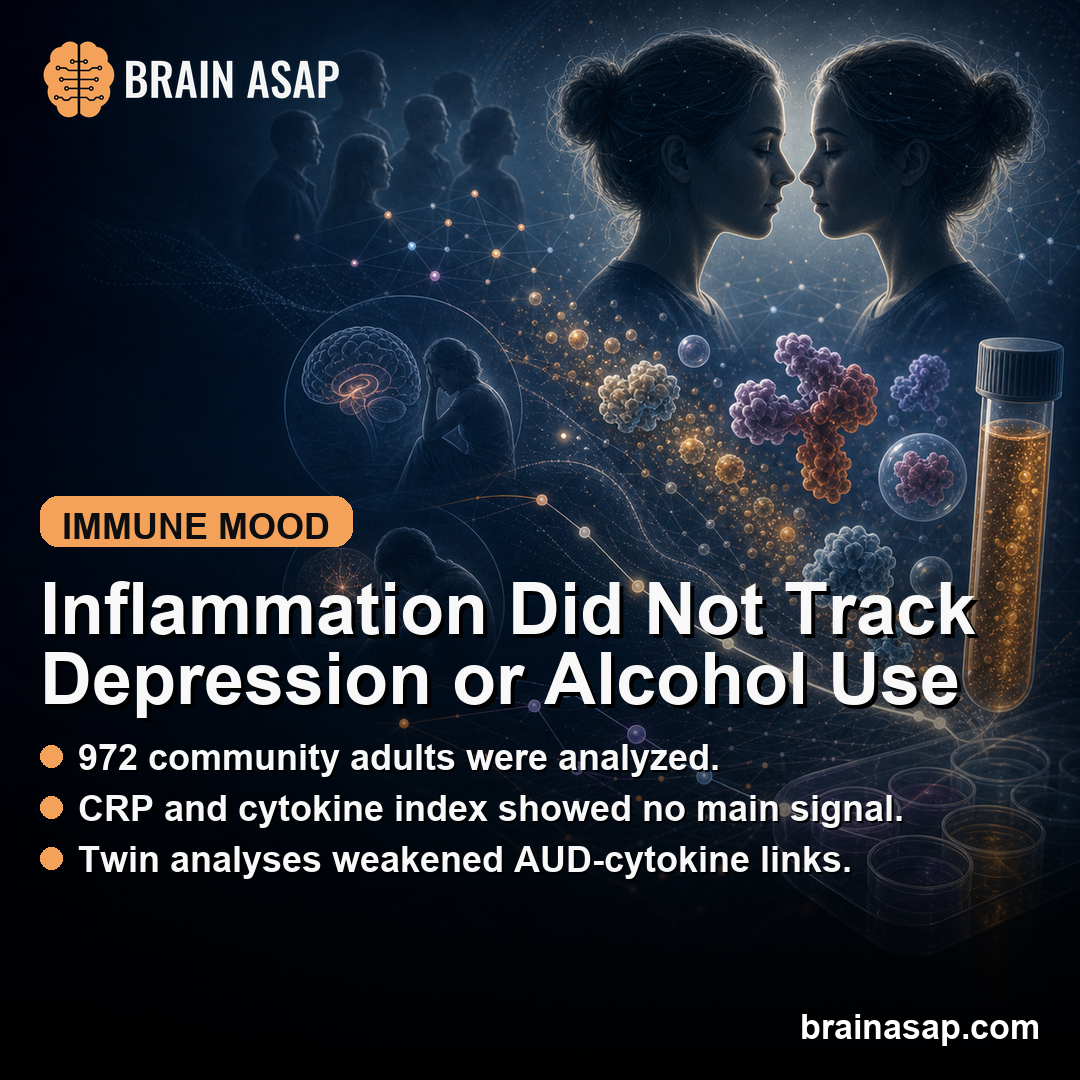
TL;DR: A 2026 study in Brain, Behavior, & Immunity – Health found that depression symptoms, alcohol use, and alcohol use disorder (AUD) symptoms were not associated with C-reactive protein (CRP), a blood inflammation marker, or a pro-inflammatory cytokine index in 972 community adults, and twin analyses suggested familial confounding explained several cytokine-AUD links.
Key Findings
- 972 community adults: The analyzed sample averaged 33.4 years old, with participants ranging from 28 to 49 years.
- Pre-registered inflammation tests: Researchers focused on CRP and a pro-inflammatory cytokine index combining IL-1 beta, IL-6, and TNF-alpha after standardization.
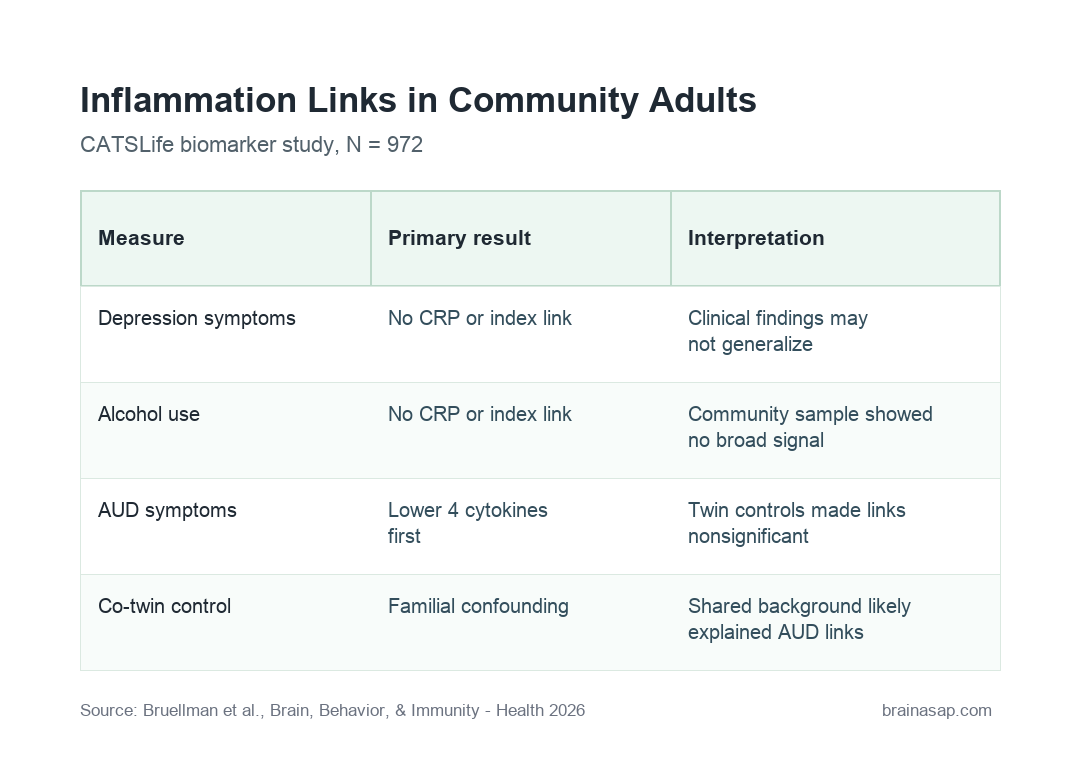
- No main inflammation signal: Depression, alcohol use, and AUD symptoms were unrelated to CRP and the pro-inflammatory cytokine index.
- AUD showed lower individual cytokines: AUD was associated with lower IL-1 beta, IL-4, IL-10, and IL-12 after multiple-testing correction.
- Twin analyses weakened those links: Co-twin control analyses made the AUD-cytokine associations nonsignificant, suggesting shared familial factors explained them.
Source: Brain, Behavior, & Immunity – Health (2026) | Bruellman et al.
C-reactive protein (CRP) is a blood marker that rises with inflammation. Cytokines are immune-signaling proteins that help coordinate the body’s response to infection, injury, and other biological stressors.
Those markers are attractive in psychiatry because they offer a possible bridge between body-wide immune activity and symptoms such as low mood, anhedonia, fatigue, sleep disruption, and alcohol-related health problems.
CATSLife Data Tested Inflammation in Community Adults
Researchers used participants from the first wave of the Colorado Adoption/Twin Study of Lifespan behavioral development and cognitive aging. The larger CATSLife sample included adopted and non-adopted siblings plus same-sex twin pairs.
After exclusions, the analysis included 972 adults. Participants were excluded for reasons such as missing blood draws, pregnancy, long gaps between blood and behavioral measures, or medications that affect cytokines.
The age range was narrow enough to reduce some aging-related noise: participants were 28 to 49 years old, with a mean age of 33.4 years.
- Blood markers: CRP was measured with an ELISA assay, and cytokines were measured in plasma samples.
- Primary cytokine index: IL-1 beta, IL-6, and TNF-alpha were standardized and averaged into a pro-inflammatory index.
- Covariates: Models included age, sex, diet-relevant measures, and antidepressant use.
Depression and Alcohol Measures Did Not Track CRP or the Cytokine Index
The primary result was negative. Depression symptoms, alcohol use, and AUD symptoms were not associated with CRP or with the pre-registered pro-inflammatory cytokine index.
That finding pushes against a simple version of the inflammation story. In clinical samples, elevated inflammation is often associated with depression severity or alcohol-related illness.
In this healthier community sample, the same broad association did not appear.
The difference may reflect baseline inflammation. If most people in a sample have low inflammatory burden, cytokine variation may not separate mental-health or drinking behavior as clearly as it does in more clinically affected groups.
AUD Was Linked to Lower Individual Cytokines Before Twin Controls
The study did find one unexpected pattern in secondary tests. AUD symptoms were associated with lower levels of four individual cytokines: IL-1 beta, IL-4, IL-10, and IL-12, after correction for multiple testing.
The direction needs caution. A common expectation is that heavier alcohol behavior would be linked to higher inflammation, especially in clinical AUD samples. Lower cytokine levels could look protective if read superficially.
The researchers were cautious about that interpretation. Prior alcohol-inflammation studies have warned that apparent protective patterns can reflect confounding, especially when abstainers, health problems, family background, or shared lifestyle factors are not fully addressed.
Co-Twin Control Analyses Pointed to Familial Confounding
The twin design made the study stronger. When a finding appeared in the full sample, researchers followed up with co-twin control analyses, comparing twins to each other.
This approach helps control for factors that twins share, including genetics, early family environment, and many background exposures. It is not a randomized experiment, but it is more informative than an ordinary cross-sectional association.
After co-twin control analyses, the negative AUD-cytokine associations became nonsignificant. That suggests the lower cytokine pattern was more likely explained by familial confounders than by AUD symptoms directly lowering cytokine levels.
- Full sample: AUD symptoms were associated with lower levels of several individual cytokines.
- Within twin pairs: Those associations no longer held.
- Interpretation: Shared familial background likely contributed to the apparent AUD-cytokine pattern.
Why the Null Results Matter for Depression and Alcohol Biology
Inflammation remains relevant to mental health, but this study argues against applying clinical-sample findings too broadly. Biomarker patterns seen in patients with major depression, inflammatory illness, or severe AUD may not appear in healthier adults.
The precision-psychiatry implication is narrow. If inflammation is a treatment target, it may be most relevant for subgroups with elevated inflammatory burden, not for every person with depressive symptoms or alcohol use.
For example, an inflammation-focused depression trial may need to enrich for high CRP or related immune markers rather than enroll broad community samples. Otherwise, a real effect in an inflamed subgroup could be diluted by participants whose immune markers are already low.
The study also reinforces a broader lesson: immune markers are sensitive to body composition, infection, medication, diet, health status, stress, and family background. A single blood marker rarely maps cleanly onto one psychiatric symptom scale.
The alcohol result fits that lesson. Apparent links between moderate drinking, lower inflammation, and better health have often weakened when analyses account for illness, abstainer effects, or shared background factors.
The co-twin result in this study points in the same direction.
The Main Caveat Is Community-Sample Generalizability
The sample was valuable because it was community-based, but that same feature limits conclusions about clinical populations.
The findings do not rule out inflammation-depression or inflammation-AUD links among people with severe depression, heavy chronic alcohol exposure, liver disease, infection, or high baseline CRP.
The study was also observational. Even with co-twin controls, it cannot identify every pathway linking immune markers, drinking behavior, family background, and mood symptoms.
- Clinical limit: Results may not generalize to treatment-seeking depression or AUD samples.
- Timing limit: Blood and symptom measures capture a point in time, while inflammation and drinking behavior can fluctuate.
- Marker limit: CRP and plasma cytokines are only part of immune biology.
In otherwise healthy community adults, depression and alcohol measures did not show a broad pro-inflammatory profile, and twin analyses argued against treating lower cytokines in AUD as a direct protective effect.
The negative result still has value. It helps narrow where inflammation research may be most informative: not as a universal explanation for depression or alcohol behavior, but as a possible pathway in selected inflammatory, clinical, or medically complicated subgroups.
The main lesson is to be careful with biomarker headlines. A cytokine finding in one clinical group should not be assumed to apply to healthier adults without direct testing.
Future studies can build on this by testing whether inflammatory subgroups, repeated biomarker sampling, or more severe AUD and depression phenotypes show clearer immune-behavior links than a broad community sample did.
That direction would also help clinicians avoid overusing inflammation language for patients whose symptoms may be driven more by sleep, stress, trauma, medication exposure, social context, or substance-use patterns than by measurable systemic inflammation.
Citation: DOI: 10.1016/j.bbih.2026.101229; Bruellman R, Reynolds CA, Smolen A, Evans D, Gustavson DE, Ellingson JM; Inflammation, mental health, and alcohol behaviors: Testing links leveraging a familial community sample; Brain, Behavior, & Immunity – Health; 2026;53:101229.
Study Design: Pre-registered community adult biomarker study with follow-up co-twin control analyses for significant associations.
Sample Size: 972 adults from CATSLife1, mean age 33.4 years, range 28-49 years.
Key Result: Depression, alcohol use, and AUD symptoms were unrelated to CRP and the pre-registered pro-inflammatory cytokine index.
Caveat: Community sample with generally healthier adults; results may not extend to severe clinical depression, severe AUD, or high-inflammation groups.