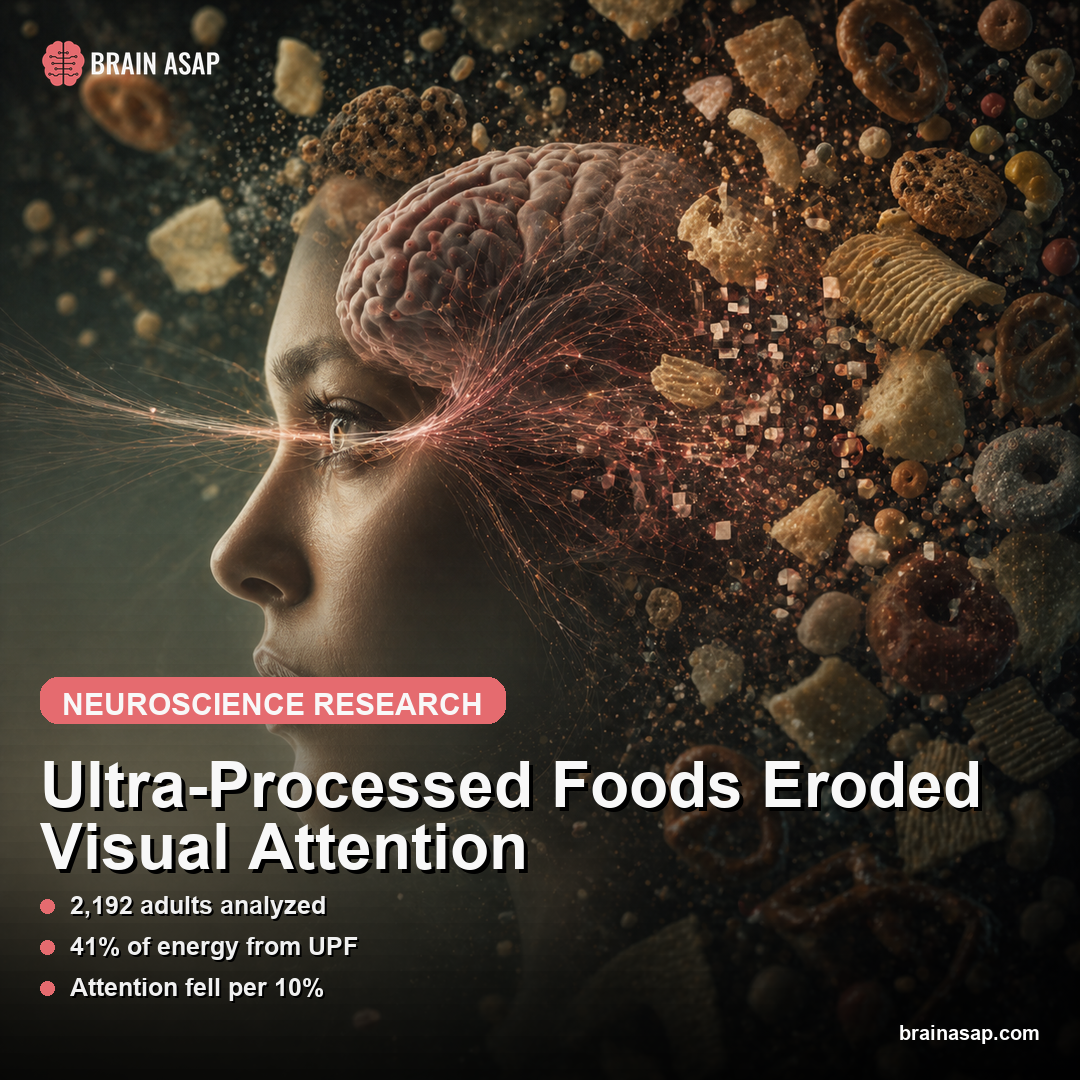
TL;DR: A 2026 study in Alzheimer’s & Dementia: Diagnosis, Assessment & Disease Monitoring found that each 10% higher energy share from ultra-processed foods was associated with lower attention scores and higher modifiable dementia-risk scores in 2,192 dementia-free Australian adults.
Key Findings
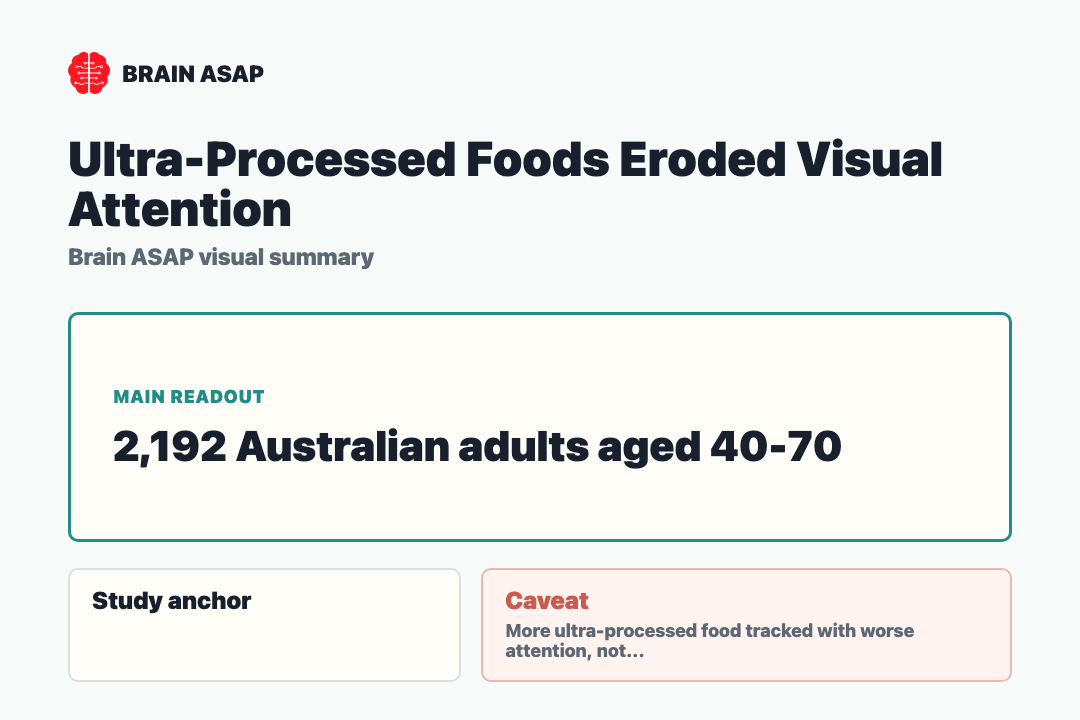
- A dementia-free midlife sample anchored the analysis: the Healthy Brain Project included 2,192 Australians aged 40 to 70.
- Ultra-processed foods made up about 41% of energy intake: that level is close to the Australian national average reported by the authors.
- Attention was the cognitive domain that shifted: each 10% higher share of energy from ultra-processed foods was associated with a 0.05-point lower attention score.
- Modifiable dementia-risk scores were higher: each 10% higher ultra-processed food share was associated with a 0.24-point higher CAIDE score.
- Memory was not significantly associated: the clearest cognitive association appeared in attention rather than memory performance.
Source: Alzheimer’s & Dementia: Diagnosis, Assessment & Disease Monitoring (2026) | Cardoso et al.
Diet studies can get blurry fast because “healthy eating” is a broad label. Someone can eat vegetables, fish, and whole grains while also getting a large share of daily energy from packaged snacks, sweetened drinks, processed meats, frozen meals, and other industrially formulated foods.
This study focused on that second layer: how much of the diet came from ultra-processed foods.
The finding was not a dementia diagnosis or a claim about one snack harming the brain.
It was a measurable association between higher ultra-processed food intake, poorer attention, and a higher score on a dementia-risk calculator built from modifiable health factors.
Ultra-Processed Foods Were Measured Separately From Diet Quality
Ultra-processed foods, often shortened to UPFs, are not just foods with a lot of calories.
Under the NOVA classification system, they are industrial formulations made mostly from substances extracted from foods, refined ingredients, additives, flavorings, emulsifiers, colors, or other processing aids.
Examples often include packaged sweet snacks, soft drinks, reconstituted meat products, instant noodles, many ready-to-heat meals, and some mass-produced breads or cereals.
The key point is manufacturing, not moral judgment. A homemade dessert and a packaged dessert can both be sugary, but NOVA asks a different question: how far has the food moved from ordinary ingredients into an industrial formulation?
The researchers used a validated food frequency questionnaire and classified reported intake according to NOVA. They then looked at ultra-processed foods as a percentage of total energy intake, which allows comparison across people who eat different total amounts of food.
They also adjusted for Mediterranean diet adherence. A person with higher ultra-processed food intake might simply have a worse overall diet; if the association survives adjustment for a healthy dietary pattern, processing level may be capturing an additional risk association.
The Study Tested Attention, Memory, and Dementia Risk
The sample came from the Healthy Brain Project and included Australian adults aged 40 to 70 who did not have dementia.
Midlife and early older adulthood are a major window for prevention.
Dementia symptoms usually appear late, but vascular, metabolic, sleep, diet, and activity patterns can shape brain risk decades earlier.
Cognition was measured with the Cogstate Brief Battery, a computerized set of cognitive tasks. In this analysis, the important domains were attention and memory.
Attention refers to the ability to respond accurately and efficiently to relevant information. It is not the same as intelligence or motivation. It supports reading, driving, working, learning, and remembering.
The dementia-risk estimate came from the CAIDE tool. CAIDE stands for Cardiovascular Risk Factors, Aging and Incidence of Dementia.
It estimates future dementia risk using midlife factors such as age, sex, education, blood pressure, cholesterol, body mass index, and physical activity. In this paper, researchers focused on the modifiable part of the risk score.
That combination gives the study two kinds of outcome: a direct cognitive measure and a risk-profile measure.
- Attention score: current cognitive performance on the Cogstate Brief Battery.
- CAIDE score: a modifiable dementia-risk profile built from midlife health factors.
- Study design: a one-time association, not proof that changing UPF intake changes cognition.
The attention score asks how people performed now.
The CAIDE score asks whether their health profile looks more or less risky for later dementia.
Each 10% Higher UPF Share Was Linked to Worse Attention
The estimated attention association was small but specific.
For each 10% increase in the share of daily energy from ultra-processed foods, attention scores were lower by 0.05 points.
Researchers also translated a 10% increase into a concrete dietary scale, roughly the size of adding a standard packet of chips to daily intake.
A 0.05-point attention-score difference is not something a person would diagnose in the kitchen.
It is not a clinical threshold.
But population-level prevention often starts with small shifts that point in the same direction across many people.
Memory did not show a significant association in this analysis. Attention and processing speed often sit upstream of everyday performance.
If attention is weaker, a person can encode information less efficiently, miss details, or feel less mentally sharp even before a memory test shows a clear deficit.
The finding also fits a broader possibility: diet-related brain effects can first appear in cognitive systems that depend on vascular health, metabolic stability, alertness, and processing efficiency rather than in classic delayed-memory measures.
The CAIDE Result Points Toward Modifiable Risk
For each 10% higher ultra-processed food share, the CAIDE modifiable dementia-risk score was higher by 0.24 points.
CAIDE is not a diagnosis and not a brain scan.
It is a structured estimate based on risk factors that have been linked to dementia over time.
The diet finding becomes more practical when viewed through cardiometabolic health.
Ultra-processed food intake is strongly tied to obesity, type 2 diabetes, blood pressure, and cardiovascular disease in the broader literature.
Those same systems are relevant to dementia risk because the brain depends on blood flow, insulin signaling, inflammation control, and metabolic stability.
So the study does not need to claim that additives directly injure neurons to be meaningful. A diet high in UPFs can push several dementia-relevant systems in an unfavorable direction at once.
Higher CAIDE scores likely reflect that broader risk environment. The Mediterranean diet adjustment also sharpens the message.
A person’s risk is not captured only by how many “good foods” they eat. The amount of industrially formulated food deserves its own line in nutrition research and prevention counseling.
Processing Level can explain Risk That Healthy-Diet Scores Miss
Healthy-diet scores are useful, but they can flatten important differences. Two people may score similarly on fruit, vegetable, fish, and whole-grain intake while having very different intakes of packaged snacks, sweetened drinks, fast food, processed meats, and ready-to-heat meals.
This study suggests that the UPF share can carry its own association.
The point is not that every packaged food is equally harmful or every minimally processed food is automatically healthy.
The structure of the modern food supply may shape brain-health risk in ways that are not fully captured by nutrient checklists.
Several routes could connect UPF-heavy diets to brain-health risk:
- Nutrition displacement: UPFs can crowd out foods that support vascular and metabolic health.
- Metabolic strain: many UPFs are energy dense, low in fiber, high in refined starches or added sugars, and easier to overconsume.
- Inflammation and gut pathways: additives, emulsifiers, microbiome changes, and reward-driven eating patterns remain possible mechanisms, although this analysis did not isolate them.
For long-term brain health, the practical question is two-sided: what protective foods are being added, and how much daily energy still comes from industrially formulated products?
Cross-Sectional Data Cannot Prove Cause and Effect
The study was cross-sectional, meaning diet, cognition, and risk factors were measured at one point in time. That design can detect associations, but it cannot prove which direction the relationship runs.
Higher UPF intake could contribute to poorer attention and higher dementia-risk scores.
But people with worse attention, busier lives, lower income, poorer sleep, depression, medication burden, or other health problems may also rely more on ultra-processed foods.
Food frequency questionnaires can also introduce measurement error because people have to estimate what they usually eat.
Those limits do not erase the finding.
They define what the finding can responsibly support.
In this case, the study supports the idea that ultra-processed food intake is associated with attention and modifiable dementia-risk markers in middle-aged and older adults, independent of Mediterranean diet adherence.
The next step is stronger longitudinal work: follow people over time, measure changes in diet, track attention and memory repeatedly, and test whether reducing UPF intake improves cognitive or dementia-risk markers.
For now, the evidence is strongest as a prevention signal, not as proof that a single food category directly causes dementia.
Citation: DOI: 10.1002/dad2.70335. Cardoso et al. Ultra-processed food intake, cognitive function, and dementia risk: A cross-sectional study of middle-aged and older Australian adults. Alzheimer’s & Dementia: Diagnosis, Assessment & Disease Monitoring. 2026;18:e70335.
Study Design: One-time analysis using NOVA food classification, a validated food frequency questionnaire, Cogstate Brief Battery scores, Mediterranean diet adherence, and CAIDE dementia-risk scoring.
Sample Size: 2,192 dementia-free Australian adults aged 40 to 70.
Key Statistic: Each 10% higher share of energy from ultra-processed foods was associated with lower attention scores (-0.05 points) and higher CAIDE modifiable dementia-risk scores (+0.24 points).
Caveat: The design shows association at one time point, so directionality between diet pattern, attention, cardiometabolic risk, and dementia-risk scoring remains unresolved.