TL;DR: A 2026 study in Frontiers in Psychology found that braless images were rated as more attractive but less faithful, while women who feared sexual harassment reported being less likely to go braless in public.
Key Findings
- 409 Slovak women surveyed: Researchers asked women about bra wearing in public and private settings, body-related factors, sexual harassment concerns, and sociosexuality.
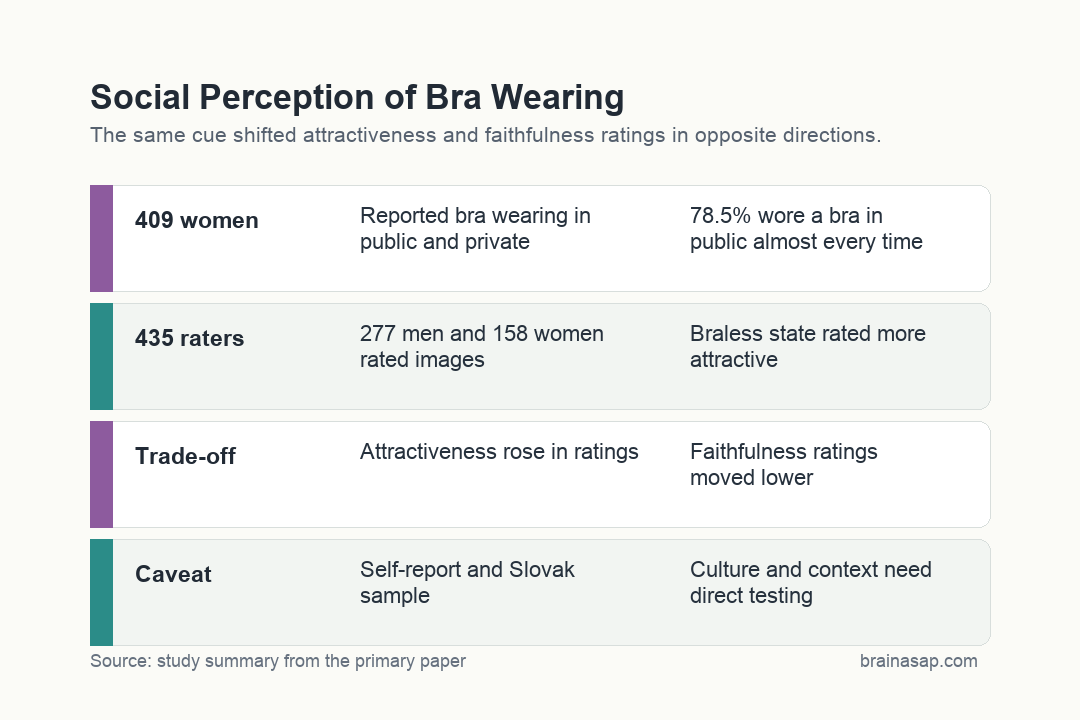
- Public bralessness was uncommon: Only 9 women, or 2.2%, reported almost never wearing a bra in public, while 321 women, or 78.5%, reported wearing one almost every time.
- Harassment concerns predicted public covering: Fear of sexual harassment was negatively associated with going braless in public.
- 435 raters judged visual stimuli: The rating sample included 277 men and 158 women who judged women with and without a bra.
- Attractiveness and faithfulness split: The braless state was rated as more attractive by both men and women, but also as less faithful.
- Male attitudes changed interpretation: Male intentions to sexually harass women and unrestricted sociosexuality were linked to seeing bralessness as a cue of infidelity.
Source: Frontiers in Psychology (2026) | Prokop et al.
Bra wearing is usually discussed as fashion, comfort, modesty, or body support. This study treated it as a social-perception cue: a visible choice that other people can interpret through attractiveness, sexuality, fidelity, and harassment-related expectations.
The same braless cue increased attractiveness ratings while lowering perceived faithfulness, showing how social perception can attach conflicting meanings to women’s clothing choices.
409 Women Reported Bra Wearing Across Public and Private Settings
The first part of the study asked 409 Slovak women about their bra-wearing behavior. Researchers separated public from private settings because the social stakes are different.
Public bralessness was rare. The mean public score was low, and 78.5% of women reported wearing a bra in public almost every time.
Several predictors moved in interpretable directions:
- Sexual harassment fear: Higher perceived risk was linked to less public bralessness.
- Age and education: Both were negatively associated with going braless in public.
- Breast size and firmness: Smaller and firmer breasts were associated with more public bralessness.
- Sociosexuality: Unrestricted sociosexuality did not explain bra-wearing behavior in the model.
The predictor pattern argues against a simple assumption that going braless mainly reflects sexual openness. In this sample, public behavior looked more tied to body features, self-presentation, and perceived safety.
The private-public split is also important. A clothing choice that is comfortable or ordinary in private can change meaning in public because other people can comment, stare, harass, or draw sexual conclusions from it.
That means the study is not only about preference. It is about how women can adapt a visible body-related decision to the social risks they expect in a particular setting.
435 Raters Saw Braless Images as More Attractive but Less Faithful
The second part used visual stimuli. Researchers asked 277 male and 158 female raters to judge women with and without a bra.
The key perceptual split was consistent: the braless state increased attractiveness ratings but reduced faithfulness ratings.
Social perception is not neutral. A clothing cue can raise one positive judgment while also triggering a more suspicious or sexualized interpretation.
The researchers also found that men with stronger preference for larger breasts rated the braless state as more attractive than men with lower preference for large breasts.
Female raters also rated the braless state as more attractive, which makes the finding broader than a male-attraction result. The cue seemed to change social perception across rater genders, even though the interpretation attached to that cue could differ.
Attractiveness ratings should not be confused with endorsement, intent, or moral judgment. Rating a stimulus as attractive is narrower than deciding how a real person should dress or be treated.
Harassment Fear Changed How Public Behavior Should Be Read
The study did not treat clothing behavior as pure self-promotion. Fear of sexual harassment was part of the model, and it predicted lower public bralessness.
Public bra wearing may reflect safety management as much as appearance management.
Three social pressures can operate at the same time:
- Attractiveness pressure: Some cues are judged as more physically attractive.
- Reputation pressure: The same cues can be judged through faithfulness or sexual availability stereotypes.
- Safety pressure: Harassment concerns can shift behavior even when the person would prefer a different choice privately.
Those pressures make the behavior difficult to interpret from the outside. A person wearing a bra in public can be choosing comfort, support, fashion, modesty, or social safety.
The model’s harassment finding is especially important because it moves the analysis away from blaming the person being judged. If perceived harassment risk changes behavior, then public clothing choices partly reflect a social environment that women are trying to navigate.
The social environment can change the same choice across settings: ordinary in one room, risky in another, and morally judged in a third.
Male Rater Attitudes Predicted Infidelity Interpretations
The study also looked at how rater traits shaped interpretation. Male intentions to sexually harass women and unrestricted sociosexuality were positively correlated with reading the braless state as a cue of infidelity.
The male-attitude finding locates part of the meaning in the observer, not just in the clothing cue. A braless state did not carry one fixed message; people with different attitudes attached different social meanings to it.
In practical terms, prevention and education work should not only tell women how clothing is interpreted. It should address the biased interpretations that observers bring to women’s bodies and clothing choices.
The study connects to harassment prevention at the observer-inference level. If some observers are more likely to interpret clothing through infidelity or sexual-availability assumptions, then the social problem is not the clothing choice by itself.
The problem is the observer’s inference, especially when that inference becomes a justification for judgment, pressure, or harassment.
The Study Is About Ratings, Not Real-World Intentions
The limits are straightforward. Bra-wearing frequency and media exposure were self-reported, so recall error and social desirability can affect the numbers.
The sample was Slovak, and the researchers framed the work partly through evolutionary psychology. Cultural norms, fashion context, body image, and local harassment climate can change the same behavior’s meaning in other groups.
Visual-rating studies also simplify real life. They measure judgments under controlled stimulus conditions, not consent, personality, relationship behavior, or actual faithfulness.
Future work would be stronger if it separated comfort, support needs, fashion norms, body satisfaction, and safety expectations in more diverse cultural samples. A diary design would also track how choices change across work, school, home, nightlife, and exercise contexts.
Braless Ratings Showed an Attractiveness-Faithfulness Trade-Off
The study suggests that going braless in public can carry a social trade-off in observers’ minds. It raised attractiveness ratings, but it also lowered faithfulness ratings and interacted with male attitudes related to harassment and sexual openness.
The more careful interpretation is not that one clothing choice means one thing. It is that social perception can sexualize and morally judge the same visible cue, while women are also managing comfort, self-presentation, and safety at once.
The behavioral choice and the observer judgment therefore belong to separate questions.
That separation is the practical point: the same visible cue can be chosen for comfort or safety while being judged by someone else through a sexualized stereotype.
Citation: DOI: 10.3389/fpsyg.2026.1797201; Prokop et al., women’s and men’s perceptions of not wearing a bra in public, Frontiers in Psychology 2026;17:1797201.
Study Design: Self-report and visual-rating study of bra wearing, attractiveness, faithfulness, and social interpretation.
Sample Size: 409 Slovak women reported behavior; 277 men and 158 women rated visual stimuli.
Key Statistic: 78.5% of women reported wearing a bra in public almost every time, while braless images were rated more attractive but less faithful.
Caveat: Self-report, visual stimuli, and one cultural sample limit how far the findings generalize to real-world behavior.