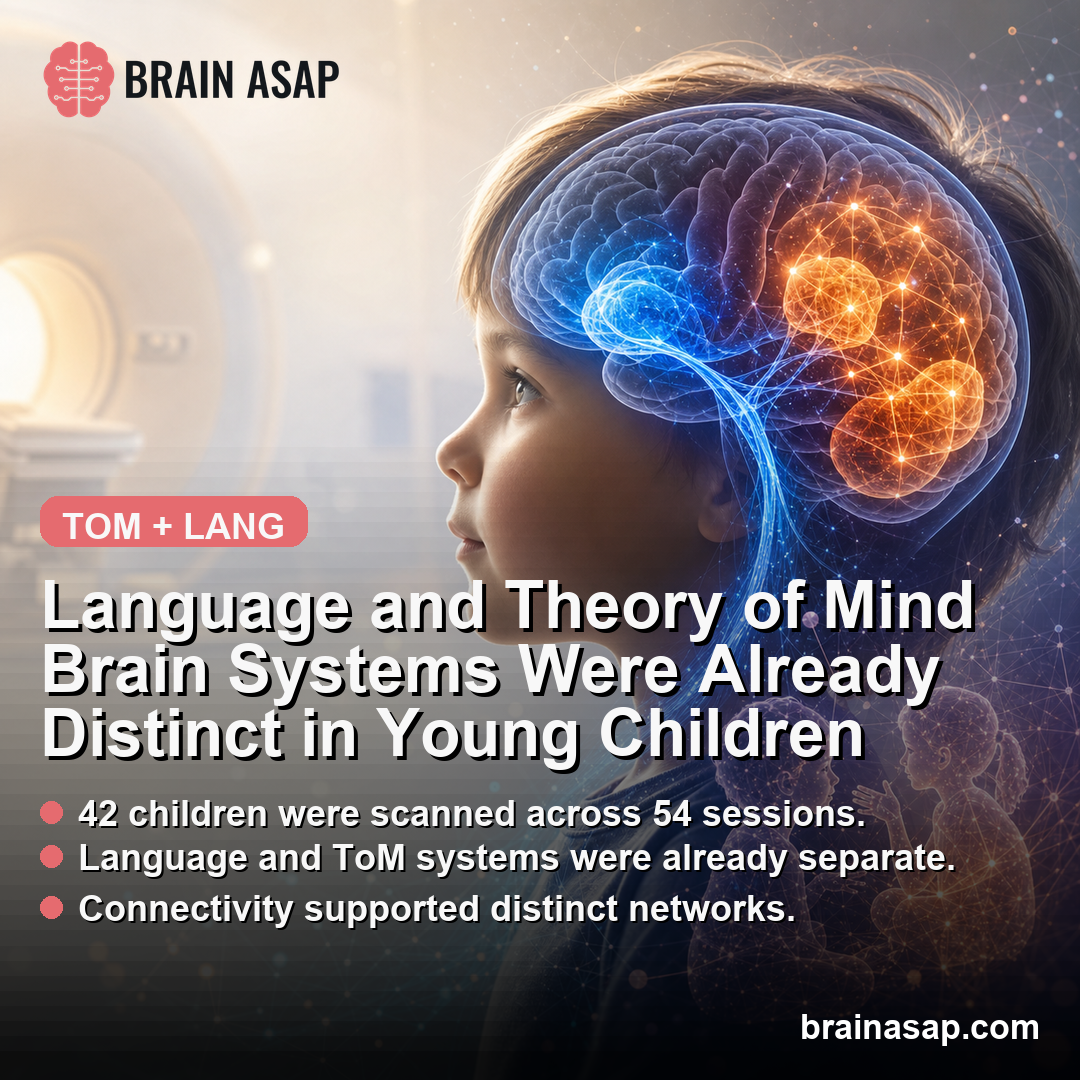
TL;DR: A 2026 Communications Biology fMRI study found that language and theory of mind, the ability to infer other people’s mental states, were already neurally distinct in children aged 3-9 rather than slowly separating during development.
Key Findings
- Children show distinct neural specificity for language and theory of mind in superior temporal lobe — just like adults: The two systems were already separated in 3–9 year olds, with no evidence the systems were ever co-located.
- No developmental “disentangling” found: Cross-sectional and longitudinal analyses both failed to find evidence that language and ToM start unified and separate over time. They appear separate from the earliest ages tested.
- Connectivity fingerprints diverged early too: Each system’s pattern of connections to other brain regions was already domain-specific in young children — not a generic social-cognition pattern that later differentiated.
- Future activation predicted by current connectivity, separately for each system: Children’s connectivity fingerprints predicting later language activation were almost identical to current language fingerprints; same for ToM. Cross-domain prediction was much weaker.
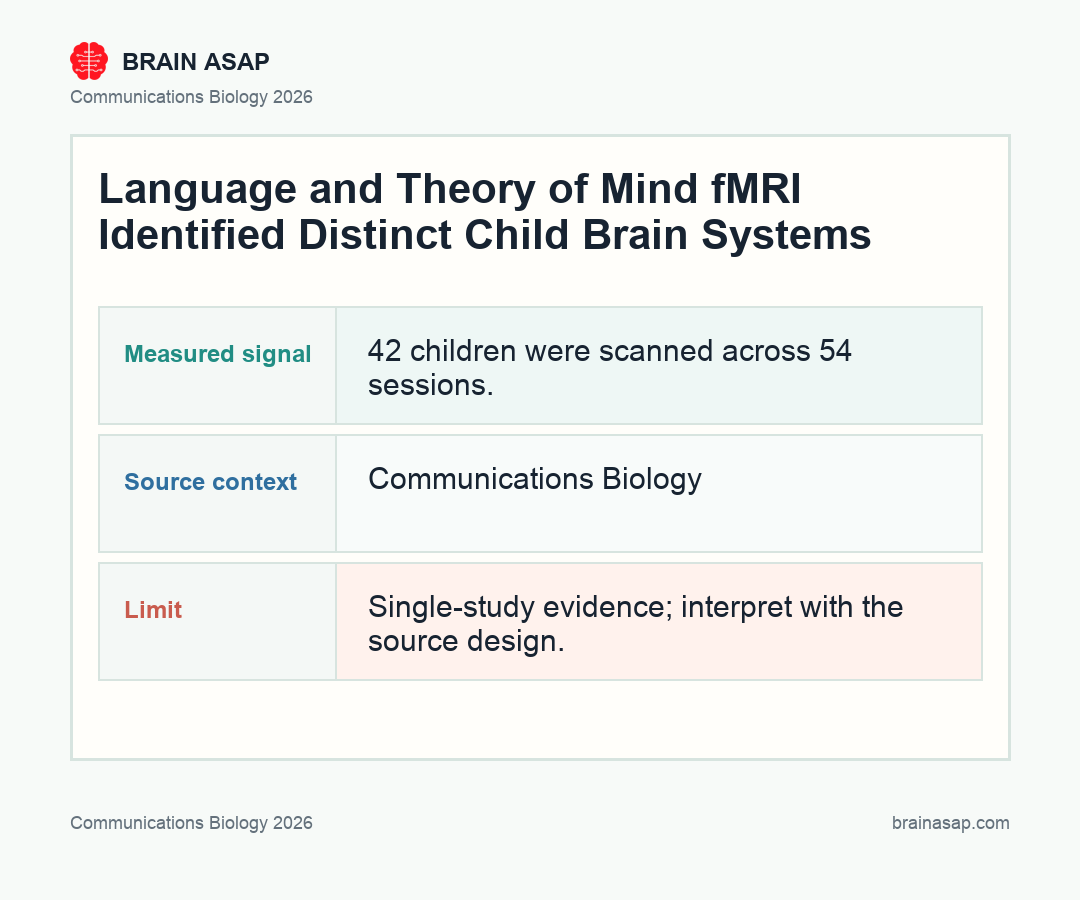
- 54 sessions across 42 children plus 28 adults: Mixed cross-sectional and longitudinal design captured both individual-difference variation and within-child developmental trajectory.
- Continued neural specialization, but from a starting point of separation: Both systems do undergo refinement to reach mature adult patterns — but the refinement is within already-distinct domains, not differentiation from a shared base.
Source: Communications Biology (2026) | Hiersche et al.
Language and theory of mind are both crucial for human communication. Both depend on temporal lobe machinery. Both develop dramatically across early childhood. The standard developmental story has been that they emerge from a shared neural substrate — a generalist social-cognition processor — and gradually specialize over years.
The Hiersche team scanned 42 children across 54 sessions plus 28 adults to test that story. The result rejects it.
The Developmental Hypothesis This Paper Just Rejected
The shared-substrate hypothesis proposed that human babies start with general-purpose social-cognition machinery in the superior temporal lobe (STL).
Some of that machinery would be recruited for language, and some would be recruited for theory of mind. As the brain matures, the functions would specialize and segregate, eventually producing the lateralized adult pattern: language strongly left, and theory of mind bilateral or right-lateralized.
It’s an appealing story. It would mean human social cognition develops as a coordinated whole, with language and mental-state reasoning growing out of the same root.
The Hiersche data don’t support it.
What the 42-Child Cohort Actually Showed
The team scanned 42 children aged 3–9 across 54 sessions, plus 28 adults as a comparison. They mapped:
- Neural specificity within STL: Which voxels respond preferentially to language tasks vs ToM tasks — a measure of how separated the two systems are in tissue.
- Connectivity fingerprints: Which other brain regions each STL location connects to functionally — a measure of how each system is wired into the broader brain.
- Longitudinal change: How these patterns shifted across multiple scans of the same children over time.
The pattern in 3–9 year olds matched the adult pattern in kind, if not in maturity. Language and ToM regions were already distinct. Their connectivity fingerprints already pointed to different brain partners. There was no developmental window during which the two were neurally co-located.
The Connectivity Test That Made the Result Hard to Argue With
The most compelling part of the paper is the predictive analysis. The team asked: can we predict future language-task activation from a child’s current connectivity fingerprint? And separately, can we predict future ToM activation?
The answer was domain-specific. A child’s current language connectivity pattern predicted their future language activation almost perfectly — and was largely non-overlapping with the connectivity pattern that predicted future ToM activation. The two systems behaved like independent prediction problems, not like a shared substrate that splits later.
If the shared-substrate hypothesis were correct, we’d expect young children’s connectivity fingerprints to be more cross-domain (predicting both language and ToM equally well), with specialization emerging only with age. That isn’t what the data show.
What “Continued Specialization” Looks Like If the Systems Were Never Tangled
The Hiersche paper isn’t claiming children’s brains are identical to adult brains. Both systems clearly continue to develop:
- Sharper neural specialization: Adult STL shows more selectively tuned responses than child STL — refinement within already-distinct systems.
- Stronger lateralization: Adult language is more strongly left-lateralized than child language.
- Tighter connectivity fingerprints: Adult connectivity patterns are more crystallized and predictable than child patterns.
The point is that this refinement happens within two domains that were already separated, rather than creating the separation in the first place. Language gets more language-y. ToM gets more ToM-y. They were never in the same neural box.
Why This Matters for How We Think About Atypical Development
Several developmental conditions affect language and theory of mind in different proportions. Autism is associated with ToM differences. Developmental language disorder affects language without necessarily affecting ToM. Fragile X and other genetic syndromes can dissociate the two.
If language and ToM emerged from a shared substrate, those dissociations would be hard to explain — you’d expect coordinated rather than independent vulnerabilities. The Hiersche finding fits the dissociation pattern much better: two distinct brain systems with separate developmental trajectories can produce conditions that affect one without the other.
It also reframes intervention design. Language interventions target language circuits; ToM interventions target ToM circuits. The Hiersche data say that approach is biologically appropriate — there’s no shared upstream substrate to intervene on instead.
The Honest Boundary on This Result
- Cohort age range: 3–9 years old. Whether language and ToM might have been co-located even earlier — under age 3 — is not directly tested. fMRI in toddlers and infants is methodologically extremely hard.
- Sample size: 42 children, 28 adults. Adequate for the central claims but limited for rare-trajectory subgroup analysis.
- STL focus: The study focused on superior temporal lobe as the historical battleground for the shared-substrate hypothesis. Other brain regions involved in social cognition (medial prefrontal, temporoparietal junction) may show different developmental dynamics.
- Healthy children only: The sample excluded children with known developmental conditions. Whether atypical development shows different language/ToM dissociation patterns is a separate question this paper doesn’t try to answer.
The Bigger Reframe for Theories of Social Cognition
The shared-substrate hypothesis was attractive partly because it suggested a parsimonious evolutionary story: one neural specialization for general social processing, secondarily recruited for language and ToM. The Hiersche data force a different story.
Language and theory of mind appear to have distinct neural origins. Each system has its own developmental trajectory, its own connectivity fingerprint, and its own predictive structure linking current to future activation. They share temporal lobe real estate but they don’t share machinery.
That makes language and ToM more like vision and hearing — separate systems that happen to be useful together — than like two functions emerging from a single underlying substrate. For developmental neuroscience, that is a meaningfully different starting point for the next generation of research on how social cognition is built.
Citation: Hiersche et al. Functional dissociation of language and theory of mind in the developing superior temporal lobe. Communications Biology. 2026. DOI: 10.1038/s42003-026-10040-2
Study Design: Mixed cross-sectional and longitudinal fMRI study of children aged 3–9 and adults; mapped language- and theory-of-mind-specific neural activation and connectivity fingerprints in superior temporal lobe; tested predictive relationships between current connectivity and future activation patterns.
Sample Size: 42 children (54 sessions, ages 3–9) plus 28 adults.
Key Result: Distinct neural specificity for language and theory of mind in superior temporal lobe was already present in young children; no evidence of developmental disentangling cross-sectionally or longitudinally; connectivity fingerprints predicting future activation were domain-specific and largely non-overlapping.
Caveat: Cohort starts at age 3 — earlier developmental periods (infancy, toddlerhood) not directly tested; STL-focused; healthy children only; whether atypical development shows different patterns requires separate study.