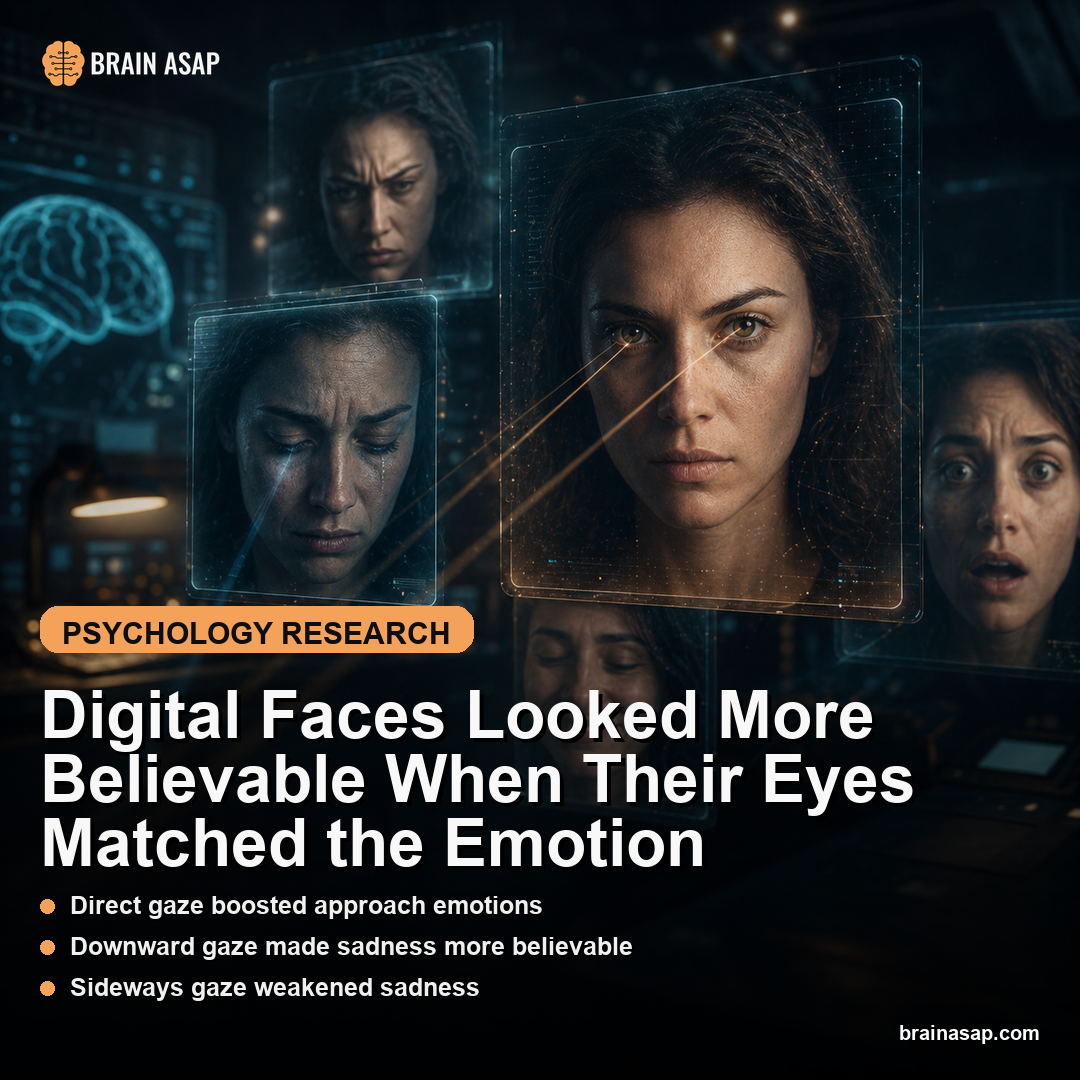
Digital Faces Looked More Believable When Their Eyes Matched the Emotion
TL;DR: A virtual smile or glare looked most believable with direct eye contact, while sadness became more believable when the digital face looked downward.
Key Findings
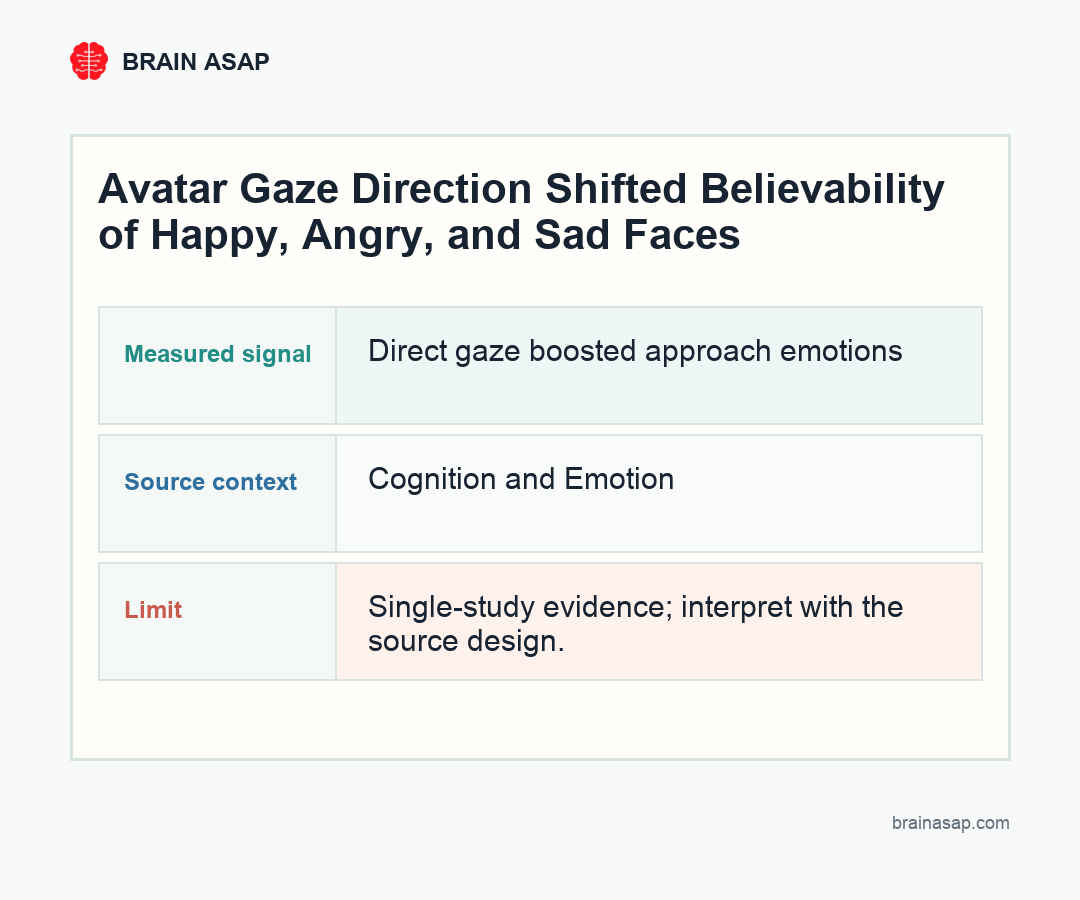
- Direct gaze boosted approach emotions: Happy and angry avatar expressions looked most authentic when the eyes met the observer.
- Downward gaze made sadness more believable: Sad expressions gained authenticity as the eyes moved farther downward.
- Sideways gaze weakened sadness: In the second experiment, looking sideways had the opposite effect of looking down.
- Fear did not follow the predicted pattern: Sideways gaze did not significantly change how believable fearful faces appeared.
- Intensity was modeled separately: The analysis tested believability beyond the simple fact that stronger expressions can look more convincing.
Source: Cognition and Emotion (2026) | Haile et al.
Computer-generated faces do not feel anything, but people still judge whether their expressions look real. This study shows that authenticity is not carried by the mouth or eyebrows alone. The eyes have to aim in a direction that fits the social meaning of the emotion.
Authenticity Lives in the Whole Face
People are skilled at reading faces, but they are not reading a checklist of isolated features. A smile may depend on the cheeks and the eyes. Anger may depend on the brow, the mouth, and whether the other person is looking straight at you.
Digital humans make this problem scientifically useful. A real person who smiles may not feel happy, and the observer can never fully separate the expression from the person’s actual state.
A computer-generated face has no inner life. Its believability is a pure perception problem, which lets researchers test how much gaze direction changes the impression created by the same animated expression.
Haile and colleagues used that advantage to test the shared signal hypothesis: the idea that gaze direction and emotion convey compatible social intentions. Approach emotions, such as happiness and anger, should fit direct gaze. Withdrawal emotions, such as sadness and fear, should fit averted gaze.
Ten Virtual Adults Held the Face Constant
The team created highly realistic virtual adults using professional animation software. Expert raters adjusted digital muscle controls until the faces conveyed anger, fear, happiness, or sadness clearly enough to be used in the main experiments.
The researchers deliberately avoided selecting only perfect expressions. If every expression looked maximally authentic from the start, gaze direction would have little room to change the result. The final stimulus set preserved enough ambiguity for eye direction to matter.
In the first experiment, 150 adults viewed the static faces while rating expression believability. For anger and fear, the eyes looked straight ahead or shifted sideways across several angles. For happiness and sadness, the eyes looked straight ahead or shifted downward.
- Approach pairings: happiness and anger were tested with direct versus sideways gaze, because both emotions can be aimed at another person.
- Withdrawal pairings: sadness and fear were tested with gaze shifts away from direct eye contact, because those emotions can signal reduced engagement or avoidance.
- Intensity control: the models separated expression strength from believability so a stronger-looking face did not automatically explain the result.
The second experiment narrowed the sadness result. Sixty-four new participants rated sad faces with direct, downward, or sideways gaze, which let the authors test whether sadness benefited from any averted gaze or specifically from looking down.
Direct Eye Contact Carried Happiness and Anger
Happy and angry faces looked most genuine when the avatar looked directly at the viewer. As the eyes moved away from center, believability dropped. That fits the social logic of approach: a smile invites contact, and anger confronts.
The study separated believability from intensity because these ratings can blur together. A more intense expression can feel more real simply because it is easier to identify. The statistical models showed that gaze direction had an effect beyond that intensity signal.
Virtual therapy, gaming, education, and customer-service agents all rely on believable social signals. A character can have the right expression sculpted into the face, yet still feel wrong if the eyes point in a socially mismatched direction.
The finding also explains why realism alone can disappoint. A face can have accurate skin texture, lighting, and muscle movement while still violating the social expectation attached to a happy or angry expression.
Sadness Needed Downward Eyes, Not Just Averted Eyes
Sadness behaved differently. The farther the avatar looked downward, the more believable the sad expression became. That result fits everyday social perception: downward gaze can signal withdrawal, shame, grief, or reduced readiness to engage.
The second experiment tested whether any averted gaze would do. A new group of 64 participants rated sad faces that looked straight ahead, downward, or sideways. Downward gaze again made sadness more believable, while sideways gaze made it less believable.
The psychological point is specific: human observers do not treat averted gaze as a generic “not looking at me” cue. They read direction. Down is not the same social signal as sideways.
Digital character design has to separate those meanings because averted gaze can signal embarrassment, distraction, threat monitoring, avoidance, or disinterest depending on the direction and expression. The study showed that sadness benefited from the downward version, not from eye movement away from the viewer in general. Sideways sadness looked less socially convincing.
Fear Refused to Behave Like the Theory Predicted
The shared signal hypothesis would predict that fear should look more believable when gaze is averted, because fear often prepares avoidance. But sideways gaze did not significantly change the believability of fearful expressions in the first experiment.
There are several plausible reasons. Fear may depend more on dynamic timing, widened eyes, or where the apparent threat is located. A static forward-facing avatar with sideways eyes does not necessarily provide enough context for the observer to know what the face is afraid of.
That exception keeps the study from becoming a simple design rule. Eye contact helps some emotions, downward gaze helps sadness, and fear often need motion or scene context before gaze direction carries the expected meaning.
Fear is especially context-hungry because the observer often needs to know whether the face is afraid of the viewer, something nearby, or something off screen. A still avatar with shifted eyes may not provide enough evidence for that judgment.
Static White European Avatars Limit the Claim
The faces were static, forward-facing, and designed to match White European physical characteristics. Participants were also drawn from majority White European countries. That control reduced appearance unfamiliarity as a confound, but it narrows the cultural reach of the finding.
Real expressions unfold over time. People move their heads, blink, glance, and coordinate gaze with posture and voice. Future work using dynamic video and more diverse digital faces could test whether the same gaze-emotion pairings survive in richer social scenes.
Digital emotion is not only a matter of drawing the right smile or frown. A believable virtual person needs eyes that tell the same social signal as the face.
Avatars used in therapy, games, education, telepresence, and customer-service systems depend on that alignment. If the eye direction contradicts the expression, a technically polished face can still feel psychologically wrong.
Paper: Eye believe you: gaze direction affects the perceived believability of facial expressions displayed by computer-generated people. Cognition and Emotion. 2026. DOI: 10.1080/02699931.2026.2620987
Authors: Haile et al.
Study Design: Two behavioral experiments using computer-generated adult faces with manipulated gaze direction and emotion expressions.
Sample Size: 150 adults in experiment 1; 64 adults in experiment 2.
Key Statistic: Direct gaze maximized believability for happy and angry expressions, downward gaze maximized believability for sadness, and sideways gaze did not significantly change fear believability.