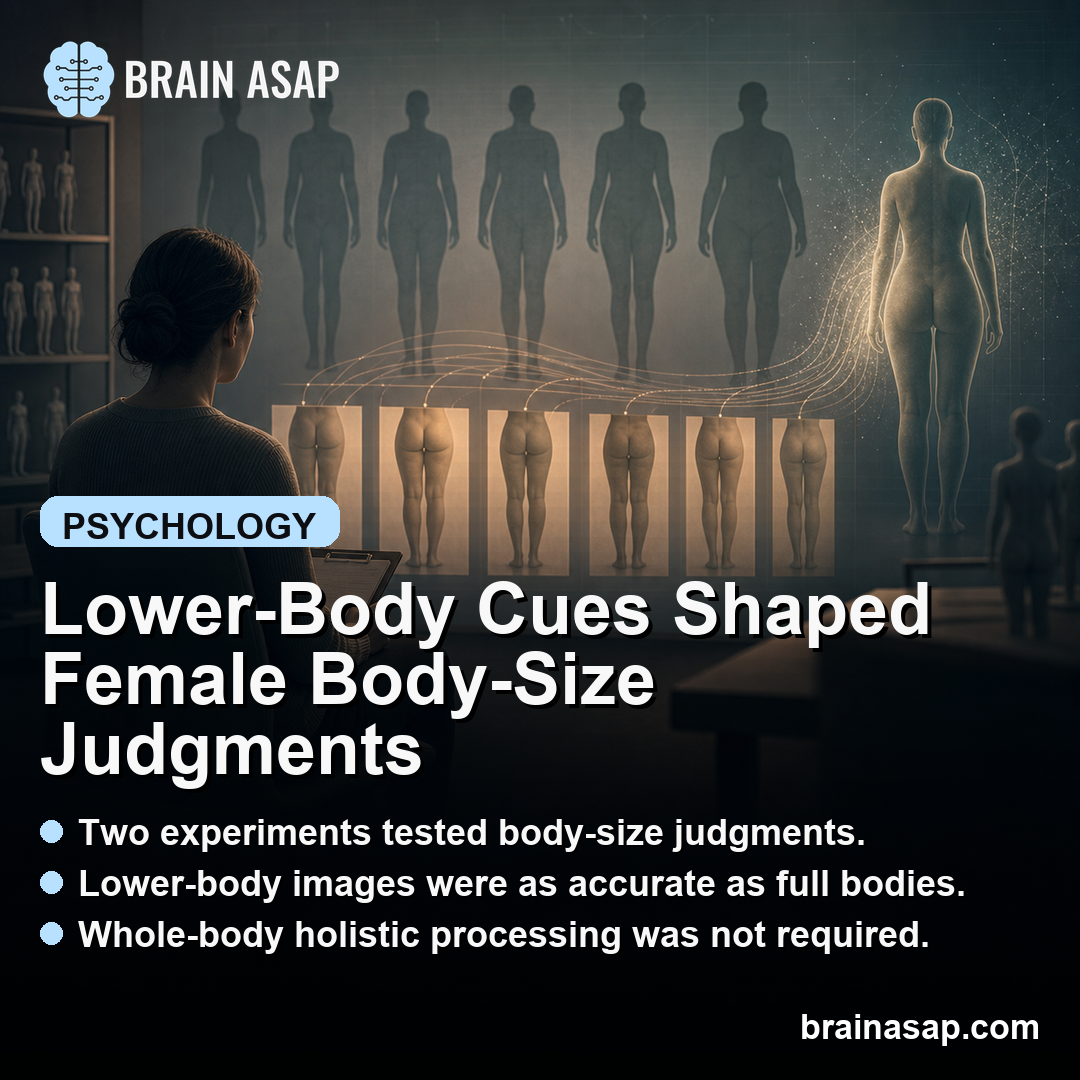
TL;DR: A 2025 study in BMC Biology found that people judged female body size about as accurately from lower-body images as from whole-body images, but isolated thigh regions alone were not enough.
Key Findings
- Two body-perception experiments: Researchers tested 99 participants in Experiment 1 and 116 participants in Experiment 2 using a bodyline task.
- Lower-body views carried accuracy: In Experiment 1, judgments from bottom-half-only images were as accurate as judgments from whole-body images.
- Top-half views were less informative: The result suggested that whole-body holistic processing was not required for accurate female body-size judgments.
- Thigh-only cues were insufficient: In Experiment 2, isolated inner-thigh or outer-thigh regions produced poorer accuracy than whole-body stimuli.
- Two error sources were measured: The bodyline task separated regression to the mean and serial dependence, two ways recent or average stimuli can bias size judgment.
- Body-image relevance was indirect: The results help frame perceptual components of body image disturbance, but the experiments did not study eating-disorder patients directly.
Source: BMC Biology (2025) | Marinko et al.
Body size perception is not just a visual-estimation problem. Distorted body-size judgments are part of body image disturbance, including in eating disorders, where people can misjudge their own body size or shape.
This study asked a more basic perceptual question: when people judge female body size, do they need the whole body, or do specific regions carry most of the relevant information?
The answer helps separate body-image research from a purely social or emotional account. Visual estimation has its own biases, and those biases can be measured before researchers ask how they change in clinical groups.
This distinction has clinical relevance because body image disturbance has several layers. A person can dislike a body, avoid looking at it, check it repeatedly, or misperceive its size; the visual-perception layer needs its own tools.
The study therefore starts with a controlled perceptual task before making any claim about treatment or diagnosis.
Bodyline Task Separated Regression-to-Mean and Serial-Dependence Error
Researchers used the bodyline task, which asks participants to judge bodies along a size continuum. The task can estimate two different sources of error.
- Regression to the mean: Very small or very large bodies can be judged closer to an average body size than they really are.
- Serial dependence: A current judgment can be pulled toward recently seen bodies.
- Accuracy across image regions: Comparing whole, top-half, bottom-half, and isolated thigh views shows which visual cues support judgment.
Separating those errors is important because an inaccurate body-size judgment can come from a general averaging bias, from recent visual context, or from missing body information.
The task also avoids relying on verbal self-report. Participants do not have to explain which cue they used; the error pattern shows whether the available visual information was enough to support accurate judgment.
The design helps body-image research because people do not always have conscious access to the cues that drive their size estimates.
Experiment 1 Found Bottom-Half Views Matched Whole-Body Accuracy
Experiment 1 included 99 participants. They judged female body size from whole-body images, top-half-only images, or bottom-half-only images.
Bottom-half-only judgments were as accurate as whole-body judgments. Participants did not need every visible body region to reach accurate size estimates.
The top half was less central to accuracy in this task. Lower-body information carried enough visual structure for participants to estimate size with similar precision to full-body images.
This finding challenges a simple holistic-processing account. If holistic processing means the viewer must integrate the entire body to judge size accurately, the bottom-half result does not fit that requirement.
The result also narrows the candidate visual information. Overall body outline, lower-body contour, hip-to-leg relations, and neighboring shape cues can carry more body-size information than upper-body features in this task.
Because the experiment compared image regions directly, the finding is stronger than asking people which body areas they think they use. It tested what information actually preserved accuracy.
Experiment 2 Showed Thigh Regions Alone Were Not Enough
Experiment 2 tested 116 participants and narrowed the visual information further. Participants judged whole-body images or images showing only the inner or outer thigh region.
Those isolated thigh regions produced significantly poorer accuracy than whole-body stimuli. The lower body mattered, but the data did not simply say “the thigh alone explains body-size judgment.”
Accurate judgments appeared to integrate multiple lower-body features. Shape, contour, proportion, and the relation between adjacent regions all remain plausible contributors.
The thigh-only result prevents an overclaim. The study does not identify one decisive body part.
It shows that lower-body information is especially informative, while also showing that stripping the image down too far damages accuracy.
For perception science, the boundary is informative. A viewer does not necessarily need the whole body, but the visual system still appears to combine several neighboring cues rather than measuring one isolated line or patch.
Lower-Body Integration Fits Body Image Research Better Than One-Cue Models
The result has body-image relevance because perceptual disturbance is one component of body dissatisfaction and eating-disorder pathology. People do not only think negatively about bodies; they can perceive size inaccurately.
For research, this suggests body-size perception should be studied as a visual-integration problem, not only as a belief or self-esteem problem.
Clinical work often emphasizes thoughts, emotions, and avoidance behaviors, which are essential parts of body image. Perceptual testing adds a different layer by asking how the visual system estimates size under controlled conditions.
- Multiple cues: Size estimates can depend on relationships among lower-body regions.
- Context effects: Serial dependence means recent visual experience can bias current judgments.
- Average-size pull: Regression to the mean can make extremes look less extreme.
- Clinical translation: Understanding these biases can improve body-image assessment, but patient studies are still needed.
A future clinical version should test whether people with body image disorders rely on different regions, show stronger serial dependence, or pull extreme bodies more strongly toward an average body size.
It should also test whether therapy changes perceptual error directly, rather than only improving distress or avoidance.
Those data would connect laboratory perception measures to treatment outcomes in a way this basic experiment cannot yet do.
Eating-Disorder Translation Still Needs Direct Patient Testing
The limitation is important. The experiments were about body-size judgment in controlled visual tasks, not direct diagnosis or treatment of body image disorders.
Because the participants were not an eating-disorder cohort, the study cannot say whether the same lower-body cue pattern drives body-size distortion in anorexia nervosa, bulimia nervosa, body dysmorphic disorder, or other clinical conditions.
It also focused on female bodies as stimuli. Future work would need to test other body types, genders, cultural contexts, and clinical samples before drawing broader conclusions.
Accurate Body-Size Judgment Used Lower-Body Structure, Not a Whole-Body Snapshot
The result is narrow but practical: people could judge female body size accurately from bottom-half views, but they could not do the same when only isolated thigh regions were visible.
The pattern points to a visual system using integrated lower-body structure. For body image science, the result helps specify where perceptual information comes from and why body-size judgments can be biased by both current cues and recent visual context.
Citation: DOI: 10.1186/s12915-025-02444-z. Marinko et al. The thighs have it: evidence for the importance of lower body regions in female body size judgments. BMC Biology. 2025;23:338.
Study Design: Two experimental visual-perception studies using bodyline size-judgment tasks.
Sample Size: 99 participants in Experiment 1 and 116 participants in Experiment 2.
Key Statistic: Bottom-half-only images supported body-size judgments as accurately as whole-body images, while isolated thigh regions did not.
Caveat: The experiments used controlled visual stimuli and did not directly test eating-disorder or body-image-disorder patients.