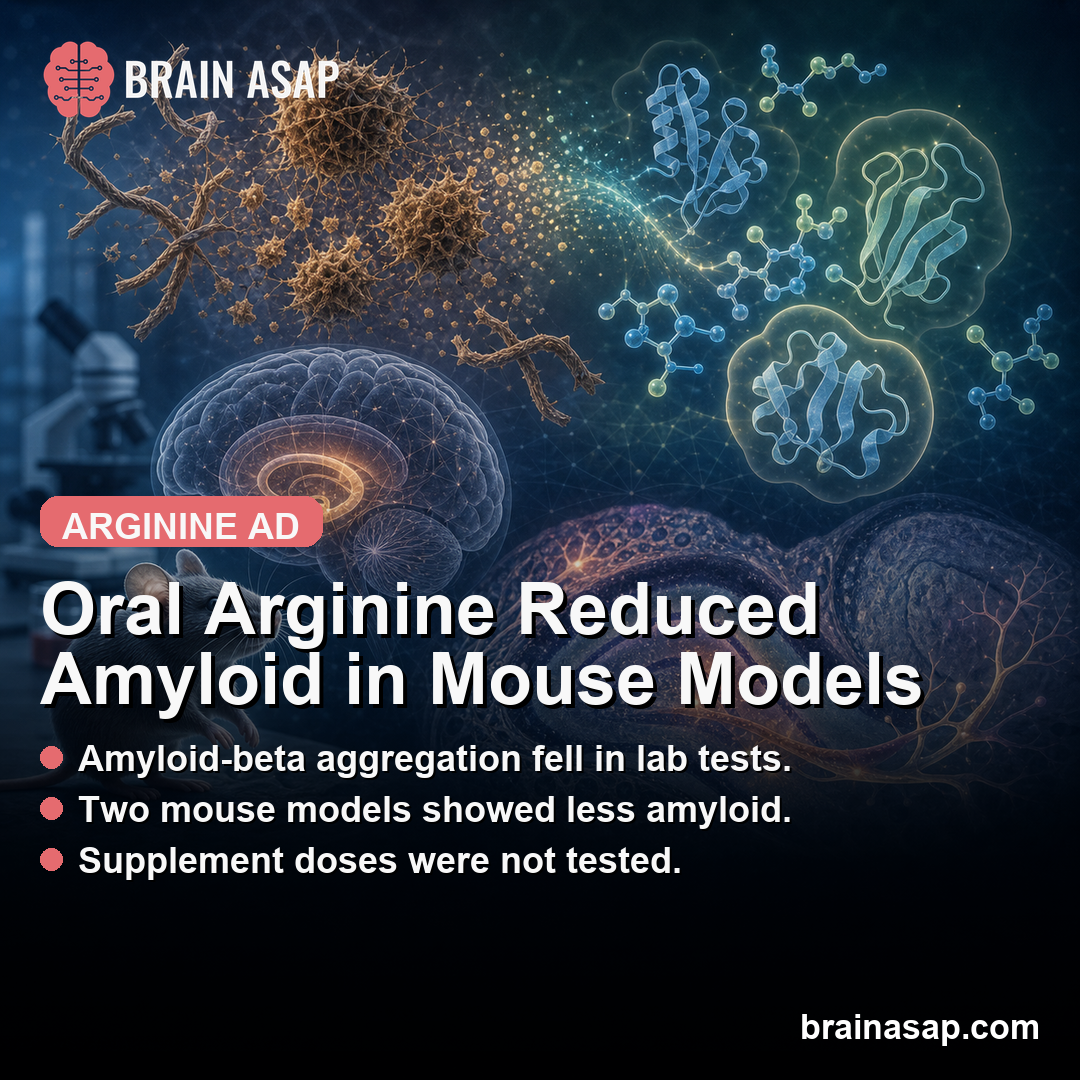
TL;DR: A 2025 study in Neurochemistry International from Kindai University showed that oral arginine, a naturally occurring amino acid, blocked the formation of toxic amyloid-beta aggregates in lab tests and reduced amyloid pathology in two well-established mouse models of Alzheimer’s disease — with the authors flagging that the research-grade doses and methods are not equivalent to over-the-counter arginine supplements.
Key Findings
- Arginine blocked Aβ42 aggregation in lab tests: In test-tube experiments, arginine prevented the formation of Aβ42 aggregates — the form of amyloid-beta most strongly linked to Alzheimer’s neurotoxicity — with effects that scaled with concentration.
- Oral arginine reduced amyloid accumulation in two mouse models: Researchers tested oral arginine in two well-established mouse models of Alzheimer’s disease. Both showed reduced amyloid-beta accumulation and lessened toxic effects in arginine-treated animals.
- Mechanism: arginine acts as a chemical chaperone: Arginine helps proteins maintain their proper folded structure. The team frames the antiamyloid effect as a chaperone action that prevents misfolded amyloid-beta from aggregating into toxic forms.
- Naturally occurring amino acid, generally safe profile: Arginine is naturally present in the body and the diet, and is widely sold as an over-the-counter supplement. The authors describe it as a safe chemical chaperone — though research-grade doses tested here were specifically designed for the experiment.
- Research dose is not the same as supplement dose: The team explicitly notes that the doses and administration methods used in the study are not the same as commercial arginine products, and that supplement-bottle arginine should not be assumed to reproduce the experimental result.
- Preclinical step toward an Alzheimer’s-prevention candidate: The combined in-vitro and dual-mouse-model evidence positions arginine as a candidate for further translational study, not a current treatment for Alzheimer’s disease.
Source: Neurochemistry International (2025) | Fujii et al.
Amyloid-beta protein accumulation is a defining pathological feature of Alzheimer’s disease, and lowering or preventing that accumulation has been the dominant pharmaceutical strategy for two decades.
Most pharmacological efforts have focused on engineered monoclonal antibodies that clear amyloid — an approach with mixed clinical results in human trials.
This Kindai University study tests a different angle: whether a naturally occurring amino acid that helps proteins fold correctly can prevent amyloid aggregation in the first place.
Arginine as a Chemical Chaperone
The mechanistic premise of the study turns on a chaperone framework rather than a clearance framework.
Chemical chaperones are small molecules that help proteins maintain or recover their proper folded structure:
- Misfolded proteins clump: Amyloid-beta becomes pathological when individual molecules misfold and aggregate into oligomers and plaques.
- Chaperones prevent misfolding: A chemical chaperone stabilizes the correctly folded state, reducing the chance of misfolding-driven aggregation.
- Arginine fits the stabilizer role: Arginine is a naturally occurring amino acid widely used in protein chemistry as a stabilizing agent, with a known role in keeping proteins soluble and properly folded.
The Fujii team built their experiments on this framework, testing whether arginine could specifically prevent amyloid-beta aggregation rather than clear it after it had formed.
Lab-Bench Test: Arginine Blocked Aβ42 Aggregation
The first set of experiments tested arginine on Aβ42, the form of amyloid-beta most strongly associated with Alzheimer’s neurotoxicity.
The findings:
- Arginine blocked aggregation: In test-tube assays, arginine prevented Aβ42 molecules from forming the toxic aggregated species.
- Concentration-dependent: The blocking effect scaled with arginine concentration — higher arginine, less aggregation.
- Mechanism consistent with chaperone action: The pattern fits a chaperone role, where arginine stabilizes individual amyloid-beta molecules and prevents the misfolding-aggregation cascade.
The lab-bench finding establishes the molecular plausibility of the approach. Whether oral arginine could reach the brain at sufficient concentration to do the same thing in living animals was the next question.
Mouse Models: Oral Arginine Reduced Amyloid Pathology
The second set of experiments moved from test tubes into living animals, using two well-established mouse models of Alzheimer’s disease.
The mouse-model design:
- Two independent models: Each genetically engineered to develop Alzheimer’s-like amyloid pathology over time.
- Oral arginine intervention: Arginine was administered orally rather than by injection, the route most relevant to a future preventive supplement-style strategy.
- Outcome measures: Amyloid-beta accumulation in brain tissue and downstream toxic effects.
The result: in both models, arginine treatment reduced amyloid-beta accumulation and the harmful effects associated with that accumulation.
Replication across two independent mouse models strengthens the reading more than a single-model result would, since each mouse model carries its own quirks.
Why Arginine Is Different From Anti-Amyloid Antibodies
The current pharmaceutical strategy in Alzheimer’s has been monoclonal antibodies that bind already-formed amyloid and help clear it. The recent Cochrane review suggests those drugs produce statistically detectable but clinically unconvincing effects in mild Alzheimer’s.
The arginine approach is mechanistically different:
- Prevention rather than clearance: Arginine acts before amyloid-beta aggregates rather than after, blocking the misfolding-aggregation cascade upstream.
- Small molecule rather than antibody: A small molecule like arginine can be taken orally and crosses biological barriers more easily than a large antibody.
- Naturally present rather than engineered: Arginine is already in the body and the diet, with a known safety profile at conventional supplement doses.
That difference in mechanism is the reason the Fujii team frames the work as a preclinical candidate worth advancing rather than another version of the antibody strategy that has produced mixed clinical results.
Mouse-to-Human Translation, Cognitive Outcomes, and Disease-Stage Timing Stay Open
- Mouse-to-human translation is not automatic: Many compounds that reduced amyloid in mouse models have failed to produce clinical benefit in human Alzheimer’s trials. The mouse-to-human leap is the most important unproven step.
- Research-grade dose is not the supplement-bottle dose: The team explicitly says the doses and administration methods used here are not the same as commercial arginine products, and they should not be substituted for the experimental regimen.
- Cognitive outcomes were not the primary endpoint: The study reports reduced amyloid pathology and lessened harmful effects in mice. Whether arginine improves memory or learning behavior in mouse Alzheimer’s models, and whether it would do so in humans, requires separate cognitive-outcome work.
- Long-term safety at therapeutic doses needs separate study: Arginine is generally safe at supplement doses, but the doses and durations relevant to an Alzheimer’s-prevention regimen would need their own safety evaluation.
- Stage and timing of treatment unknown: Mouse models received arginine before extensive pathology developed. Whether the same approach would work in established human Alzheimer’s, or only as a prevention strategy in pre-symptomatic at-risk individuals, is not addressed.
Arginine Joins the Chaperone Pipeline as a Translational Candidate, Not a Patient Recommendation
The implications are research-direction rather than clinical-practice:
- Arginine is a candidate for further translational study: The combined in-vitro and two-mouse-model evidence justifies advancing arginine through additional preclinical and eventually clinical investigation.
- Chaperone strategy deserves renewed attention: The amyloid-prevention-via-chaperone framework has been less explored than antibody-driven clearance and may be worth more pharmaceutical investment given the modest results from the antibody approach.
- Existing supplements should not be over-interpreted: Patients and families should not read this study as a recommendation to take over-the-counter arginine for Alzheimer’s prevention. Research doses, methods, and animal-model context do not transfer directly.
- Combination strategies may help: Pairing a chaperone approach with other prevention strategies (lifestyle, vascular-risk control, sleep, exercise) is consistent with the broader move toward multi-pathway Alzheimer’s interventions.
Citation: DOI: 10.1016/j.neuint.2025.106082. Fujii K, Takeuchi T, Nagai Y et al. Oral administration of arginine suppresses Aβ pathology in animal models of Alzheimer’s disease. Neurochemistry International. 2025.
Study Design: Combined in-vitro aggregation assays (Aβ42) and oral arginine intervention in two well-established mouse models of Alzheimer’s disease.
Sample/Model: Test-tube Aβ42 aggregation experiments; two genetically engineered mouse models of Alzheimer’s disease.
Key Statistic: Concentration-dependent block of Aβ42 aggregation in vitro; reduced amyloid-beta accumulation and lessened toxic effects in both mouse models under oral arginine treatment.
Caveat: Mouse-model results do not transfer automatically to humans; research-grade dose is not the same as commercial supplement; cognitive-outcome and long-term-safety data still needed; whether arginine would help in established disease vs only as prevention is not addressed.