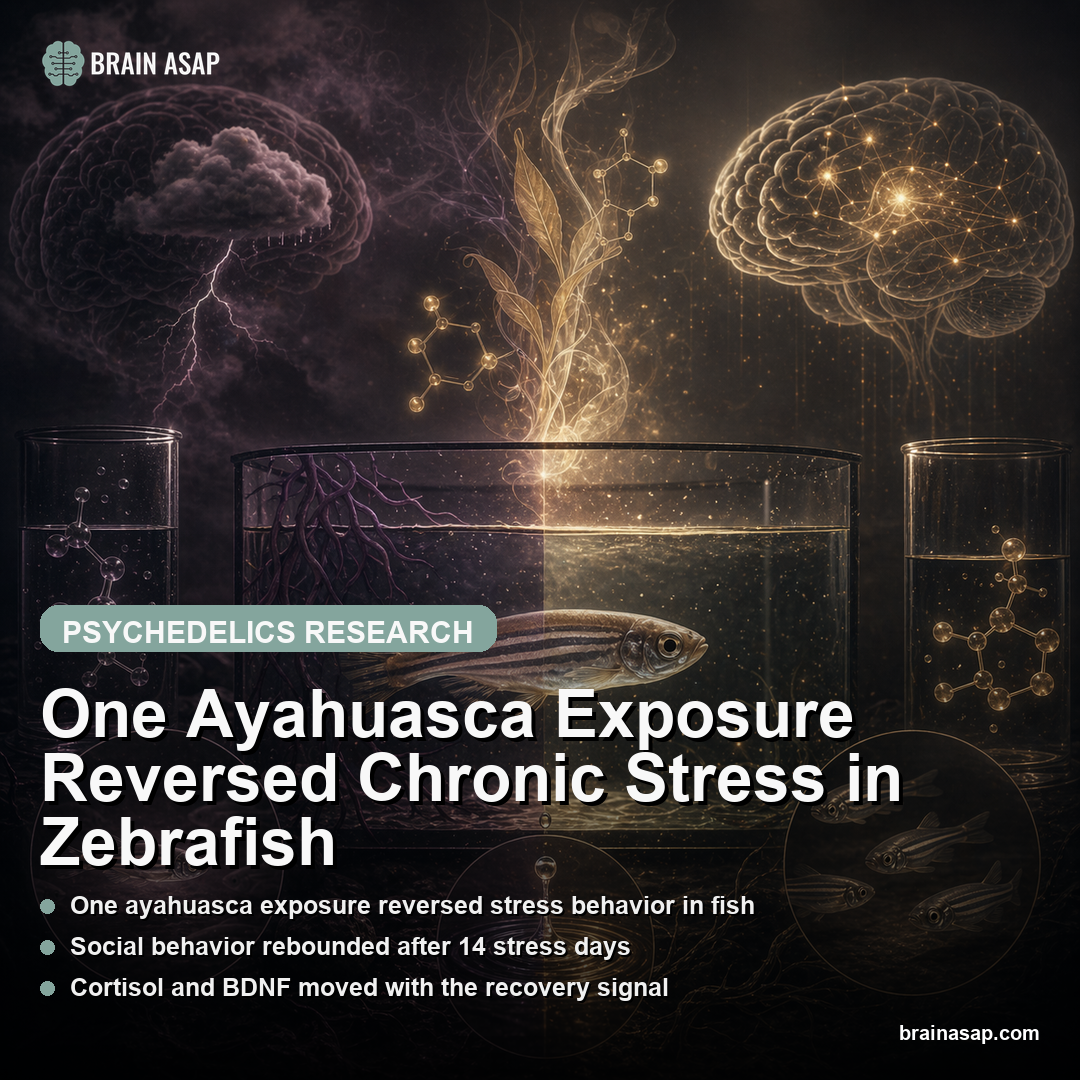
TL;DR: A 2026 study in Psychopharmacology found that after 14 days of unpredictable chronic stress, a single 1-hour ayahuasca exposure restored sociability, reduced anxiety-like behavior, normalized cortisol, and rescued whole-brain BDNF in adult zebrafish within 24 hours.
Key Findings
- 396 fish across 6 groups: Adult zebrafish were split into stressed and non-stressed groups, then exposed to either no ayahuasca, 0.5 mL/L, or 1 mL/L, with separate cohorts used for behavior and biomarker assays.
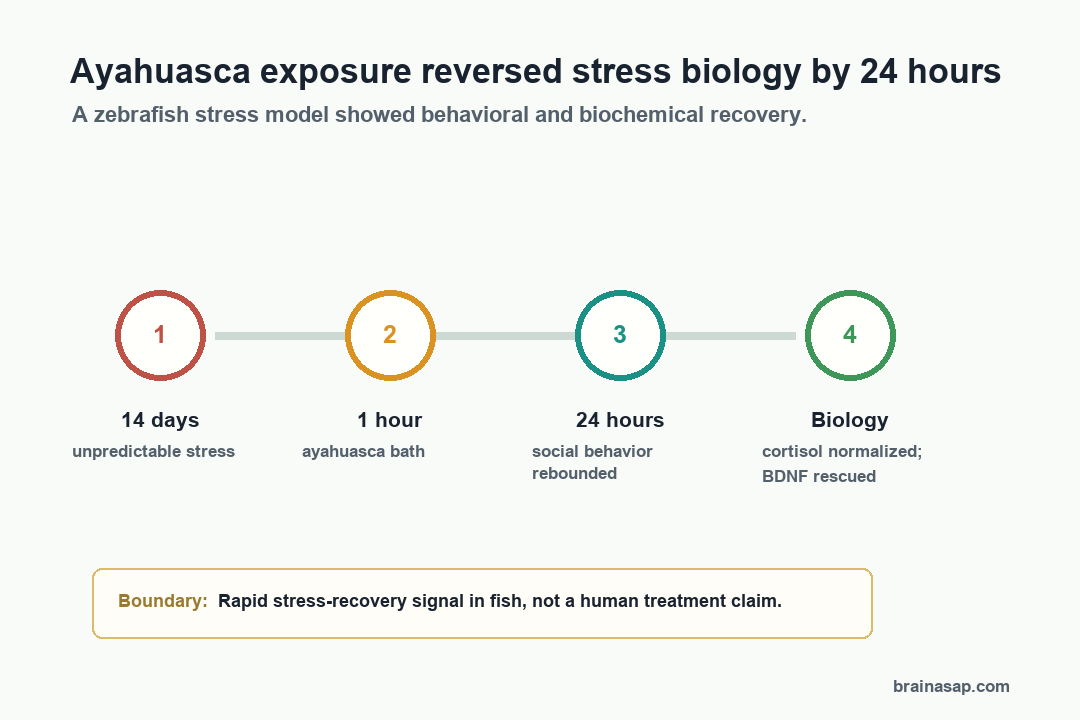
- 14 stress days, 1-hour AYA bath: The study used 14 days of unpredictable chronic stress followed by a single 1-hour ayahuasca exposure on day 15 and behavioral plus biochemical testing on day 16.
- Sociability interaction F = 5.736: Ayahuasca reversed the stress-induced drop in time spent near a shoal, with significant recovery at both doses relative to stressed controls (p = 0.0099 for the AYA x stress interaction).
- Bottom-zone anxiety readout F = 12.21: Stress drove more entries to the bottom of the novel tank, and ayahuasca normalized that anxiety-like pattern at both doses (interaction p = 0.0003).
- Cortisol and BDNF moved together: Ayahuasca brought stress-elevated whole-body cortisol back toward control levels (F = 54.46) and rescued whole-brain BDNF within 24 hours (F = 15.24), with both interactions at p < 0.0001.
Source: Psychopharmacology (2026) | Lodetti et al.
Most antidepressant stories are about repetition: dose after dose, week after week, until biology slowly budges.
This study tested a more radical idea in a zebrafish stress model and found that one short ayahuasca exposure was enough to reverse a whole cluster of stress-linked behavioral and biochemical changes by the next day.
Why a One-Hour Ayahuasca Bath Is a Tough Test of a Psychedelic Claim
Psychedelic papers often ride a wave of expectation. The expected sequence is usually familiar: intense subjective experience, rich psychotherapy, then some degree of symptom improvement.
Three details anchor the result: This study stripped almost all of that away.
No human meaning-making, no therapy room, no verbal insight. Just adult zebrafish under unpredictable chronic stress, then a one-hour exposure to ayahuasca in tank water.
That made the experiment unusually helpful as a preclinical stress-recovery test.
If an intervention can reverse chronic-stress phenotypes without the human theater around it, the finding is less likely to depend entirely on expectation, ritual, or narrative framing.
The finding still does not show the same thing will happen in people.
It does, however, make the biological test sharper: can one exposure push stress-hormone and neuroplasticity measures back toward baseline fast enough to change behavior by the next day?
The brew itself was chemically characterized, not just described vaguely.
The batch contained DMT at 1.36 mg/mL plus the beta-carbolines harmine, tetrahydroharmine, and harmaline, which is important because ayahuasca is not one molecule.
It is a pharmacological mixture built around serotonergic and monoaminergic effects, not a single-target drug.
What 14 Days of Unpredictable Stress Did to 396 Adult Zebrafish
The study used 396 adult zebrafish divided into six groups of 66. Some were left undisturbed.
Others were put through a 14-day UCS protocol that randomly rotated several stressors:
- Temperature and crowding stress: basic environmental pressure that forced the fish out of normal tank conditions.
- Shallow-water, net, and air exposure: acute threats that changed movement, handling, and survival context.
- Food deprivation: a metabolic stressor layered onto the behavioral stress schedule.
The goal was not one specific insult. The varied schedule was meant to mimic the cumulative burden of chronic stress.
The design also separated behavior from biochemistry.
Each group included 12 animals for behavioral testing and additional fish for cortisol and BDNF assays, with biomarker analyses run at N = 6 independent pooled samples per group.
That is still a preclinical study, but it is not a tiny proof-of-concept with five fish in a dish.
By day 16, the stressed animals showed the expected pattern: worse sociability, more anxiety-like exploration in the novel tank, higher whole-body cortisol, and lower whole-brain BDNF.
In other words, the stress protocol did not just make the fish wigglier. It changed social behavior, endocrine state, and a key neuroplasticity readout together.
The behavioral recovery was fast enough to be the headline. In the sociability test, chronic stress reduced the time fish spent near a shoal.
A single ayahuasca exposure restored that social preference at both 0.5 and 1 mL/L, with an AYA-by-stress interaction of F = 5.736 and p = 0.0099.
The novel tank results pushed in the same direction.
Stress increased entries into the bottom zone, a common anxiety-like readout in zebrafish, and ayahuasca normalized that finding with an interaction F = 12.21 and p = 0.0003.
It also normalized stress-linked increases in middle-zone entries and average swimming speed, and the higher dose increased time spent at the top of the tank, another sign consistent with reduced anxiety-like behavior.
What makes those findings cleaner is what did not happen. Ayahuasca did not produce the same behavioral shifts in non-stressed animals.
That finding does not support a simple “psychedelic makes everything more active” explanation. The drug-like effect looked stress-contingent, not nonspecifically activating.
Cortisol and BDNF Linked Ayahuasca to Stress Recovery
Behavioral assays in fish are helpful, but by themselves they are easy to over-read.
The stronger part of the paper is that the behavior lined up with two biochemical measures that make mechanistic sense in a chronic-stress model.
First, whole-body cortisol shot up after the UCS protocol and then normalized after ayahuasca at both doses.
Statistically, this was the loudest readout in the study, with an AYA x stress interaction of F = 54.46 and p < 0.0001.
That suggests the intervention was not just changing movement patterns. It was affecting the zebrafish equivalent of a stress-hormone axis output.
Second, chronic stress reduced whole-brain BDNF, and ayahuasca reversed that drop within 24 hours.
BDNF sits close to synaptic plasticity, stress adaptation, and circuit remodeling, which is why it appears so often in rapid-acting antidepressant discussions.
This study does not prove new synapses formed in a day. But it does show that a core plasticity-associated readout moved back toward baseline fast.
The discussion makes a helpful comparison here. Conventional antidepressants often need repeated dosing and longer neuroadaptive time to shift BDNF-related pathways.
In this model, one exposure was enough to push cortisol and BDNF in the opposite direction by the next day.
That is exactly the kind of pattern that keeps interest in rapid-acting psychedelic mechanisms alive.
How a Whole-Brain Fish readout Cannot Stand In for Human Care Yet
The study’s limits are real, and the authors are fairly explicit about them. Zebrafish behavior cannot cleanly disentangle anxiety-like behavior from heightened arousal or altered exploration.
Whole-brain BDNF is also a blunt instrument.
It tells you something changed, but not where, in which cell types, or whether the same readout would map onto a human cortical or limbic circuit.
This is also a single-exposure, short-horizon study. The paper shows recovery at 24 hours, not durability at 2 weeks or 2 months.
The experiment is better read as a model of rapid reversal than of sustained treatment.
And because ayahuasca is a multi-compound brew, the study cannot tell you whether DMT, beta-carbolines, monoamine oxidase inhibition, or some interaction among them did the heaviest lifting.
There is another judgment call worth making plainly: this is a high-interest psychedelics paper, but it is still a fish paper.
The right editorial move is to treat it as a mechanistic clue about rapid stress recovery, not as evidence that one ayahuasca session in humans will normalize depression biology on the same timetable.
What This Adds to the Rapid-Acting Psychedelics Debate
The study does not answer the biggest human tests around ayahuasca, and it was never built to.
What it does add is a more disciplined preclinical data point to a space that can drift toward vibes very quickly.
Ayahuasca reversed a chronic-stress phenotype across several layers at once: social behavior, exploratory anxiety-like behavior, cortisol, and BDNF.
It did so after one short exposure and without obvious effects in unstressed animals.
That combination makes the result more informative than a simple locomotion study and more believable than a paper that only reports one favorable behavioral endpoint.
The result adds a specific preclinical point to the rapid-acting psychedelics debate: stress recovery measures can appear across behavior, cortisol, and BDNF even without psychotherapy, language, or expectancy doing the work.
That does not shrink psychedelic treatment down to chemistry alone, but it does show that part of the recovery biology can move quickly in a controlled animal model.
What Moved Together After Ayahuasca Exposure
- Behavior: Sociability and anxiety-like tank exploration moved back toward control patterns.
- Endocrine signal: Whole-body cortisol normalized after the one-hour exposure.
- Plasticity marker: Whole-brain BDNF rebounded within 24 hours in stressed fish.
Citation: DOI: 10.1007/s00213-026-07058-z. Lodetti et al. Single exposure to Ayahuasca reverses chronic stress effects on sociability, anxiety, cortisol, and BDNF in zebrafish. Psychopharmacology. 2026 Apr 14.
Study Design: Cohort study
Sample/Model: 396 fish across 6 groups: Adult zebrafish were split into stressed and non-stressed groups, then exposed to either no ayahuasca, 0.5 mL/L, or 1 mL/L, with separate cohorts used for behavior and biomarker assays.
Key Statistic: 14 stress days, 1-hour AYA bath: The study used 14 days of unpredictable chronic stress followed by a single 1-hour ayahuasca exposure on day 15 and behavioral plus biochemical testing on day 16.
Caveat: Single-study evidence; interpret with the source design and sample.