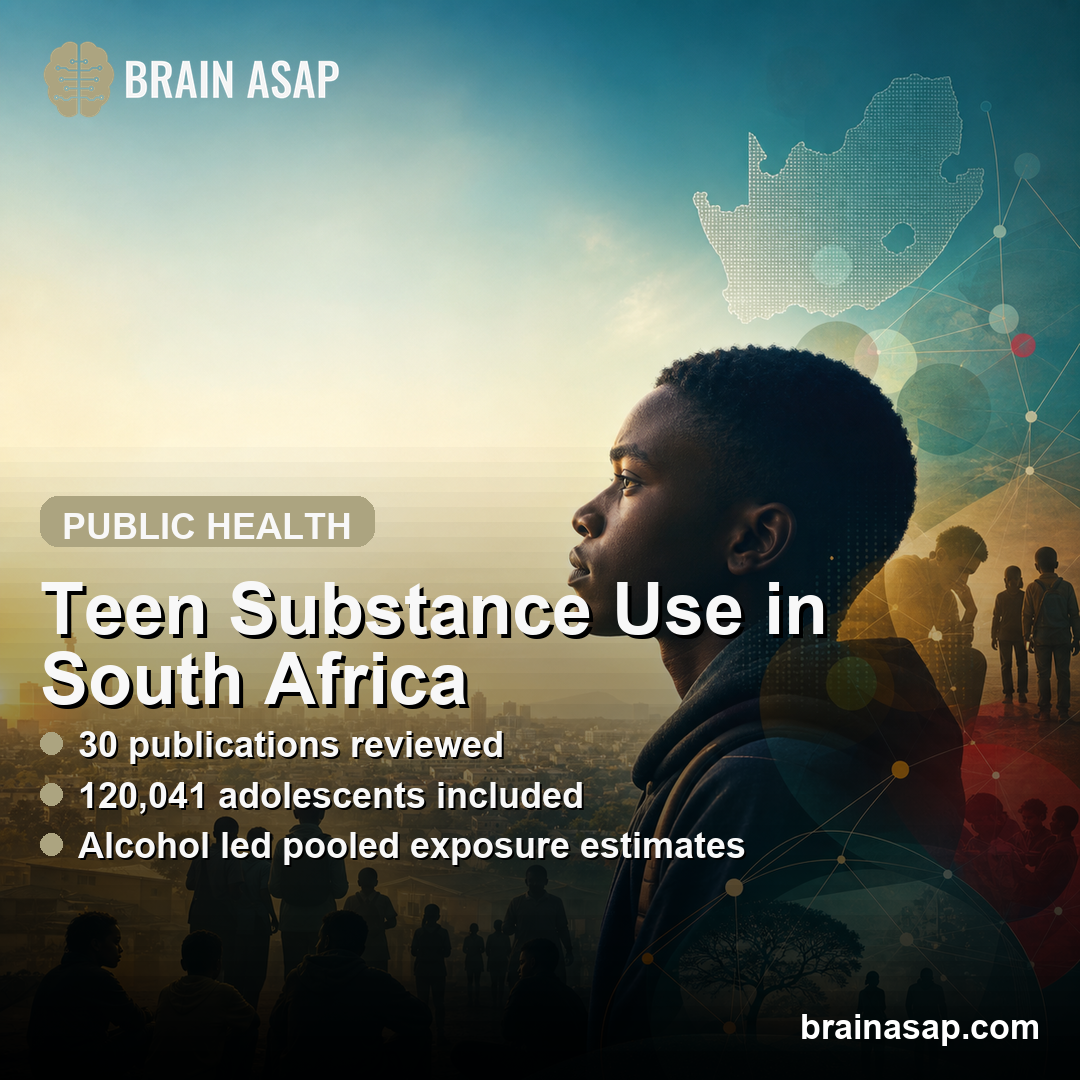
TL;DR: A 2026 systematic review and meta-analysis in Drug and Alcohol Review estimated high adolescent substance-use exposure in South Africa, with lifetime alcohol use at 35.09%, tobacco at 25.47%, and cannabis at 10.47% across community and school-based studies.
Key Findings
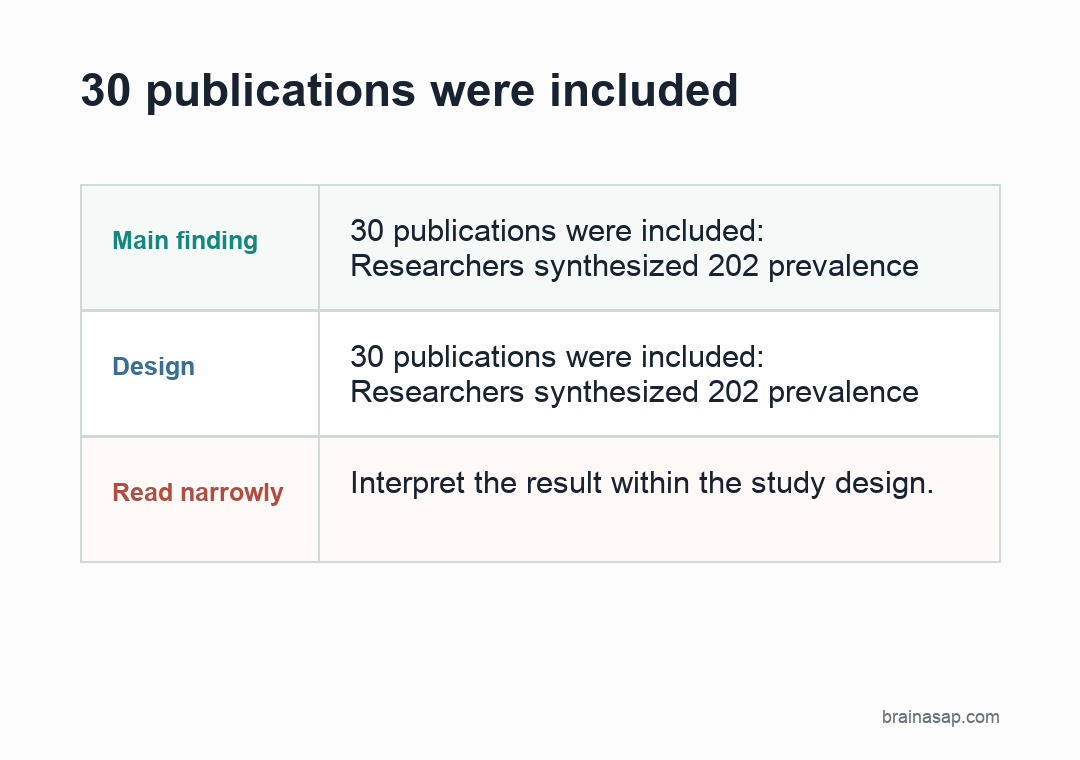
- 30 publications were included: Researchers synthesized 202 prevalence estimates from South African adolescent samples.
- Total sample size was large: The review covered 120,041 adolescents, with a mean age of 16.1 years.
- Lifetime alcohol use was the highest estimate: Random-effects meta-analysis estimated 35.09% lifetime alcohol use.
- Tobacco and cannabis were also common: Lifetime tobacco use was estimated at 25.47%, while lifetime cannabis use was estimated at 10.47%.
- The evidence was uneven: Researchers found substantial heterogeneity across studies, meaning national surveillance remains a major gap.
Source: Drug and Alcohol Review (2026) | Brooke-Sumner et al.
South Africa has long had scattered evidence on adolescent substance use, but scattered estimates are hard to turn into policy. A school survey in one province, a community sample in another, and a single-substance study elsewhere can each be useful without giving a clear national picture.
Researchers tried to organize that fragmented evidence. They reviewed studies reporting original prevalence data from community or school-based South African samples of adolescents under 19 years old, then pooled estimates when enough comparable data were available.
The synthesis is not a perfect national surveillance system. It is closer to a map of what the published evidence can and cannot currently show.
Alcohol Was the Most Commonly Reported Adolescent Substance Exposure
Alcohol was the most common substance exposure in the pooled estimates. Across included studies, lifetime alcohol use was estimated at 35.09%, with a 95% confidence interval from 23.83% to 48.30%.
That estimate means roughly one in three adolescents in the pooled published evidence had ever used alcohol. The 12-month estimate was lower, at 17.45%, but still high enough to matter for youth mental health, school functioning, injury risk, and later substance-use trajectories.
The review separated several time windows because “use” can mean very different things across studies. The core alcohol estimates were:
- Lifetime use: 35.09%, based on pooled prevalence estimates from published adolescent samples.
- 12-month use: 17.45%, showing recent exposure remained common.
- 30-day use: 15.15%, suggesting a meaningful current-use burden in the available evidence.
Interpretation: The numbers do not mean every South African adolescent has the same risk. They mean the published community and school evidence consistently places alcohol near the top of the adolescent substance-use burden.
Tobacco and Cannabis Added a Second Prevention Problem
Alcohol was not the only exposure. The meta-analysis estimated lifetime tobacco use at 25.47% and lifetime cannabis use at 10.47%. For 12-month use, the corresponding estimates were 11.57% for tobacco and 6.66% for cannabis.
Those numbers matter because adolescent substance exposure is rarely only a single-substance issue. Alcohol, tobacco, and cannabis can overlap with school disruption, family stress, peer pressure, trauma exposure, and symptoms of depression or anxiety.
The review also reported a pooled estimate for any lifetime substance use of 13.05%. That value was lower than the substance-specific lifetime alcohol estimate because the “any substance” category came from a different set of studies and measurement definitions, not because alcohol was mathematically less common.
That is one reason the paper repeatedly returns to measurement quality. Prevalence estimates depend on the exact question, the time window, the sample, the location, and whether adolescents were asked about alcohol, tobacco, cannabis, inhalants, or multiple substances together.
Thirty Studies Covered 120,041 Adolescents, But the Evidence Was Not Nationally Even
The review included 30 publications and 120,041 adolescents, which makes it a substantial evidence synthesis. Researchers searched PubMed, PsycINFO, Web of Science, and SciELO, then included studies that reported original South African prevalence data in school or community samples.
The study set still had important limits. It was not the same as a current, nationally representative surveillance program.
Published studies differed in region, age range, survey wording, substance categories, and recall window.
Several design features shaped what the authors could conclude:
- Study type: Most included evidence came from cross-sectional prevalence studies rather than longitudinal follow-up.
- Sampling frame: School-based samples can miss adolescents who are not in school, a group that may have different risk exposure.
- Measurement window: Lifetime, 12-month, and 30-day estimates cannot be treated as interchangeable.
- Regional coverage: The published literature did not provide equally strong coverage across all South African settings.
Main limitation: The high heterogeneity means the pooled numbers should be read as the best published synthesis of uneven evidence, not as a single clean national rate.
High Heterogeneity Changes How the Numbers Should Be Used
The review found substantial heterogeneity across studies. In practical terms, the studies did not all look like measurements of one identical population with one identical survey tool.
That does not make the evidence useless. It means the estimates are better used for priority-setting than for overprecise claims.
The data support a clear conclusion that adolescent substance exposure is a real public-health and mental-health issue in South Africa. They do not support pretending the exact pooled percentage is a stable national surveillance figure.
For prevention work, the difference matters. A province, district, school system, or clinic needs local data on age, gender, substance type, and recent-use patterns.
A pooled review can show the broad burden, but local prevention still needs local measurement.
The authors highlighted the need for nationally representative surveillance because repeated, comparable measurement would make several things possible:
- Trend tracking: Policymakers could see whether adolescent alcohol, tobacco, or cannabis exposure is increasing or decreasing.
- Targeted prevention: Programs could be matched to age groups, regions, and substances with the highest measured burden.
- Mental-health planning: Services could account for the overlap between substance use, depression, anxiety, trauma, and school disruption.
- Policy evaluation: Prevention efforts could be tested against repeated, comparable outcomes instead of one-time snapshots.
Adolescent Substance Use Is a Mental-Health Risk Marker
The review focused on prevalence, but the public-health relevance is broader than counting exposures. Early substance use is associated with later substance-use disorder risk, and adolescence is a period when decision-making, impulse control, social identity, and emotional regulation are still developing.
South Africa also has structural risk factors that can make prevention harder: poverty, inequality, community violence, uneven service access, and school disruption. The paper did not reduce adolescent substance use to those factors, but it placed the prevalence problem inside a wider development and mental-health context.
The most useful reading is therefore direct: alcohol, tobacco, and cannabis exposure are common enough in the published evidence that adolescent prevention cannot rely on occasional local studies alone. South Africa needs routine youth surveillance paired with prevention programs that fit adolescents’ actual environments.
The clinical relevance is that substance-use prevalence also marks adolescent brain and mental-health risk. The review does not show that every exposed adolescent will develop a disorder.
It does show that the exposure base is large enough to justify better monitoring before harms become harder to reverse.
Citation: DOI: 10.1111/dar.70143. Brooke-Sumner et al. Systematic review and meta-analysis of the prevalence of substance use among adolescents in South Africa. Drug and Alcohol Review. 2026;45:e70143.
Study Design: Systematic review and random-effects meta-analysis of published South African adolescent substance-use prevalence studies.
Sample Size: 30 publications, 202 prevalence estimates, and 120,041 adolescents with a mean age of 16.1 years.
Key Statistic: Lifetime prevalence estimates were 35.09% for alcohol, 25.47% for tobacco, and 10.47% for cannabis.
Caveat: Substantial heterogeneity across study methods and samples means the pooled rates should not be treated as precise national surveillance values.