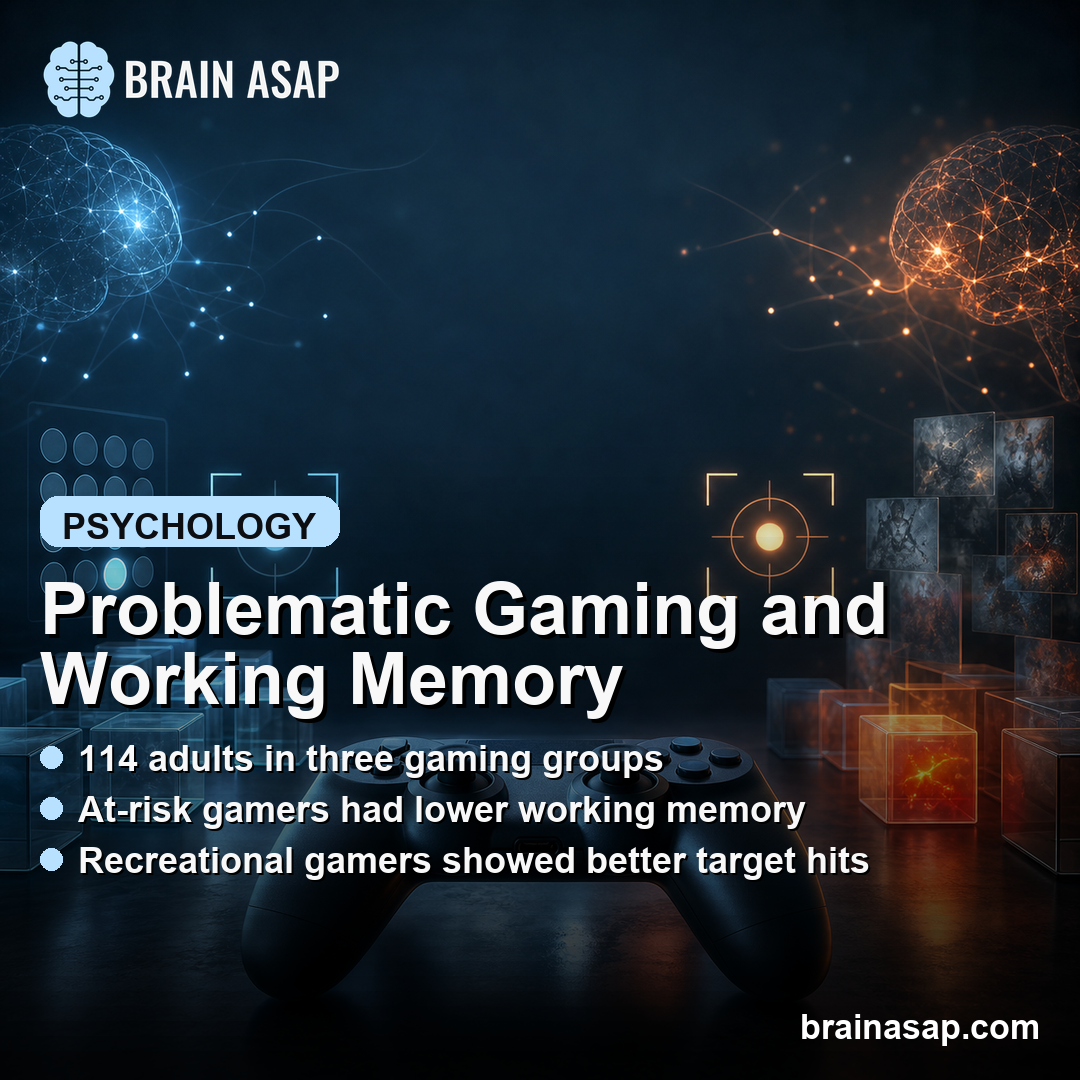
TL;DR: A 2025 study in Computers in Human Behavior linked at-risk problematic gaming to weaker basic working memory, while recreational gaming was linked to better target detection on an attention-control task.
Key Findings
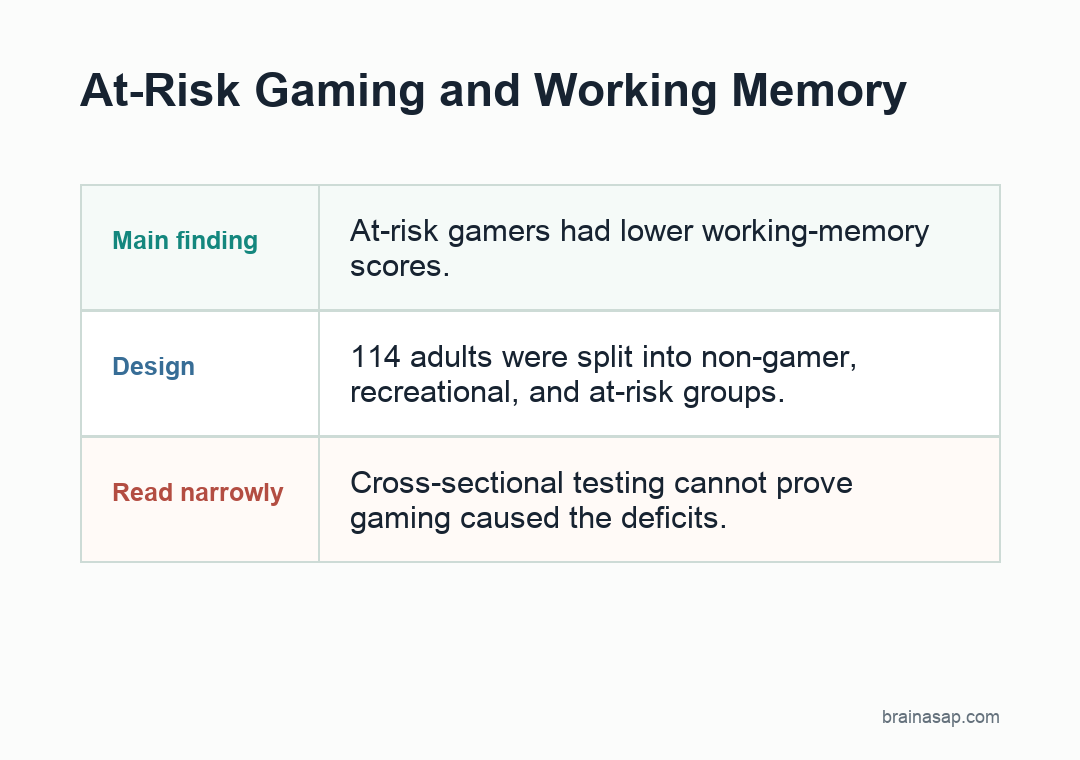
- Three gaming groups: Researchers compared 114 adults who were non-gamers, recreational gamers, or gamers at risk for gaming disorder.
- Working memory was lower in the at-risk group: Gamers at risk for gaming disorder performed worse on basic number and shape memory tasks than non-gamers and recreational gamers.
- Recreational gamers showed better target detection: On an inhibitory-control task, recreational gamers responded correctly to target letters more often than non-gamers.
- Habit learning did not separate the groups: Non-gamers, recreational gamers, and at-risk gamers learned a hidden sequence at similar rates.
- The study was cross-sectional: The results cannot show whether problematic gaming caused the working-memory differences or whether preexisting cognitive differences increased risk.
Source: Computers in Human Behavior (2025) | Berta et al.
Gaming disorder describes persistent loss of control over gaming, with gaming taking priority over daily activities despite harmful consequences. The study did not treat all video game play as the same behavior.
Researchers separated heavy but recreational play from at-risk problematic gaming, then tested whether the two profiles showed different patterns of executive function, the mental control system used for working memory, attention, inhibition, and flexible rule use.
Researchers Compared Non-Gamers, Recreational Gamers, and At-Risk Gamers
The study included 114 participants divided into three groups. One group did not play video games, one played recreationally for at least 14 hours per week without high addiction symptoms, and one scored high enough on a gaming-addiction questionnaire to be considered at risk.
The group split addressed a common weakness in gaming research. Many studies compare gamers with non-gamers and leave out the difference between controlled play and uncontrolled play.
Researchers also adjusted analyses for weekly gaming time. The finding was not simply “more hours equals worse cognition.”
The testing battery covered two broad systems:
- Goal-directed control: Working memory and memory updating measured how well participants could hold and revise information.
- Inhibition and flexibility: Other tasks measured whether participants could stop a response or shift rules.
- Automatic learning: An implicit sequence-learning task measured whether participants picked up hidden response patterns.
- Gaming-risk status: The at-risk group was identified by problematic-gaming symptoms, not only by play volume.
This design fits a common addiction model. Addictive behavior is often described as an imbalance between controlled, goal-directed decisions and more automatic habits.
The question was whether problematic gaming would show the same kind of imbalance.
At-Risk Gaming Was Linked to Weaker Basic Working Memory
The clearest difference appeared in basic working memory. Participants at risk for gaming disorder performed worse than both comparison groups on tasks that required them to store and recall number sequences or shape counts.
Working memory is not the same as intelligence, and it is not a direct diagnosis. In this study, it was a specific cognitive function: keeping information active long enough to use it.
The at-risk group also made more false-alarm errors on a memory-updating task. They were more likely to respond when the current letter did not actually match the required earlier letter, which points toward weaker response monitoring or more impulsive responding.
The main at-risk pattern can be summarized in three pieces:
- Lower storage capacity: Number-span and shape-count memory were weaker in the at-risk gaming group.
- More false alarms: The at-risk group showed a specific error pattern on memory updating rather than a uniform collapse across every task.
- Hours did not explain it away: The analysis adjusted for weekly gaming time, so addiction-risk status added information beyond simple play volume.
That is the clinically relevant part of the study. The result points to cognitive-control differences around problematic gaming, not to a blanket claim that gaming damages memory.
Recreational Gaming Was Linked to Better Target Detection
Recreational gamers did not show the working-memory weakness seen in the at-risk group. On one inhibitory-control task, they showed better target detection than non-gamers, meaning they correctly responded to target letters more often.
The task required participants to press a key when a blue star was replaced by the letter P, but withhold the response when a different letter appeared. That test mixes sustained attention with the ability to act quickly and avoid incorrect responses.
The recreational-gaming result does not prove video games improve attention for everyone. It does show that the cognitive profile of controlled gaming was not the same as the profile seen in at-risk problematic gaming.
Practical interpretation: gaming amount and gaming control should be separated. A person can play often without showing the same risk profile as someone whose gaming is difficult to control and causes life problems.
Habit Learning Did Not Explain Problematic Gaming Risk
The study also tested implicit sequence learning, an automatic process in which the brain picks up a hidden pattern without explicit instruction. Participants watched dog-head images appear in four positions and pressed matching keys while the sequence quietly followed a repeating structure.
If problematic gaming were mainly driven by unusually strong automatic habit learning, the at-risk group might have learned the hidden sequence faster than the other groups. That did not happen.
Across the three groups, sequence-learning performance was broadly similar. The result challenges a simple version of the addiction model in which at-risk behavior always comes from an overactive habit system.
Instead, the study points more strongly toward differences in controlled cognition:
- Working-memory weakness: The at-risk group had difficulty storing and recalling basic task information.
- Response-monitoring errors: False alarms suggested weaker control over when to act.
- No habit-learning advantage: Hidden sequence learning did not clearly distinguish at-risk gamers from recreational gamers or non-gamers.
The Study Cannot Show Cause and Effect
The main limitation is the cross-sectional design. Researchers measured gaming status and cognition at one point in time, so the study cannot determine which came first.
Problematic gaming might contribute to working-memory strain over time. It is also possible that people with preexisting working-memory or impulse-control difficulties are more likely to develop problematic gaming habits.
The study also relied on self-report questionnaires to classify gaming risk. Clinical interviews, longer follow-up, and tests using game-like cues would help show whether the same cognitive profile appears in formally diagnosed gaming disorder.
For now, the result supports a specific distinction. Recreational gaming and at-risk problematic gaming did not look cognitively identical in this sample.
The strongest warning sign was not gaming itself. It was the combination of gaming-risk symptoms with weaker basic working memory and more control errors.
Citation: DOI: 10.1016/j.chb.2025.108878. Berta et al. Game on or gone too far? Executive functioning and implicit sequence learning in problematic vs. recreational gamers. Computers in Human Behavior. 2025.
Study Design: Cross-sectional cognitive-testing study comparing non-gamers, recreational gamers, and gamers at risk for gaming disorder.
Sample Size: 114 adult participants divided into three gaming-status groups.
Key Statistic: At-risk gamers showed lower basic working-memory performance than both non-gamers and recreational gamers, while recreational gamers showed higher target-hit performance than non-gamers on an inhibitory-control task.
Caveat: The study cannot determine whether problematic gaming caused the cognitive differences or whether preexisting cognitive differences increased problematic-gaming risk.