TL;DR: A 2026 study in Neuron from Weill Cornell used mouse melanoma models to find that sympathetic nerves growing into tumors release norepinephrine, which activates alpha adrenergic receptors on tumor-associated macrophages and reduces their pro-tumor numbers — flipping the conventional view of the nervous system as a cancer accelerator into evidence that one branch of it can act as a brake.
Key Findings
- Sympathetic nerves slowed melanoma growth in mice: Sympathetic nerves growing into mouse melanomas exerted an anti-tumor effect, opposing the better-known pro-tumor role assigned to peripheral nerves in earlier cancer-neuroscience research.
- Pain-sensitive nerves did the opposite: The same tumors contained pain-sensitive sensory nerves that promoted tumor growth — depleting them slowed the tumor. The two nerve types had opposing effects in the same tissue.
- Norepinephrine and alpha adrenergic receptors carried the brake pathway: The sympathetic anti-tumor effect ran through norepinephrine release acting on alpha adrenergic receptors — not the more commonly studied beta adrenergic receptors.
- Macrophages were the cellular target: Alpha adrenergic pathway activity reduced the numbers of pro-tumor macrophages, the immune cells that tumors typically co-opt as allies. With fewer pro-tumor macrophages, the tumor lost an immunosuppressive support system.
- Existing alpha-adrenergic drugs are already in human use: Drugs targeting alpha adrenergic receptors are common blood-pressure medications, opening a near-term repurposing path if the mouse mechanism replicates in human cancer biology.
Source: Neuron (2026) | Liu, Simon et al.
Cancer neuroscience has built up a default story in which peripheral nerves growing into tumors accelerate tumor growth — for example by suppressing antitumor immunity or by releasing growth-promoting molecules.
That default story has been challenged in the past few years by hints that some peripheral nerves may slow tumor growth instead of speeding it up.
This Weill Cornell study takes the alternative reading seriously and tests it directly in mouse melanoma, finding a specific brake mechanism running through one branch of the peripheral nervous system.
Mouse Melanoma Models With Whole-Mount Nerve Imaging
The Weill Cornell team used mouse melanoma models to test whether different peripheral nerve types have opposite effects on tumor growth.
The experimental design:
- Models: Mouse melanoma tumors used as the primary experimental system.
- Imaging: Whole-mount immuno-labeling, in which the entire tissue sample is rendered optically transparent so nerves can be counted, identified, and traced in three dimensions.
- Two nerve populations measured: Pain-sensitive sensory nerves (release growth-promoting molecules per prior work) and sympathetic nerves (release norepinephrine).
- Functional manipulation: Each nerve population could be selectively depleted to test causal contribution to tumor growth.
The key framing is that the nervous system is not always a tumor-growth accelerator. In this mouse melanoma context, sympathetic nerves acted more like a brake, which leaves a concrete test: whether the same brake exists in human cancers and can be strengthened safely.
Sympathetic and Pain-Sensitive Nerves Had Opposite Effects
The whole-mount imaging showed that both nerve types were prevalent in the tumors, with the abundance increasing as tumors grew — especially in slower-growing tumors.
The functional manipulations split the two populations cleanly:
- Pain-sensitive (sensory) nerves: Depleting them slowed tumor growth, consistent with the prior pro-tumor reading of sensory innervation.
- Sympathetic nerves: Depleting them accelerated tumor growth — meaning their presence acted as a brake.
Two nerve types in the same tumor tissue with opposite effects on growth is the structural finding that anchors the rest of the work. It also explains why earlier studies that lumped peripheral nerves together produced inconsistent results — the net effect depends on which nerve population dominates.
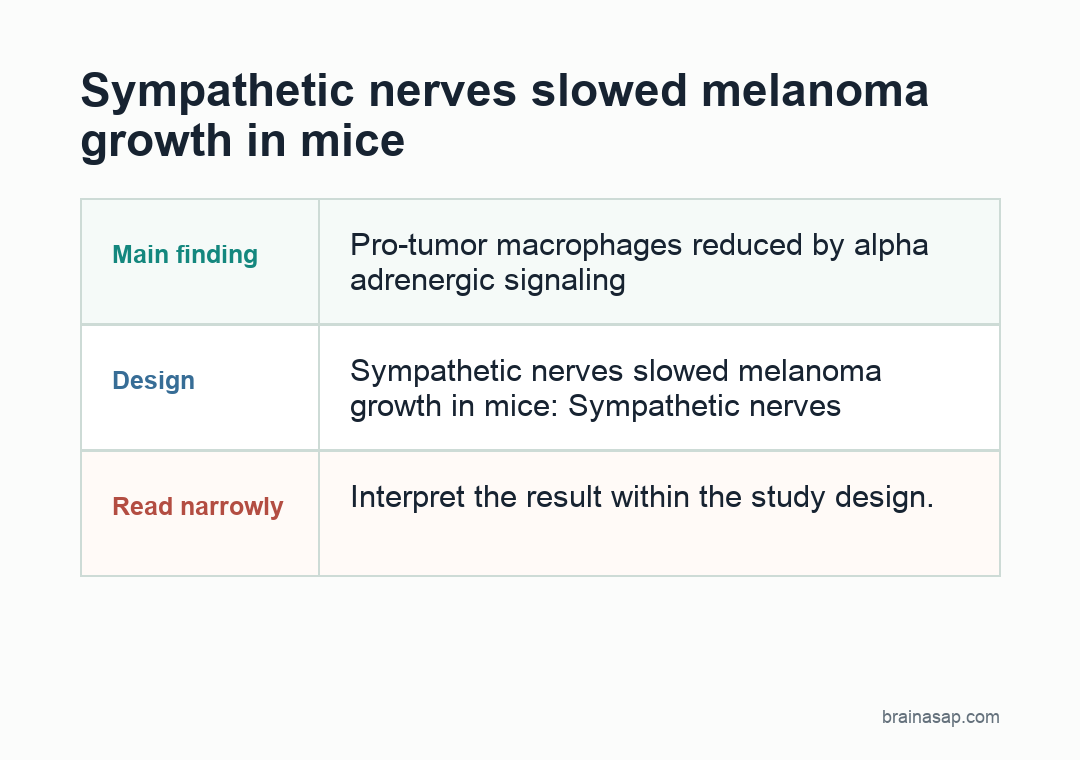
The Brake Pathway: Norepinephrine to Alpha Adrenergic Receptors on Macrophages
The sympathetic nerves the team identified release norepinephrine, the same neurotransmitter active in the body’s fight-or-flight response.
The team traced the anti-tumor effect through the receptor cascade:
- Norepinephrine release: Sympathetic nerve fibers within the tumor release norepinephrine locally.
- Receptor target: Alpha adrenergic receptors — not beta — on nearby cells.
- Cellular target: Tumor-associated macrophages, which the tumor normally tries to recruit as allies.
- Functional effect: Alpha adrenergic pathway activity reduced the numbers of pro-tumor macrophages, removing one of the immune supports the tumor depends on.
The receptor specificity is clinically important. Most prior cancer-and-stress research has focused on beta adrenergic receptors and their generally tumor-supportive role under chronic systemic stress.
The alpha-receptor finding here is biochemically distinct and pharmacologically separate from beta-receptor blocker drugs.
Local Nerve Norepinephrine Is Not the Same as Systemic Stress
A natural interpretation hazard with this finding is to read it as “stress slows cancer.”
That reading is wrong. The Liu and Simon team focused on local norepinephrine release by nerve fibers directly inside the tumor, not on systemic stress hormones circulating in the bloodstream.
Chronic systemic stress activates a different biology — cortisol release, sustained blood-pressure elevation, immune suppression — that has been associated with worse cancer outcomes in earlier work.
Local sympathetic-nerve norepinephrine acting on alpha adrenergic receptors on macrophages is a separate and more targeted pathway.
The clinical translation hinges on engaging the local pathway without recreating systemic stress effects.
Mouse-Only Evidence, Single Cancer Type, and Mechanism Still Open
- Mouse melanoma only: The findings come from a specific mouse model of one cancer type. Whether the same nerve-immune axis operates in human melanoma, and whether it generalizes to other cancers, is the largest unresolved test.
- Local vs systemic distinction underdeveloped: The study identifies a local nerve-released norepinephrine pathway. How that local pathway interacts with systemic stress hormones in living patients is not addressed here.
- Receptor mechanism partial: The alpha adrenergic receptor target is identified, but the downstream macrophage pathway that produces the population reduction needs more detail.
- Time course of nerve-tumor interaction: Nerves entered tumors and increased in number as tumors grew. Whether early-versus-late nerve presence changes the brake effect is not separated in the published findings.
- Drug-targeting feasibility uncertain: Existing alpha adrenergic agents work systemically and were developed for blood-pressure indications. Locally activating the right receptor subset in human tumors without producing cardiovascular side effects is a separate engineering problem.
Existing Blood-Pressure Drugs Become a Repurposing Direction Worth Testing
Practical implications follow from the receptor identity:
- Alpha adrenergic agents are already approved: Several alpha adrenergic drugs are in routine human use as blood-pressure medications, which compresses the regulatory and safety hurdle for cancer-context repurposing trials.
- The right subtype is the next test: Alpha adrenergic receptors come in subtypes; which subtype on which macrophage population produces the brake effect determines which existing drugs are worth testing.
- Cancer neuroscience needs nerve-type-specific framing: Aggregating sympathetic and sensory nerves into “peripheral nerves” obscures the opposite effects shown here. Future cancer-nerve studies should separate the populations from the design stage.
- Combination with checkpoint inhibitors is the natural next test: If the alpha-adrenergic pathway reduces pro-tumor macrophages, combining it with antibody therapies that re-engage T cells could compound the antitumor immune response in melanoma and other immunogenic cancers.
Citation: DOI: 10.1016/j.neuron.2026.04.016; Liu T, Simon DJ et al.; A local sympathetic-immune axis inhibits melanoma growth in mice by dictating adrenergic control; Neuron; 2026.
Study Design: Mouse melanoma model with whole-mount immuno-labeling for nerve fiber identification; selective depletion of nerve populations; receptor pharmacology and macrophage immunology to trace the mechanism.
Sample/Model: Mouse models of melanoma with peripheral nerve fiber growth into tumor tissue.
Key Statistic: Sympathetic nerves slowed tumor growth via norepinephrine release acting on alpha adrenergic receptors on tumor-associated macrophages, reducing pro-tumor macrophage numbers. Pain-sensitive sensory nerves had the opposite effect — depletion slowed tumor growth.
Caveat: Mouse melanoma model only; human cancer translation untested; local-vs-systemic norepinephrine distinction not fully separated in clinical context; receptor subtype specificity needs refinement before alpha adrenergic agent repurposing trials are designed.