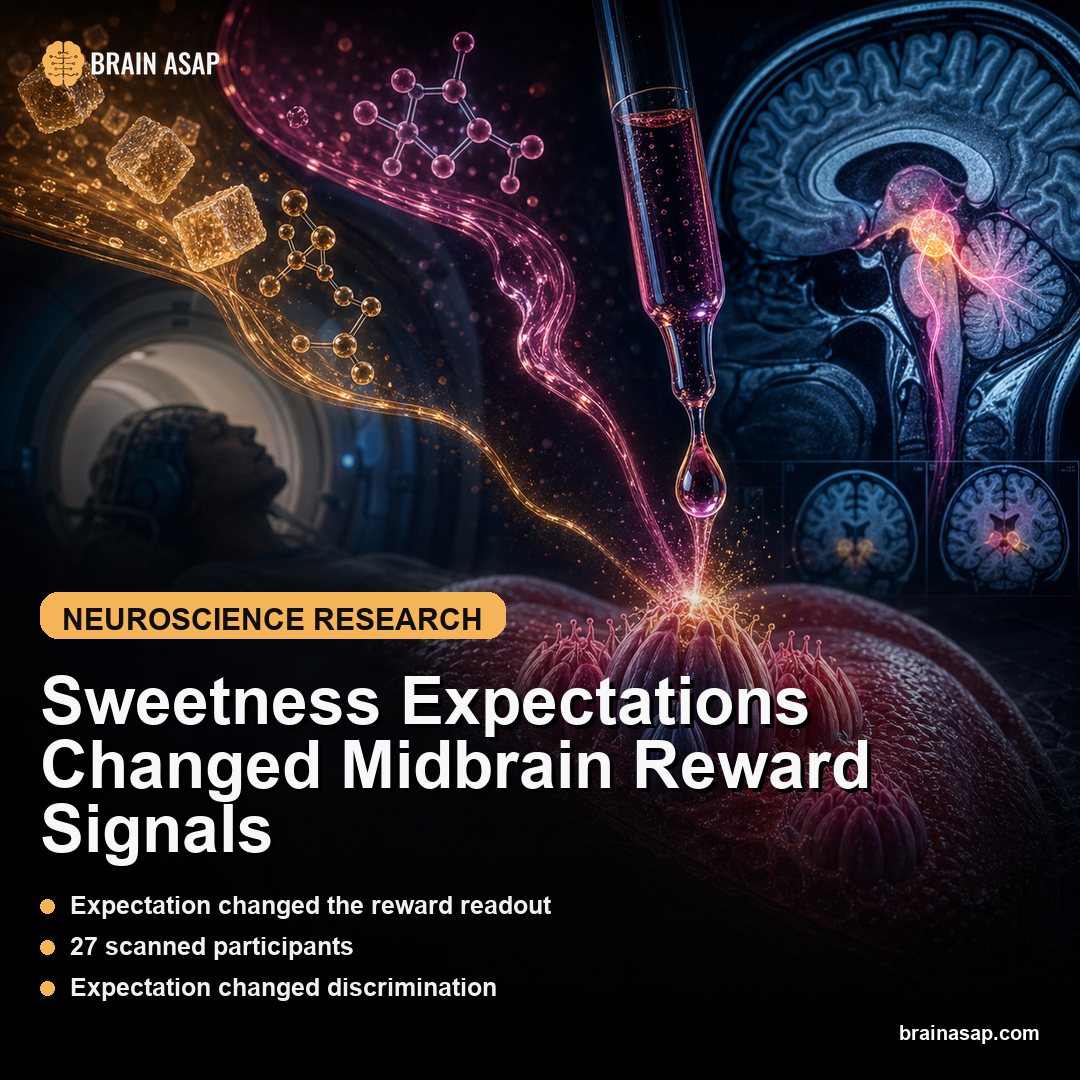
TL;DR: A 2026 study in Journal of Neuroscience found that when people expected sugar, an artificially sweetened drink became more pleasant and produced a stronger midbrain response, even though perceived sweetness was similar.
Key Findings
- Expectation changed the reward readout: The researchers selected participants who reported similar perceptual experiences of sugar and non-nutritive sweetener.
- 27 scanned participants: The functional MRI (fMRI), a scan that tracks blood-flow changes as a proxy for brain activity sample received sugar- and artificially sweetened beverages during conditioning tasks.
- Expectation changed discrimination: Participants’ ability to distinguish sugar from sweetener depended strongly on what they expected to receive.
- Pleasantness followed prediction: Expectations significantly affected how pleasant each flavor seemed.
- Midbrain response rose with expected sugar: During the deterministic task, expecting sugar increased midbrain responses to sweetener compared with expecting sweetener.
Functional MRI, or fMRI, tracks blood-flow changes as a proxy for brain activity. Here it was used to read out reward-region responses while participants tasted expected and unexpected sweet drinks.
Source: Journal of Neuroscience (2026) | Mainetto et al.
Sweet flavor is not just chemistry on the tongue.
It is chemistry filtered through prediction.
The study shows that when sensory evidence is ambiguous, the brain’s expectation of sugar can change both the subjective reward of a drink and the midbrain response to it.
The Study Removed the Easy Taste Confound
The design hinged on the screening step.
Study details:
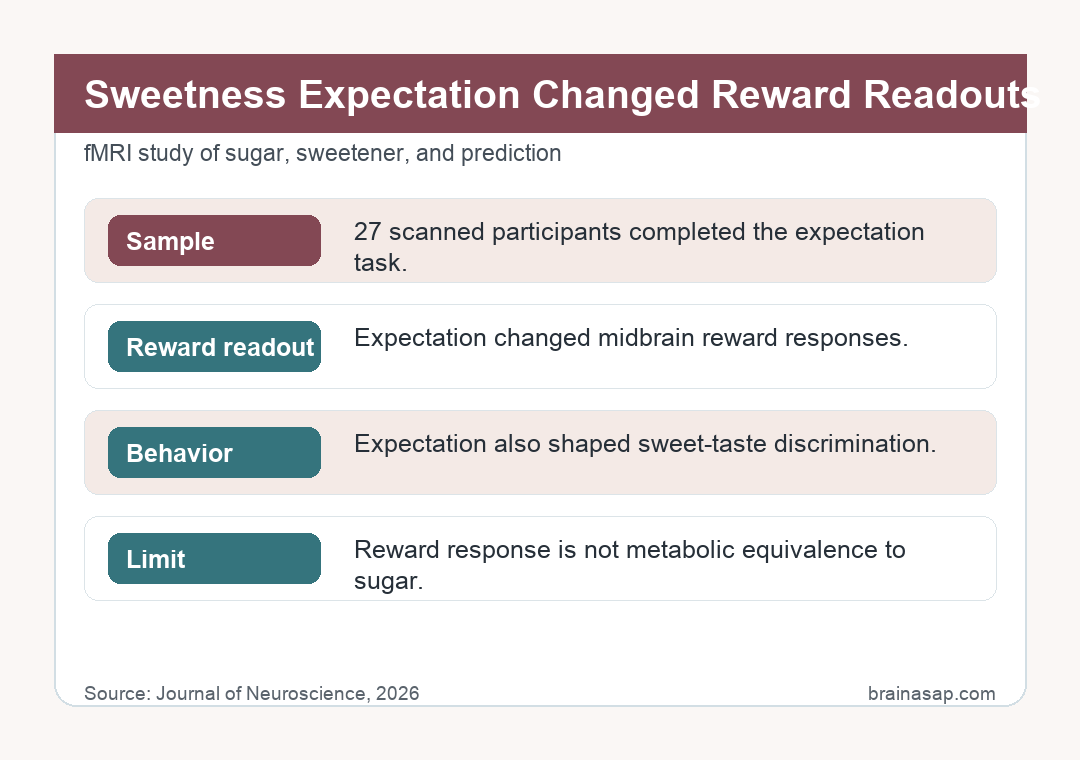
- Expectation changed the reward readout: The researchers selected participants who reported similar perceptual experiences of sugar and non-nutritive sweetener
- 27 scanned participants: The functional MRI (fMRI), a scan that tracks blood-flow changes as a proxy for brain activity sample received sugar- and artificially sweetened beverages during conditioning tasks
- Expectation changed discrimination: Participants’ ability to distinguish sugar from sweetener depended strongly on what they expected to receive
- Pleasantness followed prediction: Expectations significantly affected how pleasant each flavor seemed
Researchers first screened 99 healthy adults and selected a smaller group whose sensory experience of sugar and artificial sweetener was similar enough to make the expectation test meaningful.
The choice is important because if people can easily taste the difference, expectation has less room to do work.
The test here was sharper: when the mouth is not giving a decisive answer, does the brain’s prediction reshape reward?
The fMRI sample included 27 participants with a mean age of about 24. After quality-control exclusions, usable imaging data came from 21 participants for one task and 23 for the other.
This is not a population-scale nutrition study. It is a controlled human neuroscience experiment about expectation and reward encoding.
Sugar and Artificial Sweetener Were Tested Under Prediction
Participants received sugar-sweetened and artificially sweetened drinks under two expectation setups:
- Probabilistic cues: the cue shifted how likely sugar or artificial sweetener was to arrive.
- Deterministic cues: the cue more directly set up an expected-sugar or expected-sweetener trial before the drink arrived.
- Ambiguous perception: participants had been selected because sugar and sweetener tasted similar enough for expectation to matter.
The behavioral result was straightforward: expectation influenced both discrimination and pleasantness. People were not simply reading out the physical taste.
They were interpreting the drink through what the cue led them to expect.
That is why non-nutritive sweeteners are scientifically tricky: their role is not only about calories avoided, but about how the brain learns and values sweet flavor when sweetness is uncoupled from sugar’s usual nutrient payload.
Expected Sugar Boosted Midbrain Response to Sweetener
The midbrain is central to reward learning and dopamine-related signaling.
In this study, expectation altered brain responses during the deterministic task.
The key result was that mistakenly expecting sugar increased midbrain responses to sweetener compared with expecting sweetener.
That finding does not show artificial sweeteners become sugar in the brain.
It means that the reward system is sensitive to prediction when sensory evidence is unreliable.
A sweetener can be experienced as more rewarding when the brain is primed for sugar.
The same study found that trial-wise confidence and pleasantness ratings scaled differently with brain responses to sugar and sweetener delivery.
The detail is important because it suggests the brain was not treating the two liquids as identical, even when participants struggled to distinguish them.
Learned Sugar Expectations Shifted Midbrain Reward Signals
One interpretation is flavor-nutrient conditioning. Over a lifetime, sweet taste often predicts calories. Sugar therefore carries a learned value that a noncaloric sweetener may imitate imperfectly.
Researchers argue that the rewarding effects of sugar appeared to exceed those of sweetener, and that expectation can partly pull sweetener toward sugar’s reward profile.
For obesity and diet research, the specific point is that expectation changed reward processing without changing perceived sweetness.
The brain may care about sweetness, expected nutrient value, and past learning all at once.
For people choosing diet drinks, the study does not issue a simple verdict.
It does not show that sweeteners are harmful, and it does not show that they are equivalent to sugar.
It shows that expectation is part of the taste system.
A Small fMRI Study, Not a Dietary Commandment
The sample was small, young, healthy, and selected for similar perception of sugar and sweetener, which makes the experiment clean but limits generalization to children, older adults, people with obesity, diabetes, eating disorders, or different sweetener histories.
Still, the study gives a helpful mechanism.
If sweet flavor reward depends partly on what the brain expects, then nutrition science cannot treat taste as a simple input.
The same chemical stimulus may land differently depending on cue, context, learning history, and confidence.
The next time a “diet” version tastes better or worse than expected, that judgment may not come from the tongue alone.
It is the midbrain weighing what the drink is against what the brain thought it was about to get.
A Reward readout Is Not the Same as Sugar
The tempting misread is that artificial sweeteners trick the brain into treating them exactly like sugar. The evidence is more limited than that.
Expectation changed the midbrain response, but the broader behavioral and neural pattern still distinguished sugar from artificial sweetener. Reward response is not the same thing as metabolic equivalence.
The distinction is important for diet debates.
Labeling, brand familiarity, prior experience, and context may all shape how satisfying a low-calorie sweet drink feels, even when the drink does not carry sugar’s usual nutrient payload.
A Selected Young Sample Keeps the Mechanism Clean
The participants were healthy adults with normal-range BMI who were selected because they could not reliably discriminate the sugar and sweetener drinks, which makes the expectation manipulation stronger.
It also means the result may not generalize to people with very different sweetener histories or metabolic states.
Someone who drinks diet soda daily, someone who avoids sweeteners, and someone with impaired glucose regulation may bring different learning histories into the scanner.
Future studies could test whether expectation effects are larger, smaller, or qualitatively different in those groups.
The clean sample is a strength for mechanism, but a weakness for public-health translation.
A real food environment adds branding, texture, carbonation, habit, metabolic state, and repeated learning, any of which could change how expectation shapes reward.
Confidence Ratings Added Another Layer
The study also used confidence ratings, which are helpful because a person can make a taste judgment while still feeling uncertain.
That uncertainty is part of the mechanism.
When confidence is low, expectation has more room to steer interpretation.
In reward terms, the brain is not only asking what arrived.
It is estimating how sure it is about what arrived, which makes confidence a helpful bridge between sensory ambiguity, subjective pleasantness, and midbrain response.
The finding concerns prediction under ambiguity more than sweetener verdicts.
For neuroscience, that is the sturdier takeaway: expectation can change reward processing even when the stimulus itself barely changes.
Prediction becomes part of taste, not an afterthought added later.
Citation: DOI: 10.1523/JNEUROSCI.1121-25.2026. Mainetto et al. Expectation Modulates Hedonic Experiences and Midbrain Responses to Sweet Flavor. Journal of Neuroscience. 2026;46(12):e1121252026
Study Design: Human fMRI experiment using sugar and non-nutritive sweetener delivery under manipulated expectation.
Sample/Model: 99 adults screened; 27 selected for scanning; final usable fMRI data from 21 to 23 participants depending on task.
Key Statistic: Expecting sugar significantly increased midbrain response to sweetener compared with expecting sweetener in the deterministic task.
Caveat: Single-study evidence; interpret with the source design and sample.