TL;DR: A 2026 study in Journal of Korean Medical Science found that resistance exercise was more consistently associated with lower depression and anxiety scores than aerobic exercise in Korean adults, but the cross-sectional design means the study cannot prove exercise caused the mental-health difference.
Key Findings
- Resistance exercise had the strongest association with lower Patient Health Questionnaire-9 (PHQ-9) depression scores after matching.
- PHQ-9 scores were 0.534 points lower in the resistance-exercise group than in adults reporting neither aerobic nor resistance exercise.
- Moderate-to-severe depression odds were lower in the resistance-exercise group than in the no-aerobic/no-resistance group (OR 0.46).
- Aerobic exercise alone was not significantly associated with lower PHQ-9 or Generalized Anxiety Disorder-7 (GAD-7) scores in this analysis.
- Causality remains uncertain because exercise habits and symptoms were measured in survey data rather than assigned in a trial.
Source: Yun et al. analyzed Korea National Health and Nutrition Examination Survey data to compare aerobic exercise, resistance exercise, both exercise types, and neither exercise type.
Resistance Exercise Had the Clearest Depression Association
The study asked a practical question: when adults report different kinds of exercise, do depression and anxiety scores differ after matching people on major background factors? Researchers used the Korea National Health and Nutrition Examination Survey (KNHANES), a large national survey of noninstitutionalized Korean residents.
The depression analysis included 21,298 adults before matching. After 1:1:1:1 propensity score matching, each exercise group contained 1,509 people. The anxiety analysis started with 8,707 adults and matched each group down to 622 people.
The four exercise groups were deliberately separated:
- Total exercise: Adults who met both aerobic and resistance-exercise criteria.
- Aerobic exercise only: Adults who met the aerobic threshold but not the resistance-exercise threshold.
- Resistance exercise only: Adults who reported muscle-strengthening activity at least 2 days per week but did not meet the aerobic threshold.
- Neither exercise type: Adults who met neither the aerobic nor resistance-exercise criteria.
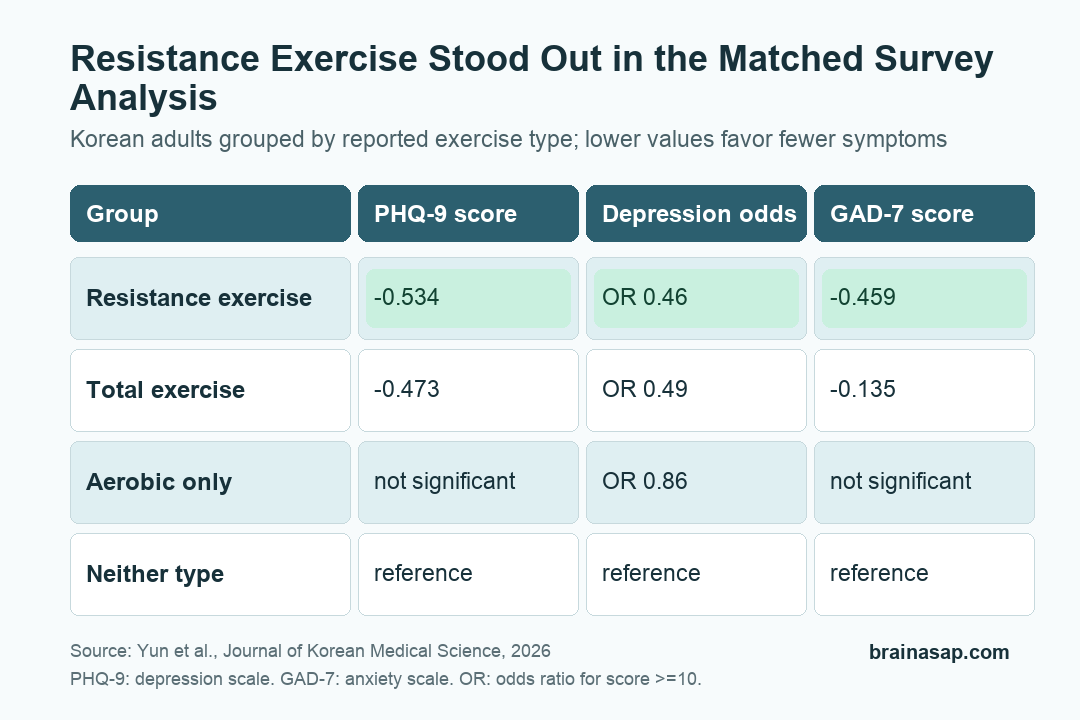
After matching, the resistance-exercise group had the strongest association with lower depression scores.
Compared with the neither-exercise group, resistance exercise was linked to a 0.534-point lower PHQ-9 score. Total exercise was also linked to lower PHQ-9 scores, with a 0.473-point lower score.
Aerobic exercise alone was not statistically different from the neither-exercise group.
Moderate-to-Severe Depression Odds Were Lower
The researchers also looked at the threshold used to flag more clinically relevant symptoms: PHQ-9 score of 10 or higher.
Compared with adults reporting neither aerobic nor resistance exercise, the resistance-exercise group had lower odds of moderate-to-severe depression, with an odds ratio of 0.46. Total exercise was similar, with an odds ratio of 0.49.
The comparison between aerobic and resistance exercise was also notable.
Adults in the resistance-exercise group had lower odds of moderate-to-severe depression than adults in the aerobic-only group, with an odds ratio of 0.55. That result supports the central point: in this survey analysis, muscle-strengthening activity carried a distinct association.
The anxiety findings pointed in the same direction but were weaker.
Resistance exercise was associated with a 0.459-point lower GAD-7 anxiety score compared with neither exercise type. For the binary anxiety threshold of GAD-7 score of 10 or higher, resistance exercise showed a lower-odds trend, but the result did not meet conventional statistical significance.
Aerobic Exercise Alone Did Not Stand Out
Aerobic activity is often treated as the default exercise advice for mood symptoms. The finding does not argue against aerobic exercise, but it did show that aerobic exercise alone was not significantly associated with lower depression or anxiety scores after matching.
Several details make that finding less surprising. The aerobic category came from self-reported survey activity, not a supervised exercise program.
Many population-level aerobic activities are likely to be light or moderate activities such as walking. The study also used a conservative aerobic threshold, which may not capture intensity, consistency, or the social context of the activity.
The analysis gives several possible reasons resistance exercise may have looked stronger in this Korean sample:
- Muscle-strengthening participation is less common: The authors note that Korean adults more often prefer aerobic activity than anaerobic or strength-focused activity.
- Older adults and women had stronger subgroup patterns: The subgroup results showed stronger resistance-exercise associations in these groups.
- Muscle-brain pathways are plausible: The discussion points to myokines, muscle strength, self-efficacy, physical function, and stress-system regulation as possible links.
- Survey activity differs from trials: Real-world exercise habits include adherence, access, and cultural barriers that controlled trials can miss.
The Matched Design Reduced Some Confounding
The study used propensity score matching to make the four exercise groups more comparable.
Matching is useful because exercise habits are tied to age, sex, income, smoking, alcohol use, metabolic health, and other factors that also relate to depression or anxiety.
Even after matching, this remains observational evidence.
People who do resistance exercise may differ from people who do not in ways the survey did not fully measure. Better mental health may also make it easier to exercise, rather than exercise being the sole cause of better mental health.
The authors explicitly list several limits:
- Cross-sectional data: Exercise and symptoms were measured at the same time, so direction of effect cannot be proven.
- Self-reported exercise: Participants can misremember activity type, duration, or intensity.
- Treatment data were missing: The analysis could not fully control for current or past depression or anxiety treatment.
- Population specificity: The findings come from Korean adults and do not automatically generalize to other settings.
Exercise Advice Should Include Strength Training
The most useful takeaway is not that resistance exercise replaces other mental-health care.
The narrower practical point is clear: strength training belongs in the conversation when clinicians, public-health programs, or adults themselves think about exercise and mood.
A simple recommendation to “exercise more” can sound like advice to walk, run, cycle, or do another aerobic activity.
This analysis suggests that, at least in this national Korean sample, resistance exercise at least 2 days per week carried a distinct association with lower depression scores and a smaller but significant association with lower anxiety scores.
The boundary is important. This cross-sectional analysis does not prove that starting resistance training will reduce depression or anxiety for every person.
It supports a more balanced exercise message: aerobic activity is valuable for health, but muscle-strengthening activity is relevant to mental-health outcomes and should not be left out of routine prevention or treatment-adjacent advice.
Citation: DOI: 10.3346/jkms.2026.41.e123. Yun et al. Comparative Associations of Aerobic Exercise and Resistance Exercise With Depression and Anxiety in Korean Adults: A Nationwide Propensity Score Matching Analysis. Journal of Korean Medical Science. 2026;41:e123.
Study Design: Cross-sectional national survey analysis using propensity score matching.
Sample Size: 21,298 adults in the depression analysis and 8,707 adults in the anxiety analysis before matching.
Key Statistic: Resistance exercise was associated with lower PHQ-9 depression score (coefficient -0.534) and lower odds of moderate-to-severe depression (OR 0.46) versus neither aerobic nor resistance exercise.
Caveat: The study cannot prove causality because exercise type and symptoms were measured from survey data rather than assigned experimentally.