TL;DR: A 2026 mouse study in Blood found that Thrombosomes, a freeze-dried platelet-derived blood product, reduced bleeding, vessel leak, inflammation, and blood-brain-barrier disruption after traumatic brain injury.
Key Findings
- Thrombosomes were tested after traumatic brain injury: the product is made from preserved platelet material and was originally designed for hemorrhage control.
- Treatment was given after injury: mice received Thrombosomes either 1 hour or 1 day after brain injury in the reported model.
- Brain bleeding and vessel leak were lower: treated mice had less hemorrhage and less leaky brain vasculature than the source described for untreated injury.
- Inflammation and swelling biology also shifted: Thrombosomes reduced brain inflammation, a process linked to delayed cerebral edema after TBI.
- The evidence is still preclinical: the product is already in Phase II trials for bleeding disorders, but this TBI finding still needs human injury studies.
Source context: The analysis below is based on the underlying Blood paper and DOI metadata, not the Neuroscience News discovery page.
Traumatic brain injury creates two linked problems. The first is immediate bleeding from damaged vessels.
The second can unfold later, when the injured blood-brain barrier becomes leaky and contributes to cerebral edema, or dangerous brain swelling inside the skull.
Researchers tested whether a shelf-stable platelet-derived product could affect both parts of that injury pattern. The product, called Thrombosomes, is made from platelets that have been freeze-dried with the sugar trehalose to preserve platelet contents.
Thrombosomes Targeted Bleeding and Blood-Brain-Barrier Leak
Platelets are usually discussed as clotting cells, but they also carry proteins and other factors that interact with blood-vessel walls. In this study, that broader vessel-stabilizing role was the main reason Thrombosomes were relevant to TBI.
Fresh platelets are hard to use outside hospitals because they need cold storage and have a short shelf life. The captured source described fresh platelets as lasting about 7 days, while Thrombosomes were described as potentially shelf-stable for up to 5 years.
Storage life changes the trauma-care use case. Ambulances, battlefield settings, and remote emergency departments need treatments that can be kept ready before a patient reaches a neurosurgical center.
- Immediate injury target: hemorrhage after traumatic brain injury.
- Delayed injury target: blood-brain-barrier leak that contributes to edema and inflammation.
- Operational target: a product that could be stored where fresh platelet transfusion is not practical.
Cell and Vessel Models Showed Barrier-Stabilizing Effects
Before the mouse injury work, researchers tested Thrombosomes on blood-vessel cells and in 3D vessel organoid models. The source described both systems as becoming more resilient to damage after exposure to the product.
Those tests are important because the paper is not only about stopping blood loss. A product that merely clots blood would not automatically explain reduced brain-vessel leak days after injury.
The reported mechanism centered on platelet-derived factors that may reinforce endothelial cells, the cells that line blood vessels. Researchers highlighted a protein that activates a receptor on vessel cells and may help make damaged vessels less permeable.
- Cell-layer test: researchers exposed blood-vessel cells to injury-relevant stress and assessed whether the barrier held together.
- 3D vessel model: organoid-like vessel structures provided a more tissue-like test of vascular resilience.
- Mechanistic clue: the product contained high levels of a vessel-stabilizing protein, though the source described it as one candidate in a broader mixture.
Mice Treated After TBI Had Less Hemorrhage and Inflammation
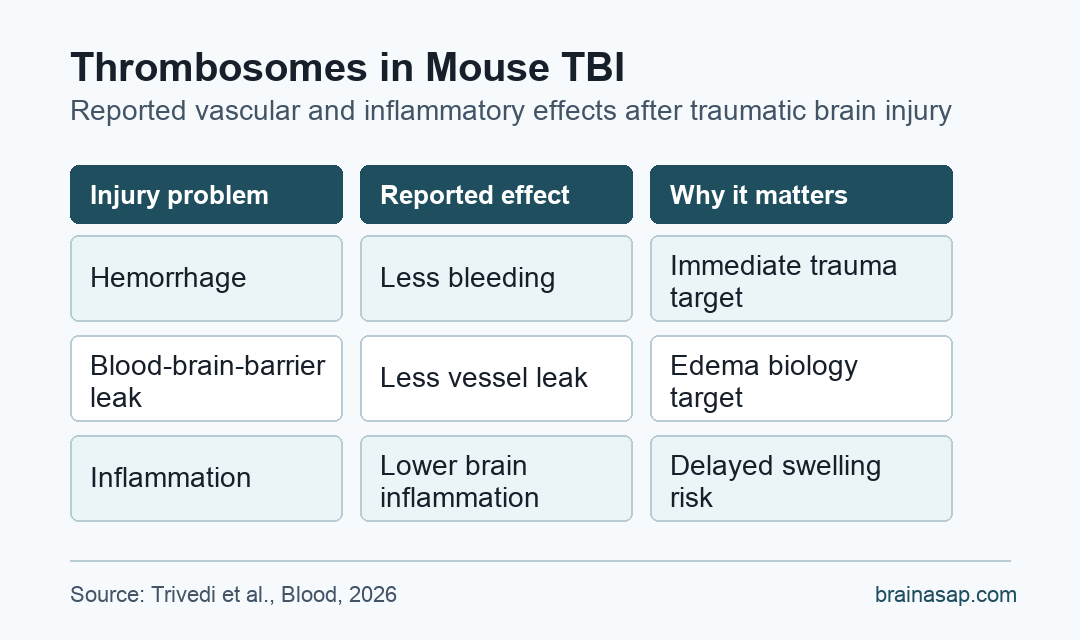
The central in vivo result came from mice treated after traumatic brain injury. According to the captured source, Thrombosomes were given either 1 hour or 1 day after injury, and treated animals had less hemorrhage.
The same source described reduced vessel leak and lower brain inflammation. This combined pattern is stronger than a bleeding result alone because cerebral edema often develops after the initial impact, when the barrier between blood and brain tissue remains disrupted.
Clinical context: severe brain swelling can raise pressure inside the skull. In current care, one last-resort option is decompressive surgery, where part of the skull is removed to relieve pressure.
A drug or biologic that directly limits edema biology would fill a different treatment role. It would not replace trauma stabilization or surgery, but it could give clinicians a vessel-focused tool earlier in the injury sequence.
- Hemorrhage result: treated mice had less bleeding after TBI.
- Barrier result: brain vessels were described as less leaky after treatment.
- Inflammation result: treated mice showed lower brain inflammation, a process tied to edema risk.
- Timing result: benefit was reported when treatment came after injury, not only as a pre-injury intervention.
Fresh Platelets Did Not Explain the Same TBI Effect
The source contrasted Thrombosomes with fresh platelets, which are already used for some bleeding contexts but have not been shown to work well for traumatic brain injury. The preserved product may concentrate or preserve a distinct mixture of platelet-derived factors.
Other platelet products should not be assumed to have the same effect. Freeze-drying, trehalose preservation, and the final biologic composition all matter because they shape which proteins remain available after storage.
The paper’s interpretation was therefore narrower than “platelets treat TBI.” The more specific claim is that a dried platelet-derived biologic reduced hemorrhage and blood-brain-barrier dysfunction in a mouse injury model.
Human TBI Testing Remains the Main Boundary
The strongest practical feature is that Thrombosomes are already in Phase II clinical trials for bleeding disorders. Existing human safety work in another indication could make future TBI trials easier to start than they would be for an entirely new biologic.
Still, TBI is a difficult translation problem. Mouse injury models can show barrier biology clearly, but human traumatic brain injury varies by impact type, age, co-injuries, time to care, medications, and the severity of bleeding or swelling.
Before this becomes a BrainASAP-relevant clinical treatment claim, researchers would need to show:
- Human safety in acute injury: the product must be safe in patients with recent trauma, possible surgery, and complex bleeding risk.
- Clinically meaningful endpoints: trials need more than biomarker or imaging changes; they need pressure, edema, survival, neurological, or recovery outcomes.
- Timing rules: researchers need to know whether treatment works minutes, hours, or a day after injury.
- Comparison to standard care: benefit has to be tested alongside existing trauma and neurosurgical management.
Practical takeaway: the study points to vascular stabilization as a plausible TBI treatment route. The combined mouse result joined bleeding control with blood-brain-barrier repair, but the evidence remains preclinical until acute human TBI trials are done.
Citation: DOI: 10.1182/blood.2025031826. Trivedi et al. A Dried Platelet-Derived Biologic for Blood-Brain Barrier Repair and Hemorrhage Control Following TBI in Mice. Blood. 2026.
Study Design: Preclinical traumatic brain injury study using blood-vessel cell models, 3D vessel organoids, and mice.
Sample/Model: Mouse TBI model plus vascular cell and organoid systems; the captured source did not provide animal counts.
Key Statistic: Thrombosomes were reported to reduce hemorrhage and vessel leak when given 1 hour or 1 day after mouse brain injury.
Caveat: The TBI evidence is preclinical, and human injury trials are still needed before the product can be treated as an emergency-care therapy for brain swelling.