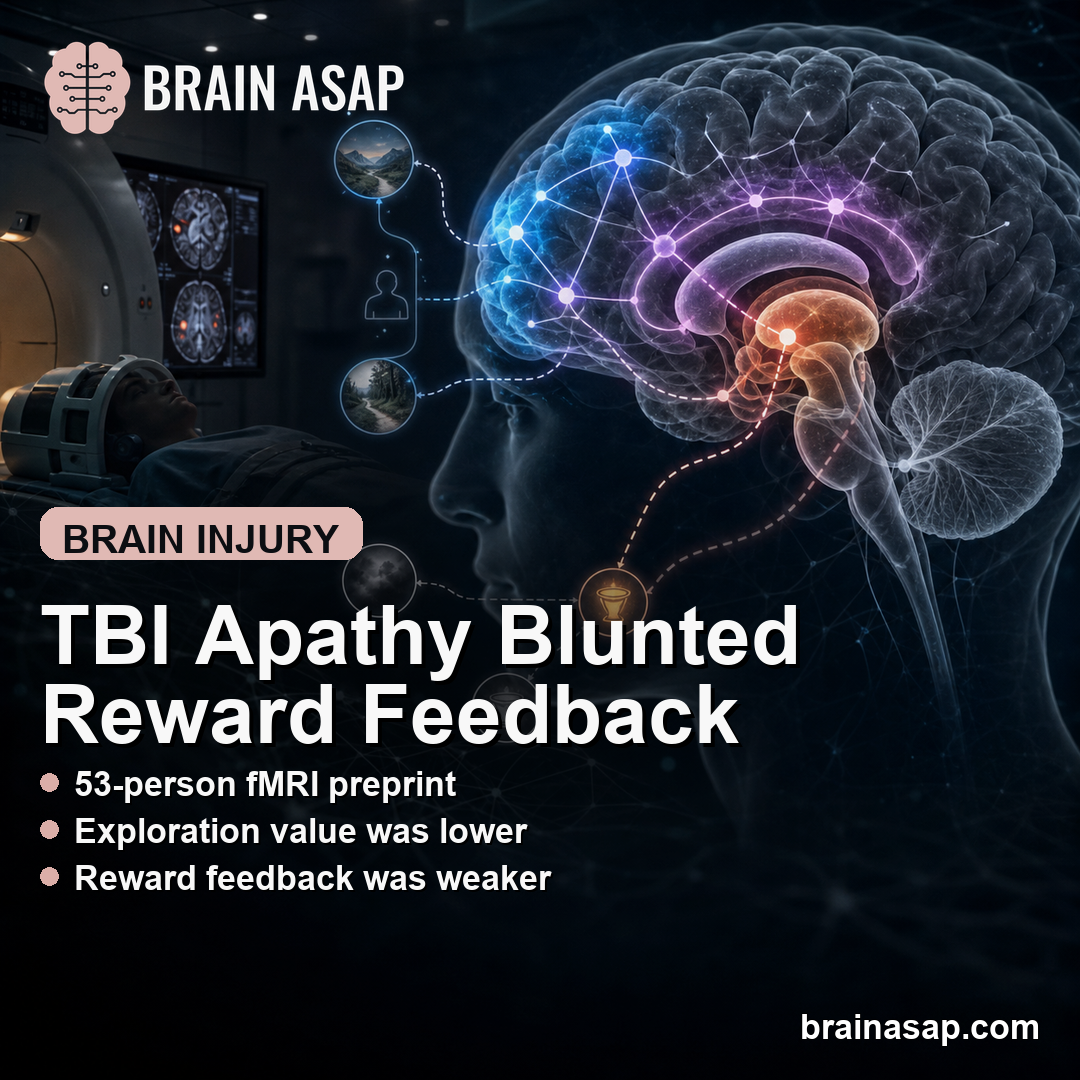
TL;DR: A 2025 medRxiv fMRI preprint linked higher apathy in both traumatic brain injury (TBI) and control groups to greater effort discounting, while TBI-related apathy was also associated with less exploratory decision-making and weaker neural encoding of differences between expected and received rewards.
Key Findings
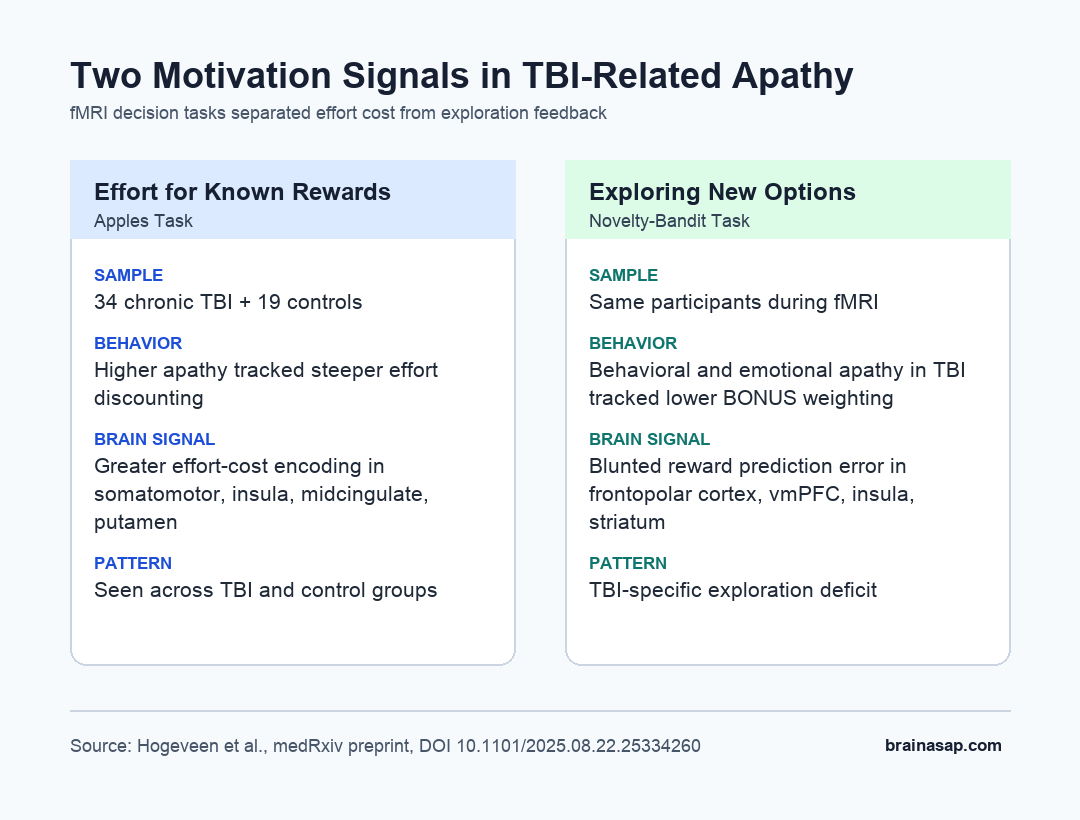
- 53-person fMRI sample: Researchers analyzed 34 people with chronic TBI and 19 non-brain-injured controls after excluding participants for missing data, task nonresponse, or excessive motion.
- Effort discounting tracked apathy: Higher apathy was associated with steeper effort-based reward discounting across both TBI and control participants (TBI r = -0.43; controls r = -0.35).
- TBI apathy reduced exploration value: Behavioral and emotional apathy in the TBI group tracked lower weighting of the Novelty-Bandit task’s exploration bonus, with behavioral apathy r = -0.36 and emotional apathy r = -0.46.
- Reward feedback was blunted: Higher emotional apathy in TBI was linked to weaker reward prediction error encoding in frontopolar cortex, ventromedial prefrontal cortex, insula, cingulate, nucleus accumbens, caudate, and related regions.
- Preprint status caveat: The source is a non-peer-reviewed medRxiv preprint, so the finding is best read as a mechanistic hypothesis for TBI apathy, not a clinical treatment rule.
Source: medRxiv (2025) | Hogeveen et al.
Traumatic brain injury apathy can mean less initiation, more task avoidance, and less interest in daily goals. The preprint separates that surface pattern into two computational problems that may not come from the same brain response.
One problem is reluctance to spend effort for a known reward. The other is reduced willingness to explore uncertain options that might teach the brain something valuable for the future.
Chronic TBI Participants Completed Two fMRI Motivation Tasks
The final sample included 34 chronic TBI participants and 19 controls. TBI participants were at least 6 months after injury, and the median time since injury was about 110 months, so the study focused on long-running symptoms rather than acute concussion recovery.
Researchers measured apathy with the Apathy Evaluation Scale and the Apathy Motivation Index (AMI), which separates behavioral, emotional, and social apathy domains. The TBI group also reported more post-concussive symptoms, depression, anxiety, and impulsivity than controls.
The two fMRI tasks were built to test different motivational calculations:
- Apples Task: Participants decided whether to accept different grip-effort demands for different reward values, letting researchers estimate how strongly effort reduced reward appeal.
- Novelty-Bandit Task: Participants chose between familiar options with known reward histories and new options with uncertain value, letting researchers model exploration versus exploitation.
- Brain readout: fMRI data were modeled around choice and feedback variables, including effort cost, expected value, exploration value, and reward prediction error.
That split is the main design feature. If apathy only reflected low effort tolerance, both tasks should point to the same broad motivational deficit.
Instead, the exploration task produced a more TBI-specific pattern.
Effort Costs Tracked Apathy Across Both Groups
In the Apples Task, participants behaved as expected: higher effort made offers less attractive, and higher reward value made offers more attractive. The model estimates showed three main choice patterns:
- Effort effect: Higher required effort reduced the probability of accepting an offer (b = -0.96, 95% CI -1.02 to -0.91).
- Reward effect: Higher reward value increased acceptance (b = 0.33, 95% CI 0.32 to 0.35).
- Effort-value interaction: Reward and effort interacted in the expected direction (b = 0.03, 95% CI 0.02 to 0.05).
Higher apathy tracked steeper effort discounting across both groups. In practical terms, more apathetic participants needed a more favorable reward-to-effort tradeoff before saying yes.
The fMRI pattern matched that behavior. Higher apathy was linked to stronger effort-related activity in somatomotor areas, midcingulate cortex, middle insula, and putamen.
The correlation between AMI total scores and effort-related BOLD scaling was similar in TBI (r = 0.47) and controls (r = 0.48).
Effort sensitivity was a broad apathy pattern in this dataset. It was not unique to TBI, and it was not simply a global tendency to reject every task.
TBI Apathy Specifically Reduced Exploration Value
The Novelty-Bandit Task asked a different question: when a new option appears, does the person spend a choice learning about it, or keep choosing the best familiar option? Across the whole sample, participants initially explored and exploited at similar rates, then shifted toward exploitation as they learned more.
The computational model fit observed choices well in both groups. The apathy-specific finding involved the exploration bonus, not only the value of familiar options.
- TBI model fit: Median model-choice correlation was r = 0.69.
- Control model fit: Median model-choice correlation was r = 0.79.
- Expected-value weighting: TBI participants showed lower weighting of immediate expected value than controls.
Among TBI participants, higher behavioral and emotional apathy were associated with lower weighting of the task’s BONUS parameter, the model’s estimate of future value gained by exploring an uncertain option. The corresponding correlations were r = -0.36 for behavioral apathy and r = -0.46 for emotional apathy.
Controls did not show the same exploration-bonus pattern. That is why the study frames exploration loss as a possible acquired feature of TBI apathy rather than a general apathy effect.
Reward Prediction Error Was Weaker in TBI Apathy
The brain result focused on reward prediction error (RPE), the feedback response that updates expectations when an outcome is better or worse than predicted. RPE is relevant for exploration because trying a new option only helps future choices if the brain registers what was learned.
In TBI participants with higher emotional apathy, RPE encoding was weaker across a distributed motivation and salience network. The affected regions included:
- Frontopolar cortex: A prefrontal region involved in exploration, information seeking, and monitoring nonhabitual task sequences.
- Ventromedial prefrontal cortex: A value-related region that helps represent reward and feedback information.
- Insula and rostral anterior cingulate: Salience-network regions that help evaluate important internal and external signals.
- Nucleus accumbens and caudate: Striatal regions closely tied to reward learning and motivational updating.
The preprint’s interpretation is straightforward: if feedback from exploration is encoded weakly, a person may not learn that trying a new option can pay off later. Over time, that could make familiar low-effort choices more dominant, even when exploration would be adaptive.
This is more specific than saying TBI apathy is “low motivation.” The finding points to a feedback-learning mechanism that could make future-oriented exploration less rewarding after brain injury.
Small Preprint Sample Keeps the Claim Mechanistic
The source should be read with several limits in view. It is a non-peer-reviewed preprint, and the final analyzed sample was modest.
The TBI group was also older than the control group. Age was included in fMRI models, but group differences still complicate interpretation.
Other limits are also concrete:
- Cross-sectional design: The study cannot prove that blunted RPE caused apathy or that changing the signal would improve symptoms.
- Chronic mixed TBI sample: The TBI group included repeated injuries, mild injuries, and moderate-to-severe injuries, so the result may not apply equally to every TBI subgroup.
- Task-specific evidence: Exploration behavior was measured in a laboratory decision task, not in daily-life choices after injury.
- Treatment not tested: Neuromodulation, medication, or behavioral interventions were discussed as future directions, not evaluated in this dataset.
Even with those limits, the preprint gives a concrete working model: TBI apathy may combine a broad effort-cost bias with a more specific failure to learn from exploratory feedback. That distinction is relevant because a treatment aimed only at effort tolerance might miss the future-oriented exploration problem.
Citation: DOI: 10.1101/2025.08.22.25334260. Hogeveen et al. Blunted Reward Prediction Error Encoding Drives Diminished Motivation to Explore in Apathy Associated With Traumatic Brain Injury. medRxiv. 2025.
Study Design: Cross-sectional fMRI decision-making preprint comparing chronic TBI participants with non-brain-injured controls.
Sample Size: 34 chronic TBI participants and 19 controls after exclusions.
Key Statistic: In TBI, emotional apathy correlated with lower exploration-bonus weighting (r = -0.46) and weaker reward prediction error encoding in prefrontal, salience-network, and striatal regions.
Caveat: Non-peer-reviewed preprint with a modest sample; the study identifies a mechanistic association, not a tested treatment.