TL;DR: A 2026 preprint on medRxiv tested transcutaneous vagus nerve stimulation (tVNS), a noninvasive ear-based stimulation method, during a grip-strength reward task and found that people with severe depressive symptoms made more efficient effort choices under active stimulation than under sham.
Key Findings
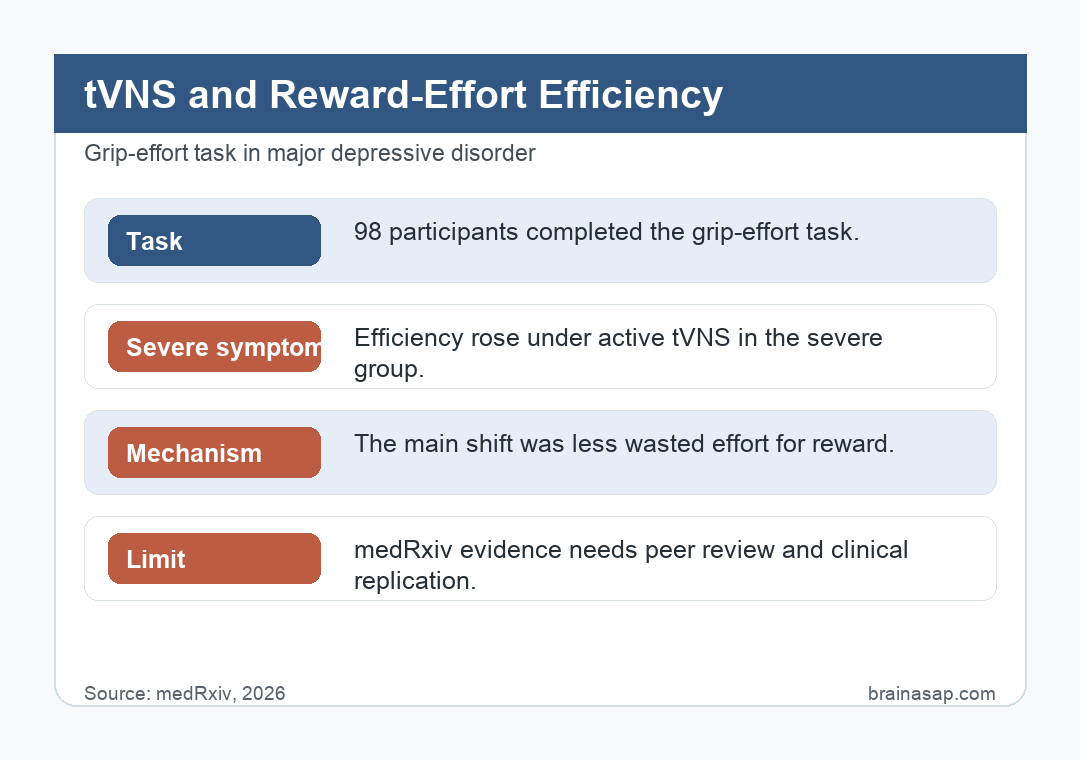
- Reward-effort task included 98 participants: The analysis included 53 people with major depressive disorder and 45 non-depressed controls in a randomized, single-blind crossover design.
- tVNS improved efficiency only in severe symptoms: In the Beck Depression Inventory-II (BDI-II) severe group, reward-effort efficiency increased from an estimated 0.894 under sham to 0.946 under active tVNS.
- The signal came from less unnecessary effort: Severe-symptom participants chose the high-effort option when it offered no extra reward less often under active stimulation: 0.100 under sham versus 0.018 under tVNS.
- Necessary effort did not change: tVNS did not significantly alter the choice to work harder when the harder option paid more, so the main behavioral change was avoiding wasted effort.
- Acute preprint evidence sets the boundary: This was a same-day task result from a preprint, not evidence that tVNS improves long-term depression symptoms or daily functioning.
Source: medRxiv (2026) | Forbes et al.
Motivation problems in depression are often described as not wanting rewards enough.
Researchers tested a narrower and more practical question: when a reward is available, does a person choose the amount of effort that actually fits the payoff?
Researchers used tVNS, which delivers electrical stimulation to the outer ear region connected to the auricular branch of the vagus nerve.
The behavioral target was not same-day mood improvement. Researchers tested whether stimulation changed reward-effort decision-making during a controlled task.
tVNS Was Tested Against Sham Stimulation in the Same Participants
The study was part of the MODULATE Depression trial.
Participants attended two test days within 10 days. On one day they received active tVNS at the right cymba conchae; on the other day they received sham stimulation at the right earlobe.
The design helped separate stimulation effects from stable person-level differences:
- Crossover comparison: Each participant served as their own comparison across active and sham days.
- Single-blind setup: Participants did not know which condition they were receiving.
- Task timing: Stimulation started about 10 minutes before the first behavioral task and continued during the session.
- Blinding check: Among 71 participants who guessed both sessions, only 15.5% correctly identified active versus sham on both days.
The main analysis used 98 participants: 45 controls and 53 people with major depressive disorder. Researchers also grouped participants by BDI-II symptom severity: no/minimal symptoms, mild/moderate symptoms, and severe symptoms defined as BDI-II >= 29.
Grip Task Separated Useful Effort From Wasted Effort
The Grip Strength Effort Task used a hand dynamometer to measure how much force participants produced.
Before the main task, each person completed calibration trials to estimate maximum voluntary contraction, or the strongest grip-force level they could produce.
Each main trial offered an easy or hard option:
- Easy option: Produce 50% of maximum grip force for a 0.1 euro reward.
- Hard option: Produce 90% of maximum grip force for either 0.1, 0.2, or 0.4 euros.
- 54 total trials: Three effort-reward combinations were each presented 18 times.
In that setup, the hard option was not always rational. When both choices paid 0.1 euros, choosing hard meant doing extra work for no extra reward.
When hard paid 0.2 or 0.4 euros, choosing hard could be worth it.
Researchers called a choice efficient when the participant either chose easy for equal pay or chose hard when hard paid more.
Inefficiency had two forms: unnecessary effort, meaning hard work without extra reward, and missed necessary effort, meaning passing up a harder option that did pay more.
Severe-Symptom Participants Made More Efficient Choices Under tVNS
The main result was symptom-specific. Across a simple control-versus-MDD analysis, the interaction between diagnostic group and stimulation condition was not significant.
The clearer effect appeared when researchers used BDI-II severity groups.
In participants with severe depressive symptoms, active stimulation increased reward-effort efficiency:
- Efficiency under sham: estimated probability 0.894.
- Efficiency under tVNS: estimated probability 0.946.
- Group-by-condition result: BDI-II group interacted with stimulation condition, p=0.042; the severe-group term was p=0.012.
The same pattern held when BDI-II was analyzed as a continuous symptom score rather than as three categories.
The continuous-score analysis reduces one concern about the small severe group, which included only 19 participants.
The Main Change Was Avoiding Extra Work When It Did Not Pay
The non-change is clinically important.
tVNS did not significantly increase necessary effort, the choice to work harder when the harder option paid more.
Instead, the severe-symptom group showed less unnecessary effort. Under sham stimulation, the estimated probability of unnecessary effort was 0.100.
Under active tVNS, it was 0.018. The sham-versus-tVNS comparison in that group was significant at p=0.045.
The interpretation is narrower than a broad push-harder effect.
The data suggest stimulation helped the severe-symptom group stop choosing high effort when high effort produced no larger reward.
The Mechanism Is Still Open
The researchers discuss several possible pathways, but the task result cannot identify a single neural mechanism.
Vagus nerve stimulation can affect arousal, attention, autonomic state, noradrenergic signaling, dopamine-linked reward circuits, and executive control.
Two interpretations are especially plausible:
- Reward-effort computation: tVNS may have helped participants better match effort cost to reward value.
- Cognitive flexibility: The task required switching between easy and hard choices as reward value changed, so the effect may reflect better rule updating rather than a reward-specific mechanism.
The study does not resolve those alternatives.
Neuroimaging, pharmacology, and longer treatment designs would be needed to show whether the behavioral change comes from dopamine, noradrenaline, executive control, or some combination.
Preprint Status and Short-Term Testing Limit the Claim
The claim should stay narrow. The manuscript is a medRxiv preprint, so it has not completed peer review.
The behavioral effect was acute, measured during a laboratory task on stimulation days, not across weeks of depression treatment.
Several boundaries matter for clinical interpretation:
- Small severe group: The key subgroup had 19 participants, so replication is important.
- Task-specific outcome: The study measured grip-task choices, not work performance, daily motivation, or symptom remission.
- Same-day stimulation: The evidence does not show whether repeated tVNS would produce lasting motivation changes.
- Mechanism unresolved: The result points to a motivational mechanism but does not prove the underlying brain pathway.
The narrow takeaway is that tVNS may influence how people with severe depressive symptoms allocate effort for rewards.
In this task, the signal was not more effort everywhere. It was less wasted effort when extra work did not improve the payoff.
Citation: DOI: 10.64898/2026.04.16.26351003. Forbes et al. Transcutaneous vagus nerve stimulation enhances reward-effort efficiency in major depressive disorder. medRxiv. 2026.
Study Design: Randomized, single-blind, within-subject crossover trial comparing active transcutaneous auricular vagus nerve stimulation with sham stimulation during a grip-strength reward-effort task.
Sample Size: 98 participants completed the task analysis: 53 people with major depressive disorder and 45 non-depressed controls; the severe BDI-II subgroup included 19 participants.
Key Statistic: In the severe-symptom group, estimated reward-effort efficiency increased from 0.894 under sham to 0.946 under tVNS; unnecessary effort decreased from 0.100 to 0.018.
Caveat: Preprint evidence, small severe-symptom subgroup, acute same-day laboratory task, and no proof yet that repeated tVNS improves long-term depression symptoms or daily motivation.